
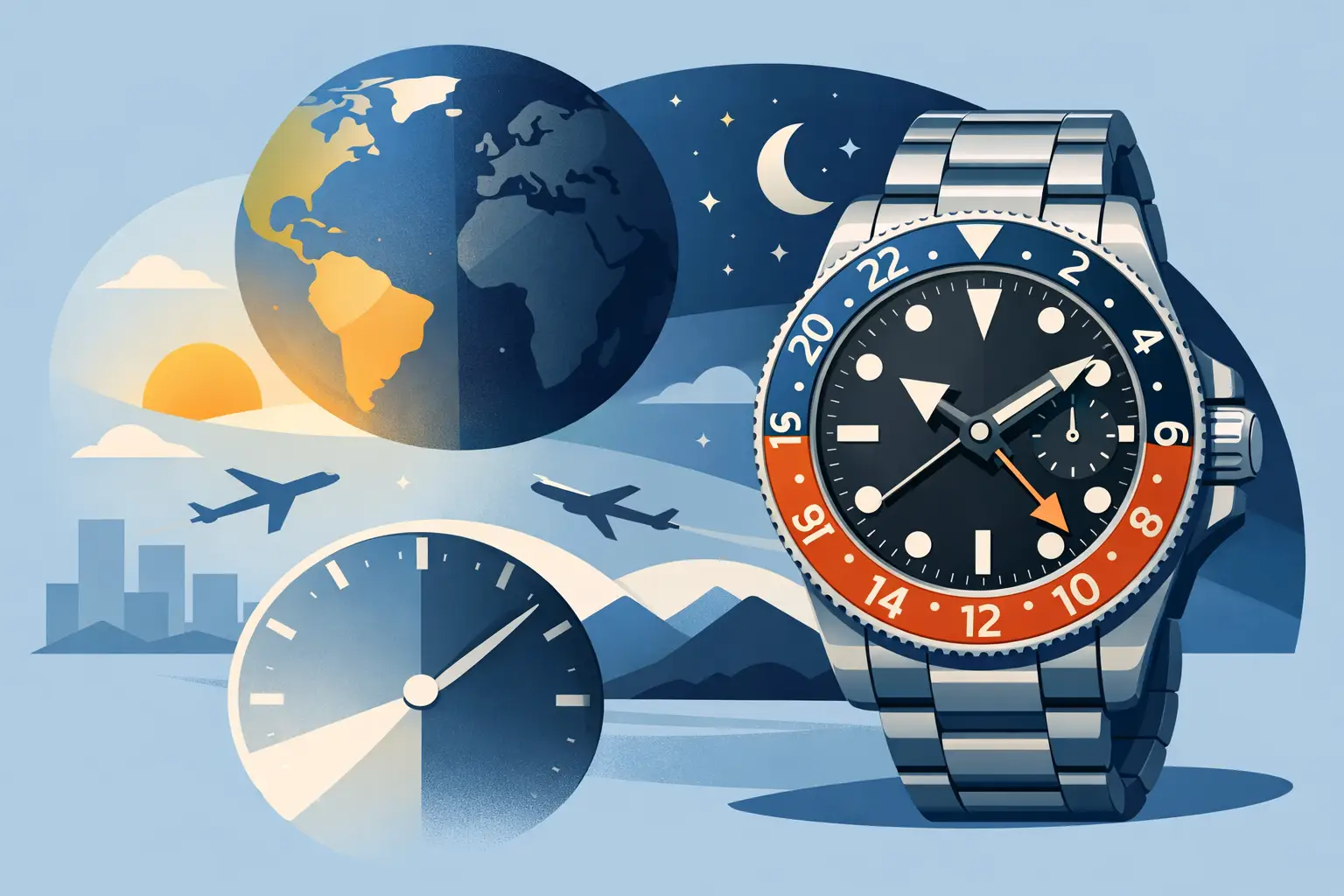
A second time zone can look like a small detail on the dial, right up until you actually need it. If you travel for work, have family overseas, or simply like the idea of a watch that does more than tell local time, you’ve probably asked: what is a GMT watch? It’s one of the most useful complications in modern watchmaking, and one of the easiest to appreciate once you understand how it works.
What Is a GMT Watch?
A GMT watch is a watch designed to track at least two time zones at once. Most GMT models do this with an extra 24-hour hand that circles the dial once per day rather than twice, paired with a 24-hour scale either on the dial or on a rotating bezel.
That extra hand is the key. Your regular hour and minute hands show local time in the standard 12-hour format. The GMT hand points to a 24-hour scale, letting you read a second time zone without guessing whether it’s day or night.
The term GMT stands for Greenwich Mean Time, the time standard historically tied to Greenwich, London. In everyday watch language, though, GMT has become shorthand for any watch with a second-time-zone function.
How a GMT Watch Works
On a typical GMT watch, the standard hour hand, minute hand, and seconds hand operate as you’d expect. The difference is the fourth hand, often styled in a contrasting color or arrow tip, which tracks a 24-hour cycle.
Because the GMT hand moves around the dial once every 24 hours, it points to a full-day scale instead of the usual 12 hours. That means you can instantly tell whether the second time zone is showing 10 in the morning or 10 at night. It sounds simple, and it is. That’s part of the appeal.
Some GMT watches place the 24-hour scale on the bezel. Others print it on an inner chapter ring or dial. If the bezel rotates, you can often use it to track a third time zone as well. That adds flexibility, although it also makes the watch slightly busier visually.
GMT Watch vs Dual Time Watch
This is where new buyers sometimes get tripped up. A GMT watch and a dual time watch are not always exactly the same thing, even if they solve a similar problem.
A GMT watch usually uses one main dial plus an extra 24-hour hand. A dual time watch may instead use a subdial, digital display, or separate hour track for the second zone. In practical terms, both help you track another location, but the GMT format is more iconic and often more elegant on the wrist.
If you like a cleaner, sportier look with strong travel heritage, GMT usually wins. If you prefer a more technical or dress-oriented layout, dual time designs can be appealing too.
The Two Main Types of GMT Movements
Not every GMT watch sets the same way, and this matters more than many first-time buyers realize.
Caller GMT
A caller GMT, sometimes called an office GMT, lets you independently adjust the GMT hand. This setup is great if you spend most of your time in one place and want to track another location, like a corporate office, a business partner overseas, or family in another country.
For daily use, it’s straightforward and practical. For frequent travel, it’s a little less convenient because adjusting local time after landing can take more steps.
Flyer GMT
A flyer GMT, sometimes called a traveler GMT, lets you independently jump the local hour hand in one-hour increments. The GMT hand remains set to home time. This is the more desirable setup for actual travelers because you can land in a new time zone and reset the watch quickly without stopping it.
That convenience usually comes at a higher price, especially in Swiss-made models. Still, if you fly often, it can be worth paying for.
Why Men Buy GMT Watches
Part of the GMT’s attraction is functional, and part of it is pure watch culture. It’s useful without feeling overly technical. It adds character to a watch without turning the dial into clutter.
For a lot of men, a GMT is the sweet spot between style and utility. It suggests purpose. A dive watch hints at adventure, a dress watch signals restraint, and a GMT projects movement, ambition, and a broader world beyond your own ZIP code.
That doesn’t mean you need a passport full of stamps to justify one. Plenty of buyers choose GMT watches because they like the extra hand, the bezel design, and the heritage tied to travel icons from brands like Rolex, Omega, Seiko, and Tudor. There’s a certain prestige to a complication that feels grounded in real use.
Who Should Actually Consider a GMT Watch?
If you regularly deal with more than one time zone, a GMT watch makes immediate sense. Frequent flyers, remote workers, international business professionals, military personnel, and men with family abroad all have clear reasons to own one.
It also suits the buyer who wants a watch with more personality than a basic three-hander but doesn’t want the visual complexity of a chronograph. A GMT adds interest while staying readable.
On the other hand, if you never think about another time zone and prefer a minimalist dial, you may end up paying for a feature you rarely use. In that case, the appeal becomes more about design and collecting than necessity. That’s not a bad reason to buy a watch, but it’s worth being honest about it.
What to Look for When Buying a GMT Watch
The first thing to consider is how you’ll use it. If your second time zone is mostly for checking in on home or work from one fixed location, a caller GMT is often enough. If you travel frequently, a flyer GMT is the better fit.
Then look at the layout. Some GMT watches are bold and sporty, with large bezels and high-contrast hands. Others are more refined and can pass easily in business settings. The best choice depends on whether you want an all-around daily wear watch, a travel-specific piece, or something with stronger luxury appeal.
Movement matters too. Automatic GMT watches tend to carry more enthusiast appeal and mechanical prestige, while quartz GMTs are often more affordable, accurate, and lower-maintenance. For many buyers, especially in the entry-level category, quartz is a smart move. For others, the romance of a mechanical GMT is part of the reason to buy.
Case size should not be overlooked. Many GMT watches wear larger because of their bezel and sport-watch proportions. If your wrist is on the smaller side, a compact GMT can look much sharper than a bulky one that overwhelms your frame.
Finally, pay attention to legibility. A GMT complication only helps if you can read it at a glance. A brightly tipped GMT hand, a clear 24-hour scale, and strong contrast are all worth having.
Are GMT Watches Good for Everyday Wear?
Yes, often more than people expect. A GMT watch can work as an everyday piece because the complication adds utility without demanding attention every minute. You set it, glance at it when needed, and otherwise wear it like any other watch.
The real question is style. A steel GMT sports watch is one of the most versatile formats in men’s watches. It works with jeans, business casual, and even a blazer. A more colorful bezel or oversized case may lean casual, while a restrained GMT with a slimmer profile can feel polished enough for the office.
This is where the category becomes especially attractive. A good GMT doesn’t just solve a practical problem. It also gives your wrist presence.
What Is a GMT Watch Doing That a Phone Can’t?
Strictly speaking, your phone can show multiple time zones more easily. That’s the honest answer. But watches have never been only about convenience.
A GMT watch puts the information on your wrist in an intuitive, analog format that feels immediate and satisfying. It also carries a sense of craftsmanship and intentionality that a phone screen never will. You’re not pulling a device out of your pocket and swiping through apps. You’re reading a purpose-built instrument.
For watch enthusiasts, that difference matters. For style-conscious buyers, it matters too. A GMT watch says something about taste. It signals that you appreciate function, but you also care how that function is expressed.
Is a GMT Watch Worth It?
If the feature matches your lifestyle, absolutely. A GMT is one of the few complications that remains genuinely useful in modern life, whether you travel often or simply keep tabs on another city. It’s practical, masculine, and rich with heritage.
If you’re buying purely for style, it can still be worth it, provided you like the look enough to wear it often. The best GMT watches deliver more than a second time zone. They offer depth, identity, and a sense that your watch has a job to do.
That’s why the GMT category continues to hold its place, from affordable Seiko and Casio options to luxury heavyweights. It gives you a complication you can actually use, wrapped in a format that still feels sharp years after the trend cycle moves on.
If you’re building a watch collection, a GMT is one of the smartest additions you can make – not because it does everything, but because it does one thing especially well.