
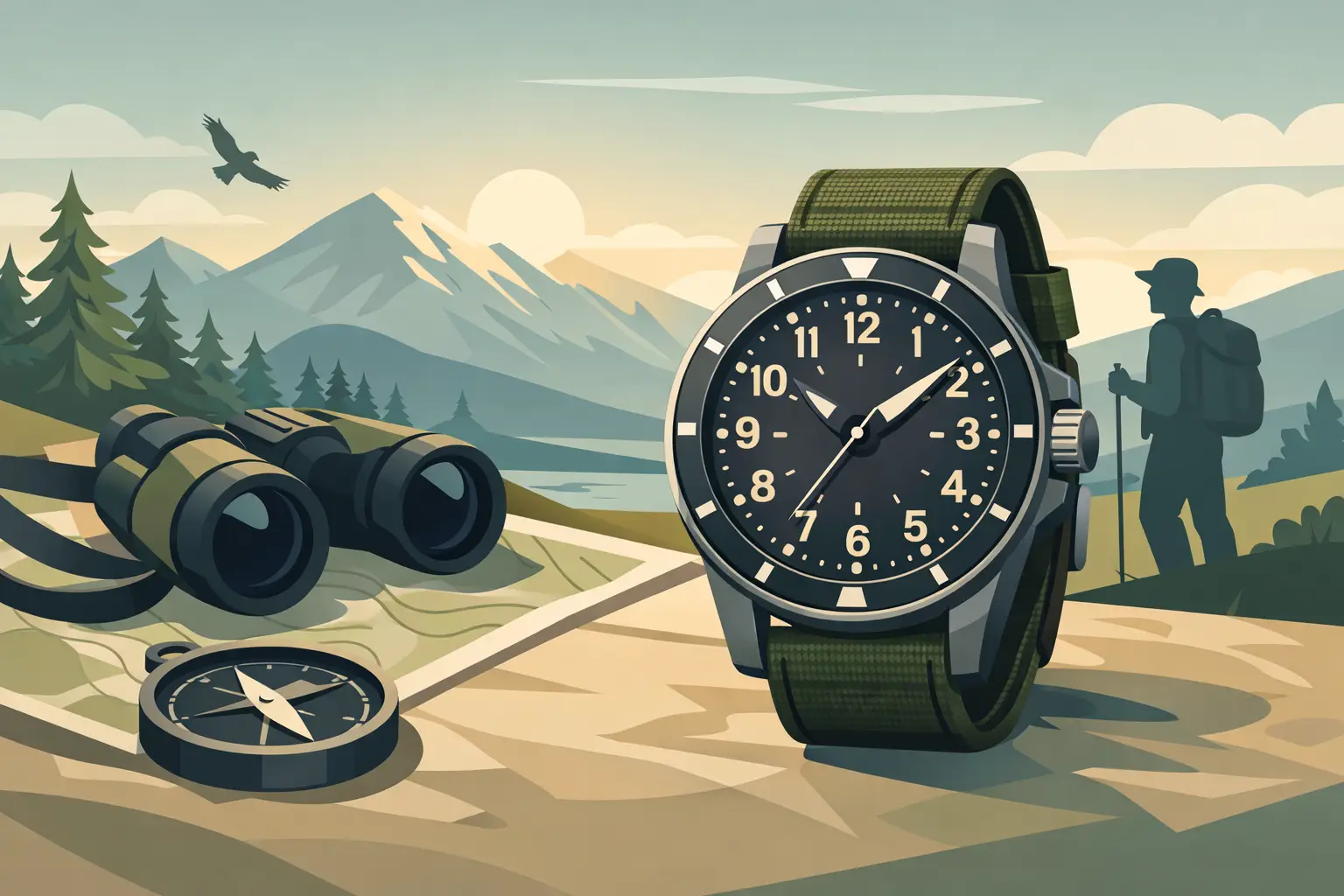
A field watch earns its place the old-fashioned way: by being easy to read, hard to break, and handsome enough to wear long after the trail ends. So, what is a field watch? At its core, it is a practical wristwatch inspired by military-issued timepieces, built for clear legibility and dependable daily use rather than showy complications.
For men building a versatile watch collection, the field watch is one of the smartest starting points. It has more character than a basic digital watch, less formality than a dress watch, and a timeless restraint that works with denim, boots, OCBDs, and even a casual blazer.
What Is a Field Watch?
A field watch is a rugged, straightforward watch designed around function. The style traces back to military watches worn by soldiers who needed to check the time quickly in difficult conditions. That heritage explains the category’s familiar details: a clean dial, prominent Arabic numerals, luminous hands, a durable case, and a strap that can handle hard wear.
Traditional field watches are compact by modern standards, often measuring 34mm to 38mm. Today, 38mm to 42mm is more common, giving buyers more choice without losing the purposeful proportions that define the style. Most display only the hours, minutes, and seconds, although a date window is a useful modern addition for everyday wear.
The appeal is not that every field watch is ready for a military deployment. It is that the design puts utility first. You should be able to read it at a glance, wear it without worrying about a scratch, and pair it with most of the clothes already in your closet.
The Details That Define a Field Watch
A watch does not become a field watch simply because it has a canvas strap or an olive-green dial. The category is defined by a combination of practical choices.
A dial built for fast reading
Legibility is the signature feature. Field watch dials usually use high-contrast colors, most often black with white numerals or cream with dark markings. Arabic hour numerals are large and clear. Many models include an inner 24-hour track, a nod to military time, while luminous paint on the hands and hour markers keeps the watch useful after dark.
There is very little visual clutter. You will not typically find a polished sunburst dial, diamond-cut indices, or multiple subdials competing for attention. That restraint gives a good field watch its confident, masculine presence.
Durable materials, not delicate finishing
Stainless steel is the standard case material, though titanium is increasingly popular for its low weight and corrosion resistance. A sapphire crystal offers the strongest scratch resistance, while mineral crystal is common on affordable models. Acrylic crystal is less scratch-resistant but appears on some heritage-inspired watches because it suits the vintage look and can be polished more easily.
Water resistance varies. A rating of 50 meters is adequate for rain and handwashing, while 100 meters offers better peace of mind for swimming and outdoor weekends. A field watch is not necessarily a dive watch, so water resistance should be judged by your actual lifestyle rather than the label alone.
A strap made to be worn hard
Nylon NATO straps are closely associated with the field-watch look. They are comfortable, inexpensive, quick-drying, and easy to replace when they become worn. Canvas, leather, and rubber also make sense depending on the setting.
A brown leather strap makes a field watch feel more polished for the office or a dinner date. Nylon keeps it casual and military-inspired. On a steel bracelet, the same watch can look more substantial and city-ready. This ability to change character with a strap is one reason the category delivers such strong value.
Field Watch vs. Pilot, Dive, and Everyday Watches
Watch categories overlap, and brands are not always strict with their labels. Still, the differences are useful when deciding what belongs on your wrist.
A pilot watch is also designed for legibility, but it is usually larger and often features oversized numerals, a prominent crown, and aviation-inspired dial layouts. A dive watch prioritizes water resistance, a rotating timing bezel, and luminous markers that remain visible underwater. It tends to be heavier and sportier than a field watch.
An everyday watch can be almost anything you wear regularly. A field watch is one especially capable version of an everyday watch, with a distinct military design language and an emphasis on durability. If your wardrobe leans relaxed, rugged, or classic American, it may be the most natural everyday option you can buy.
Quartz or Mechanical: Which Movement Fits?
The movement is where a field watch becomes a personal decision rather than a simple style choice.
Quartz field watches run on batteries and are exceptionally accurate. They are usually more affordable, require less attention, and suit buyers who want a grab-and-go watch for work, travel, or outdoor use. Brands such as Timex, Citizen, Casio, and Seiko offer strong options in this lane.
Mechanical and automatic field watches have more emotional appeal. Their movements are powered by a mainspring rather than a battery, and an automatic movement winds itself through wrist motion. Many enthusiasts appreciate the craftsmanship, the sweep of the seconds hand, and the connection to traditional watchmaking.
The trade-off is simple: mechanical watches cost more, can be less accurate than quartz, and eventually need servicing. They are worth it if the ritual and engineering matter to you. Quartz is the better answer if you want the most practical tool for the money. Neither choice is inherently more stylish.
How to Choose a Field Watch That You Will Actually Wear
Start with size. A field watch should feel secure and balanced, not oversized. For many men, 36mm to 40mm is the sweet spot. If you have a smaller wrist or prefer a vintage look, 36mm to 38mm is exceptionally versatile. Larger wrists can carry 40mm to 42mm well, provided the lug-to-lug length remains reasonable.
Next, consider the dial. Black is the most traditional and easiest to pair with nearly anything. A cream, khaki, olive, or navy dial can add personality while keeping the watch grounded in its heritage. Prioritize contrast over novelty. If you have to search for the hands against the dial, the design has missed the point.
Then match the specification to your routine. Commuting, office wear, and occasional weekends outdoors do not demand the same features as frequent hiking, fishing, or travel. A sapphire crystal and 100-meter water resistance are worthwhile upgrades for someone who is hard on his watches. For a desk-based lifestyle, a simpler model with mineral crystal may offer better value and plenty of charm.
Budget matters, but a field watch is a category where modest spending can go far. Affordable quartz models provide the essential look and function. Mid-range automatics introduce stronger finishing, better movements, and details such as sapphire crystals. At higher prices, you are often paying for Swiss heritage, refined casework, and brand prestige rather than a dramatic leap in basic usefulness.
Why a Field Watch Belongs in a Collection
The best field watches have an unforced confidence. They do not announce themselves across the room, yet they reward a closer look with useful design, military history, and honest craftsmanship. That makes them especially appealing for a first serious watch or for the man who already owns a dress watch and wants something less precious.
They also age well. A few marks on a polished dress watch can feel frustrating; a few marks on a field watch usually add credibility. Whether you choose a budget-friendly quartz model or a Swiss-made automatic, choose the one that feels ready for your real life. The right field watch should not wait in a box for an occasion – it should make every ordinary day look a little more considered.