
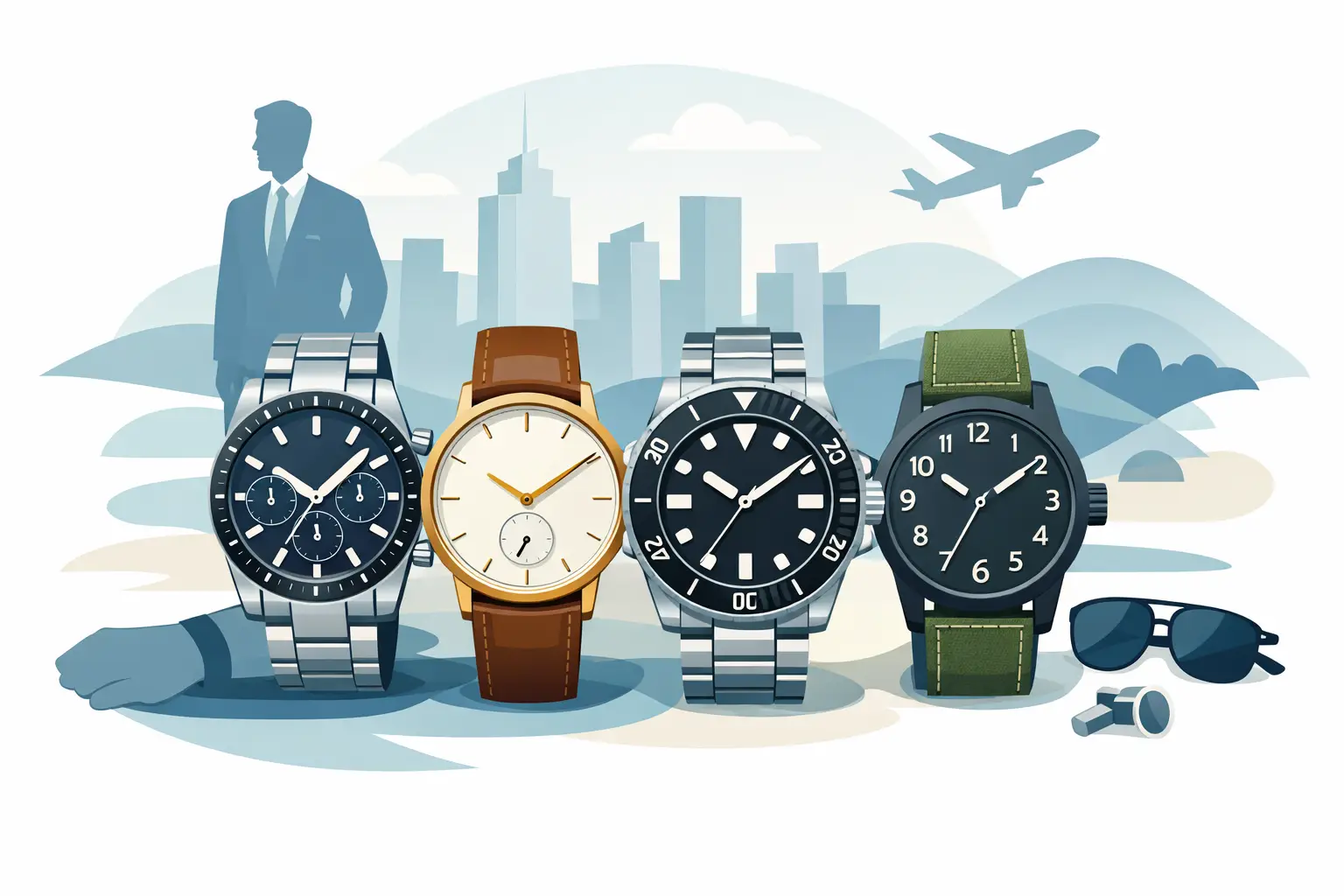
A watch can make a navy suit feel sharper, give a plain T-shirt more intention, or signal that you value utility over flash. This guide to men’s watch styles is built around that reality: the right watch is not simply a timekeeper. It is a compact expression of how you dress, where you spend your time, and what you want your gear to say about you.
The best starting point is not a brand name or price tag. It is understanding the character of each watch category, then choosing the one that suits your real life. A formal office, frequent travel, weekend hiking, and a growing interest in mechanical craftsmanship all call for different strengths.
Guide to Men’s Watch Styles: Start With Your Lifestyle
Most men do not need a separate watch for every occasion, but they do benefit from knowing where one style ends and another begins. A polished dress watch looks excellent under a cuff but can feel too delicate at the gym. A dive watch is built for abuse and water, though its bold case may overpower a tailored look. The goal is not to follow rigid rules. It is to choose a watch whose proportions, materials, and purpose feel natural on your wrist.
For a first serious purchase, versatility usually wins. A restrained steel sports watch, a simple field watch, or a clean dress-casual model can cover more ground than a highly specialized piece. Once you know what you reach for most often, adding a second or third style becomes much easier.
Dress Watches: Quiet Confidence for Formal Settings
The dress watch is the classic choice for business attire, weddings, dinners, and any moment where understatement carries more weight than spectacle. It is typically slim, compact, and cleanly designed, with a simple dial, narrow bezel, and leather strap. Roman numerals, baton markers, and small seconds subdials are common, but none are mandatory.
Think of brands such as Cartier, Jaeger-LeCoultre, Longines, and Tissot, as well as affordable Timex and Seiko dress options. The appeal is elegance rather than technical theater. A white, silver, black, or deep blue dial paired with a black or brown leather strap remains a reliable choice.
A dress watch works best when the case is modest, generally around 36mm to 40mm for most wrists, and thin enough to slide beneath a shirt cuff. The trade-off is durability. Many dress watches offer limited water resistance and polished surfaces that show scratches more readily. If you wear tailoring often, that compromise is worth it. If your days involve commuting, travel, and outdoor weekends, choose a more versatile alternative.
Best for: Offices, formal events, and refined everyday wear
Dive Watches: The All-Purpose Modern Classic
A dive watch may be designed for water, but it has become one of the most adaptable styles in men’s watchmaking. Its defining features are water resistance, a rotating timing bezel, luminous hands and markers, and a sturdy case built to take a knock. The Rolex Submariner set the visual template, while the Omega Seamaster, Seiko Prospex, Citizen Promaster, and many microbrands offer their own interpretations.
What makes a dive watch so popular is its balance of toughness and presence. On a steel bracelet, it feels substantial and capable. On rubber or fabric, it becomes casual and weekend-ready. A black or blue dial is easy to wear with denim, knitwear, polos, and casual jackets, while a restrained model can even work with business casual clothing.
Size deserves attention here. Many dive watches are 40mm to 43mm and thicker than dress watches, especially with automatic movements. Men with smaller wrists may prefer compact options around 38mm to 40mm. Also, do not assume you need 300 meters of water resistance. For swimming and normal daily wear, 100 meters is often plenty. Higher ratings are valuable, but they can add bulk and cost.
Field Watches: Rugged Style Without the Bulk
The field watch has military roots, which explains its no-nonsense design. It usually features a highly legible dial, Arabic numerals, luminous details, a practical strap, and a case that favors durability over shine. It is the watch equivalent of a well-made pair of boots: useful, unfussy, and better with a little wear.
Hamilton is closely associated with the category, but Seiko, Timex, Citizen, and Bulova all offer compelling field-inspired models across different budgets. Many use canvas, nylon, leather, or NATO-style straps, though a steel bracelet can make the look more polished.
A field watch is an excellent answer for the man who wants one dependable everyday watch but does not connect with the flashier profile of a dive watch. It pairs naturally with jeans, chinos, workwear, flannels, and casual outerwear. The limitation is formality. A rugged dial and fabric strap are rarely the strongest choice with a dark suit, even if they look perfectly at home in nearly every other setting.
Pilot Watches: Legibility With Vintage Character
Pilot watches were created for aviation, so their identity is built around instant readability. Large numerals, broad hands, high contrast, and oversized crowns are recurring traits. Some models take inspiration from early military cockpit instruments, while others lean into the precision and technical sophistication of modern flight.
A pilot watch has more visual personality than a standard field watch. The dial can be larger, the numerals bolder, and the case more substantial. Brands including IWC, Breitling, Hamilton, Laco, and Citizen have strong ties to this space.
These watches suit men who appreciate heritage design and want a piece that stands out without relying on gold-tone finishes or heavy embellishment. They are particularly strong with casual and business-casual wardrobes. Just watch the diameter and lug-to-lug measurement. A 43mm pilot watch can wear much larger than its number suggests because of its open dial and long lugs.
Chronographs: Sporty, Mechanical, and More Expressive
A chronograph is a watch with stopwatch functionality, usually identified by pushers on the side of the case and multiple subdials on the dial. It is one of the most recognizable styles in the market, ranging from motorsport-inspired pieces to polished dress chronographs.
The appeal is easy to understand. Chronographs feel active and engineered, even if you never time a lap or a flight. The Omega Speedmaster, TAG Heuer Carrera, Rolex Daytona, and Seiko Speedtimer have each helped make the format an enduring symbol of performance and prestige.
The trade-off is visual complexity. Three subdials, a tachymeter scale, and pushers create a busier look than a simple three-hand watch. That can be exactly what you want if your wardrobe is casual, sporty, or modern. For a first watch, however, some men find a clean dial easier to wear every day. Quartz chronographs are generally more affordable and accurate, while mechanical versions offer the craftsmanship enthusiasts tend to value.
GMT and Travel Watches: Built for Men on the Move
GMT watches track a second time zone, often through an additional hand that circles the dial once every 24 hours. They are practical for frequent travelers, men who work with overseas teams, or anyone who likes the visual appeal of a 24-hour bezel.
The Rolex GMT-Master II is the category’s most famous name, but strong choices exist from Tudor, Seiko, Longines, Citizen, and many others. A GMT can look sporty, vintage, or refined depending on the bezel, bracelet, and dial treatment.
For occasional travelers, a GMT is a luxury rather than a necessity. A world time watch may be more useful for tracking multiple cities, while a simple dual-time quartz watch can offer convenience for less money. Still, a GMT has a distinct sense of purpose, and that makes it one of the most satisfying complications to own.
Digital and Sport Watches: Function First, Style Included
Digital watches have moved well beyond the gym. A square Casio, a G-Shock, or a sleek solar-powered sports watch can bring an intentional, slightly retro edge to casual style. They are often affordable, durable, accurate, and packed with practical functions such as alarms, timers, backlights, and multiple time zones.
The G-Shock is especially compelling for active men, tradesmen, travelers, and anyone who wants a watch they never need to baby. It will not replace a dress watch at a black-tie event, but that is not its job. A good collection often includes one watch chosen purely for resilience.
How to Choose the Right Watch Style
Before committing, consider how the watch will sit with the clothes you actually wear. A leather-strap dress watch is stronger if you live in button-downs and jackets. A dive watch or field watch makes more sense if your uniform is denim, polos, sneakers, and weekend layers. If your wardrobe shifts between both, a medium-sized steel sports watch with a clean dial is usually the safest middle ground.
Movement matters, but it should support the decision rather than dominate it. Quartz is accurate, low-maintenance, and often the best value. Automatic watches offer mechanical charm and a stronger connection to traditional horology, but they cost more and may need servicing over time. Solar watches are particularly appealing for buyers who want convenience without frequent battery changes.
Finally, respect fit. A watch can be beautifully designed and still look wrong if the lugs hang over your wrist or the case sits excessively high. Try to assess case diameter, thickness, lug-to-lug length, and bracelet adjustability before buying. Prestige is satisfying, but comfort is what determines whether a watch becomes part of your daily routine.
The right watch style should feel less like a costume and more like a signature. Choose the piece you will want to wear when no one is asking what it costs, because that is usually the one that earns a lasting place on your wrist.