
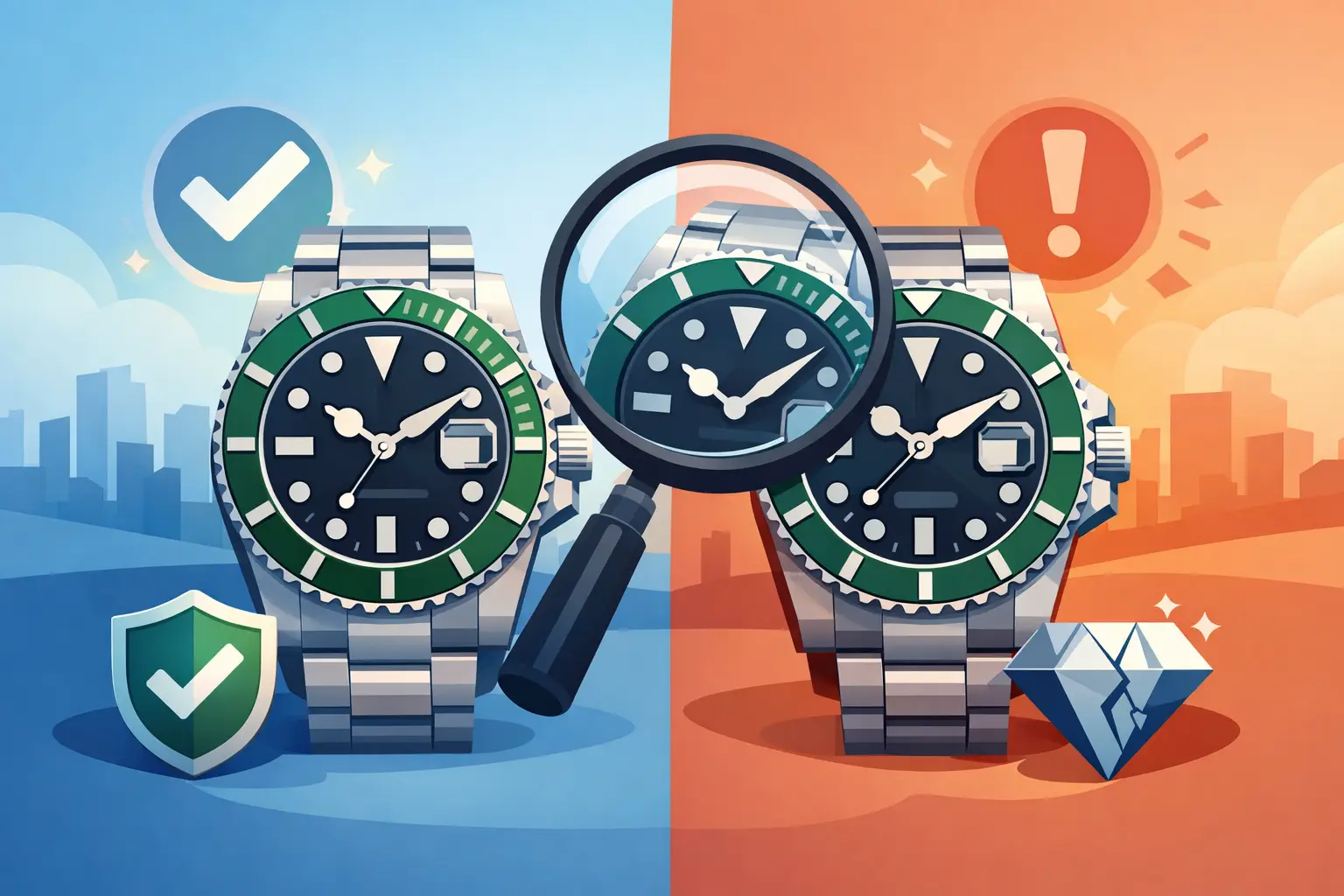
The easiest time to learn how to spot fake Rolex is before money changes hands, not after the excitement of finding a “great deal.” A Rolex carries real prestige, but that same prestige makes it one of the most copied watch brands in the world. If you’re shopping pre-owned, inheriting a watch, or considering your first serious luxury piece, a few sharp checks can save you from an expensive mistake.
A convincing fake is rarely obvious in a listing photo. The better counterfeits get the broad strokes right – the crown logo, the cyclops lens, the polished case, the familiar bracelet. What usually gives them away is execution. Rolex is obsessive about finishing, proportions, and consistency, and counterfeiters tend to miss the small details that make the watch feel right on the wrist and under close inspection.
How to spot fake Rolex before you buy
Start with the seller, because the watch itself is only part of the story. A legitimate Rolex can be sold without box and papers, but a vague seller, inconsistent photos, or a price that feels wildly below market should put you on alert immediately. In luxury watches, bargain pricing is often the first red flag, not the best opportunity.
That does not mean every attractively priced Rolex is fake. Some older models trade lower than hype suggests, and condition affects value. But if a Submariner, GMT-Master II, or Daytona is offered for a fraction of normal resale pricing, assume there is a reason. The real watch market is competitive and informed. Genuine Rolex pieces rarely slip through unnoticed.
The first signs a Rolex may be fake
The quickest giveaway is often overall quality. A real Rolex feels substantial, precise, and carefully finished. Edges should be clean without feeling sharp, the bracelet should move smoothly, and the clasp should shut with a secure, engineered feel. On many fakes, the metal finishing looks slightly dull, overly reflective, or uneven, and the bracelet may rattle more than it should.
Weight matters too, although it is not a perfect test on its own. Rolex uses quality materials, and most genuine models have a reassuring heft. A fake can feel suspiciously light, especially if it uses cheaper alloys or hollow components. That said, some counterfeiters add weight to mimic the real thing, so treat this as one clue rather than the deciding factor.
The crystal and magnification are another place to look. On many Rolex models with a date, the Cyclops lens should magnify the date clearly and prominently. Cheap fakes often get this wrong, showing weak magnification or a date that looks too small and sits awkwardly in the window. If the date appears timid rather than bold, pay attention.
Look closely at the dial
Rolex dials are crisp. The printing should be sharp, evenly spaced, and clean under magnification. If the text looks fuzzy, too thick, off-center, or slightly messy, that is a problem. The same goes for hour markers. They should align cleanly, with consistent finishing and no visible glue, tilt, or sloppy lume application.
The seconds hand sweep is often misunderstood. People say a real Rolex does not tick, and while that is directionally true, the better explanation is that a mechanical Rolex has a very smooth sweep compared with a cheap quartz imitation. Still, some high-end fakes use automatic movements that also sweep. A smooth hand alone does not prove authenticity.
Pay attention to proportion. Rolex is known for balanced design, and counterfeit dials often feel just a little off. The font might be close but not exact. The coronet logo may look too fat, too narrow, or poorly formed. On a genuine watch, those details come together with a sense of discipline that is hard to fake consistently.
Check the caseback and engravings
Most modern Rolex watches have a plain metal caseback. If you see an exhibition caseback showing off the movement on a model that should not have one, be skeptical immediately. That alone does not identify every fake, but it is a common mistake on counterfeit pieces trying to look more luxurious than the real product.
Engravings deserve a careful look as well. Serial numbers, model numbers, and inner rehaut engraving should be clean and precise, not shallow, rough, or inconsistent. On newer Rolex watches, the rehaut – the inner bezel ring between the dial and crystal – typically features repeated ROLEX engraving aligned with the dial. Poor alignment or weak engraving is a warning sign.
Movement clues that separate real from fake
If the watch is opened by a qualified professional, the movement tells the truth quickly. Rolex calibers are exceptionally well made, and their architecture is distinct. A fake may use a generic automatic movement dressed up to resemble something premium, but under inspection the differences are obvious.
For most buyers, though, opening the case is not practical before purchase. Instead, watch how the time and date functions behave. The crown action on a real Rolex should feel smooth and deliberate when you unscrew it and set the time. The date change should be precise. On a fake, the crown can feel gritty, loose, or imprecise, and the date mechanism may seem cheap or inconsistent.
Water resistance claims are another area where buyers get burned. Rolex is built for durability, but you should never test authenticity by dropping a watch in water. A fake may survive a splash, and a real watch with worn seals may not be ready for swimming. If water resistance matters, have the watch pressure tested professionally.
Box and papers help, but they are not proof
A lot of first-time buyers put too much faith in packaging. Counterfeiters now copy boxes, warranty cards, hang tags, booklets, and even receipts with surprising accuracy. These accessories can support a watch’s story, but they should never outweigh the watch itself.
The safer approach is to treat box and papers as supporting evidence. They can add confidence when the watch already checks out on condition, details, and seller credibility. If the watch looks wrong but the packaging looks perfect, trust the watch, not the accessories.
There is also the reverse scenario. A genuine older Rolex may come watch-only, especially if it has changed hands more than once. That is not ideal, but it is common in the pre-owned market. In that case, authentication becomes even more important.
Where buyers make the biggest mistake
Most people do not get fooled because they missed one microscopic dial flaw. They get fooled because they wanted the deal to be real. That is where discipline matters. If a seller avoids clear answers, refuses movement photos, will not provide a serial, or pressures you to act fast, step back.
Buying from a reputable dealer usually costs more than buying from a random marketplace listing, but that extra margin often buys inspection, authentication, return protection, and peace of mind. For a watch with Rolex-level prestige, that trade-off usually makes sense. Saving a little up front is not worth owning a very expensive counterfeit.
A simple buying checklist
Before you commit, compare the watch against known specifications for that exact reference. Case size, bezel type, dial layout, bracelet style, clasp code, and date magnification should all make sense together. Then assess seller reputation, review the serial and engravings, and inspect macro photos of the dial, crown, clasp, and rehaut.
If anything feels inconsistent, have the watch authenticated by a trusted watchmaker or luxury watch specialist. That step is especially smart if you are buying a higher-demand model like a Submariner, Daytona, GMT-Master II, or Datejust. Those are heavily counterfeited because the demand is so strong.
For mainstream buyers entering the luxury space, this is the smartest mindset to carry: buy the seller first, the watch second. That principle works whether you’re shopping through a private party, a gray-market source, or a pre-owned specialist. It is the kind of practical caution that protects both your money and your style.
A Rolex should feel like a confident purchase, not a gamble dressed up as a flex. If a watch leaves you with doubts, walk away and wait for the right one. The real thing is worth patience.