
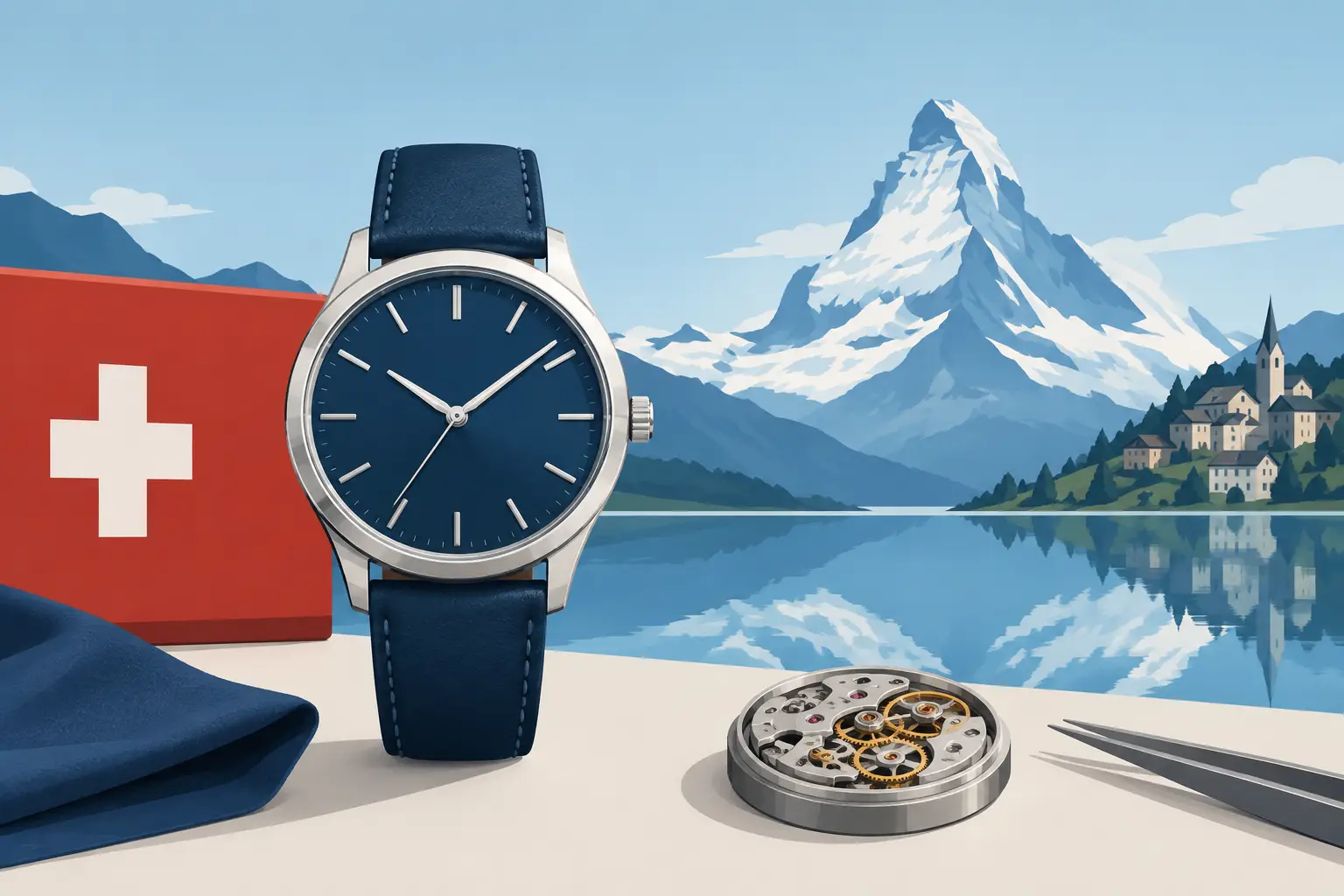
A Swiss watch can look perfectly at home beneath a tailored cuff, on a weekend drive, or across a conference table. But before paying a premium for the words “Swiss Made” on the dial, it helps to know what you are actually buying. This swiss made watches guide separates the legal standard from the marketing appeal, so you can choose a watch with confidence rather than simply chase a famous label.
For many men, Swiss Made represents a satisfying middle ground: serious mechanical craftsmanship, recognizable prestige, and designs that remain relevant long after seasonal trends disappear. It is a meaningful designation, but it is not a blanket guarantee that every Swiss watch is better than every Japanese, German, or American-designed alternative.
What Does Swiss Made Mean on a Watch?
“Swiss Made” is a protected designation governed by Swiss law. For a complete watch to carry it, the movement must be Swiss, the movement must be cased up in Switzerland, and the manufacturer must conduct final inspection in Switzerland. At least 60 percent of the watch’s production costs must also be generated in Switzerland.
A Swiss movement has its own requirements. It must be assembled and inspected in Switzerland, developed there, and have at least 60 percent of its production costs generated in the country. Those standards matter because they go beyond a simple final assembly claim.
Still, the label does not mean every component was made in Switzerland. Cases, crystals, hands, straps, and some movement parts may come from elsewhere. That is common at nearly every price level and is not automatically a concern. Modern watchmaking is a global supply chain. The question is whether the finished watch delivers the design, reliability, finishing, and value you expect at its price.
Why Swiss Made Still Carries Weight
Switzerland earned its reputation through centuries of specialized watchmaking, from precise escapements and mechanical calibers to disciplined case finishing and elegant dial work. Brands such as Rolex, Omega, Longines, Tissot, TAG Heuer, and Hamilton have helped make Swiss watches a global shorthand for refined engineering and enduring style.
For a buyer, the advantage is often consistency. Established Swiss brands tend to offer strong quality control, well-developed service networks, and designs with clear heritage. A steel Swiss automatic can be a first serious watch, a daily companion, or the foundation of a collection without feeling like a temporary purchase.
The resale conversation also matters, though it should be handled realistically. Certain Swiss luxury names hold value exceptionally well because of demand, scarcity, and brand equity. Plenty of Swiss watches do not. Buying a watch solely as an investment is usually a poor strategy. Buy the piece you will enjoy wearing, then consider value retention a welcome bonus rather than a promise.
Swiss Made Is Not a Quality Ranking
The designation is valuable, but it does not settle every comparison. A well-made Japanese watch from Seiko, Citizen, or Casio may offer more features for the money. A German watch may appeal more if you prefer architectural design and restrained finishing. At the entry level, a Swiss quartz model can be less mechanically interesting than a Japanese automatic at the same price.
Swiss Made tells you where a meaningful portion of the watchmaking happened and that the product meets a regulated standard. It does not tell you whether the movement is in-house, how carefully the case is finished, whether the bracelet feels substantial, or whether the watch suits your wrist and lifestyle.
Swiss Quartz vs. Swiss Automatic Watches
Movement choice is usually the most practical decision in any Swiss made watches guide. Swiss quartz and Swiss automatic watches serve different priorities, and neither is universally better.
A Swiss quartz watch runs on a battery and a quartz oscillator. It is highly accurate, low-maintenance, and often thinner than a mechanical alternative. For a man who wants a reliable office watch, a sharp dress piece, or a grab-and-go everyday option, quartz makes a strong case. It also allows Swiss brands to offer polished casework and dial design at more accessible prices.
An automatic watch is powered by the motion of your wrist. Its appeal is emotional as much as technical: a mechanical movement is a miniature machine working beneath the dial, often visible through a display caseback. You accept less accuracy than quartz, periodic servicing, and a higher price in exchange for tradition, character, and the ritual of ownership.
If you are buying your first Swiss watch, do not assume automatic is mandatory. A quartz Tissot or Longines can be a smarter daily purchase than an automatic watch that stretches your budget too far. If the movement itself is what draws you to watches, however, an automatic is likely worth the extra cost.
How Much Should You Spend?
Swiss Made covers a surprisingly wide range of prices. Your budget should reflect how you plan to wear the watch, not just how impressed you want others to be by the dial.
Below roughly $500, you will find Swiss quartz watches and entry-level automatics from brands such as Tissot, Hamilton, Certina, and Mido, depending on sales and model availability. Expect solid everyday quality, familiar Swiss movements, and classic styling. At this level, compare the bracelet, water resistance, crystal type, and warranty rather than relying on the country of origin alone.
From about $500 to $2,000, the selection becomes especially compelling. This range includes versatile mechanical watches with sapphire crystals, capable water resistance, improved bracelets, and more distinctive heritage. A Hamilton Khaki Field, Tissot Gentleman, Longines Conquest, or Mido Ocean Star can cover very different lifestyles while still feeling like a meaningful step up.
Above $2,000, finishing, brand heritage, proprietary movement technology, and status become more prominent. Omega, Tudor, Breitling, and TAG Heuer offer recognizable luxury with serious technical credibility. The premium can be justified when you value the details, but it is not always proportional to timekeeping performance. A $4,000 watch will not necessarily keep better time than a well-regulated $800 model.
Choose the Right Swiss Watch for Your Life
Start with your actual wardrobe and routine. A man who wears suits most days may get more use from a clean 38mm to 40mm dress-sport watch on leather or a refined steel bracelet. Look for a restrained dial, a date display if useful, and a case thin enough to slide under a shirt cuff.
If your week shifts between the office, travel, and casual weekends, a versatile sports watch is the safest choice. A steel case, black, blue, or silver dial, sapphire crystal, and 100 meters of water resistance will handle almost anything. This is where Swiss brands are particularly strong: watches that look polished with a blazer but do not feel precious with jeans.
For active use, prioritize function over prestige. A dive watch with a screw-down crown and 200 meters of water resistance is more appropriate around water than a dress watch, no matter how prestigious the latter may be. Frequent travelers should consider a GMT, while chronograph buyers should be honest about whether they enjoy the complication or simply like the visual energy it brings to a dial.
Fit is just as important as specifications. Many men buy a case that is too large because product photos make oversized watches look normal. For most wrists, 36mm to 40mm offers the most timeless proportion, while 41mm to 43mm can work well for sport watches or larger wrists. Pay attention to lug-to-lug length, which often determines comfort more than case diameter.
Details That Separate a Good Purchase From a Great One
Once you have narrowed the category, inspect the parts you touch and see every day. Sapphire crystal resists scratches far better than mineral glass. A solid bracelet with a useful micro-adjustment system makes a watch feel more expensive and more comfortable. Applied indices, crisp printing, aligned hands, and clean date placement reveal whether a brand paid attention to the details.
Also consider service before buying. Mechanical watches eventually need maintenance, and luxury servicing can be expensive. A widely used Swiss movement can be easier and more affordable to service than a rare or highly specialized caliber. That does not mean you should avoid an in-house movement, only that ownership costs deserve a place in the decision.
A Swiss Made watch should feel like more than a passport stamp on the dial. Choose one whose proportions, movement, and purpose make sense for your life, and its craftsmanship will become part of your daily rhythm rather than something saved for special occasions.