
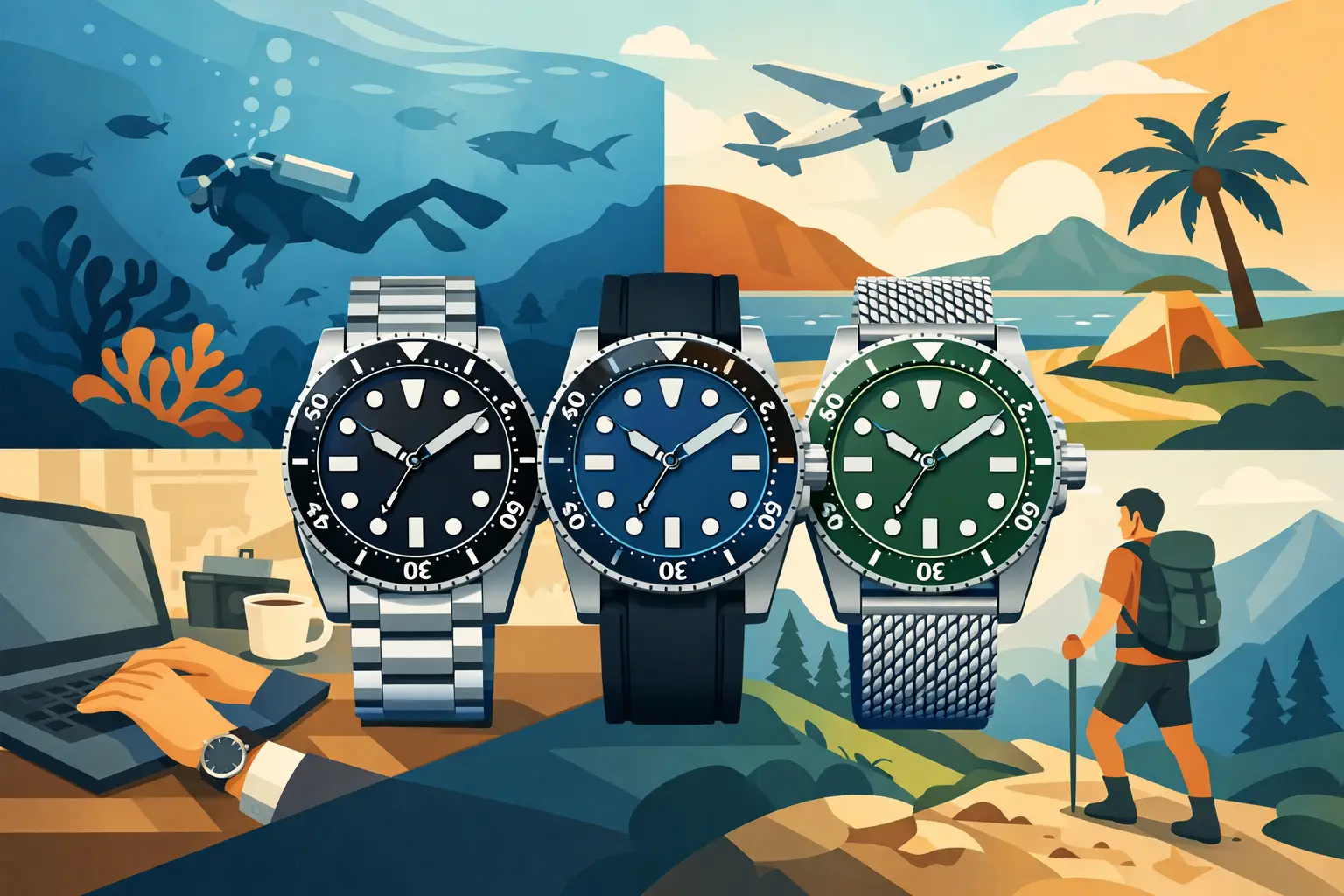
A good dive watch should look just as convincing beneath a shirt cuff as it does strapped over a wetsuit. That is the appeal – and the challenge. Knowing how to pick a dive watch means looking beyond the familiar formula of a dark dial, rotating bezel, and steel bracelet. The right model has to suit your wrist, your budget, and the way you actually spend your time.
For some men, a dive watch is a capable weekend companion for swimming, boating, and travel. For others, it is the first serious mechanical watch: masculine, versatile, and rich with heritage. Either way, the best choice is not automatically the deepest-rated, largest, or most expensive option. It is the one you will want to wear often.
Start With Real Water Resistance
Water resistance is the practical foundation of a dive watch, but the numbers on the dial can be misleading if you read them too literally. A watch marked 30 meters is generally built to withstand splashes and rain, not a day in the pool. For regular swimming, look for at least 100 meters of water resistance from a reputable brand.
A true dive watch typically offers 200 meters or more, along with a screw-down crown and a unidirectional rotating bezel. This level is more than enough for swimming, snorkeling, and recreational diving. Most buyers do not need 500, 1,000, or 3,000 meters of resistance. Those ratings can be impressive feats of engineering, but they often bring a thicker case and more weight.
If diving is genuinely on your calendar, seek out a model certified to ISO 6425, the standard associated with professional dive watches. It calls for specific traits such as legibility in darkness, resistance to saltwater, and a secure timing bezel. If your adventures stay closer to a hotel pool than the open ocean, a well-made 200-meter watch is usually the smarter balance.
One rule applies at every price: do not operate the crown or pushers while the watch is wet. And remember that water resistance is not permanent. Gaskets age, crowns take knocks, and a watch used heavily in water deserves periodic pressure testing.
How to Pick a Dive Watch by Size and Fit
Dive watches have a reputation for presence. Their broad bezels, bold markers, and solid cases are part of the design language. Still, bigger is not always better. A watch that hangs over your wrist or catches on every cuff will spend more time in a drawer than on your arm.
For many men, a case between 38mm and 42mm is the sweet spot. A 38mm or 39mm diver has a refined, vintage-leaning feel and works especially well on smaller to medium wrists. At 40mm to 42mm, you get the classic modern sport-watch profile. Watches above 43mm can look excellent on larger wrists or when worn for active use, but case diameter alone does not tell the full story.
Pay attention to lug-to-lug measurement, which describes the length from one end of the case to the other. A 42mm watch with compact, curved lugs may wear more comfortably than a 40mm model with long, straight lugs. Thickness matters, too. A slim 12mm case can easily move between casual and business-casual settings, while a 15mm tool watch makes a more unapologetically sporty statement.
Bracelets tend to make a dive watch feel more substantial and polished. Rubber is lighter, more comfortable in heat, and the natural choice for water sports. A fabric strap adds relaxed military character, although it can stay damp after a swim. Ideally, choose a watch with standard strap sizing and drilled lugs or a quick-change system, so its personality can shift with the occasion.
Look Closely at the Bezel, Dial, and Crystal
The rotating bezel is not decoration. On a functional dive watch, it tracks elapsed time. Because a unidirectional bezel only turns counterclockwise, an accidental bump can shorten the indicated remaining time but cannot dangerously extend it. Even if you never time a descent, it is useful for parking meters, grilling, workouts, and meetings.
Turn the bezel before buying if possible. It should have a controlled action with minimal play, easy grip, and crisp alignment at the 12 o’clock marker. A 60-click bezel can feel smooth and traditional; 120-click versions allow finer adjustment. Neither is automatically superior. What matters is that it feels deliberate rather than loose or cheap.
Legibility deserves equal attention. The best dive dials are clear at a glance, with strong contrast, generous lume, and markers that remain distinct in low light. Black, blue, and gray are classic choices that work with nearly anything. Green, white, burgundy, or vintage-inspired cream can offer more personality, but make sure the color still fits your wardrobe five years from now.
Sapphire crystal is the premium standard for scratch resistance and is worth seeking out on most watches above entry level. Mineral crystal is common on affordable divers and can be perfectly serviceable, though it scratches more easily. Acrylic has old-school charm and can often be polished, but it is a niche preference rather than the practical default.
Choose the Movement for Your Routine
A dive watch does not need an automatic movement to have legitimacy. Quartz divers are accurate, durable, and usually less expensive. They are particularly practical if you want a grab-and-go watch for travel, weekends, or the gym. Solar quartz takes that convenience further by reducing battery changes.
Automatic movements are the traditional enthusiast choice. Their mechanical sweep, visible craftsmanship, and connection to classic diving history give the watch a stronger sense of occasion. They also require more ownership awareness. Accuracy varies, power reserves are limited, and service eventually becomes part of the cost of ownership.
At the affordable end, Japanese automatic movements from Seiko, Citizen, and Miyota-powered brands often offer excellent value and proven reliability. Swiss automatic options from names such as Tissot, Mido, Longines, Oris, and Tudor tend to add refinement, finishing, and brand prestige as the budget rises. At the luxury level, the appeal of an Omega Seamaster or Rolex Submariner extends beyond specifications: these are cultural icons with lasting design equity.
Buy quartz when convenience is your priority. Choose automatic when the ritual and mechanical character are part of why you want a watch. There is no status penalty in choosing the movement that better fits your life.
Set a Budget With the Long View in Mind
The dive-watch market is unusually strong at nearly every price point. Under $300, you can find capable quartz and entry-level automatic models with real-world water resistance and classic styling. Between $300 and $1,000, the upgrade is often noticeable in finishing, bracelet quality, lume, and movement quality. This is where many buyers find their first keeper watch.
From $1,000 to $3,000, you enter the territory of stronger Swiss branding, more refined case work, ceramic bezels, better clasps, and increasingly sophisticated movements. Beyond that, you are paying not only for performance but also for heritage, detail, recognition, and the pleasure of owning an object built to a very high standard.
Do not spend your entire budget on the watch alone. A proper fit adjustment, an extra strap, and eventual service matter. If resale value is a concern, choose established brands and enduring designs rather than chasing a short-lived color trend. That said, buying solely for resale can drain the enjoyment from the decision. A watch should earn its place through wear.
Match the Style to Your Wardrobe
A dive watch can be one of the most versatile pieces in a man’s collection, but some designs travel more easily than others. A 39mm to 41mm steel diver with a black or navy dial, restrained text, and a clean bracelet can work with denim, polos, knitwear, and a casual jacket. It offers quiet confidence without looking overly precious.
If your office leans formal or you often wear tailored clothing, avoid extreme thickness, oversized cases, and overly aggressive color combinations. A refined vintage-inspired diver, perhaps on a tapered bracelet or textured rubber strap, will preserve the sport-watch character while feeling more considered.
For a bolder weekend watch, larger cases, bright dial colors, rubber straps, and pronounced bezel knurling can be exactly right. The point is not to make a dive watch behave like a dress watch. It is to choose one whose proportions and finish complement the rest of your style.
Before you commit, picture the watch on an ordinary Tuesday, not just on vacation. The right dive watch should make reaching for it feel automatic – whether the day involves saltwater, a client lunch, or nothing more dramatic than a strong coffee and a well-worn jacket.