
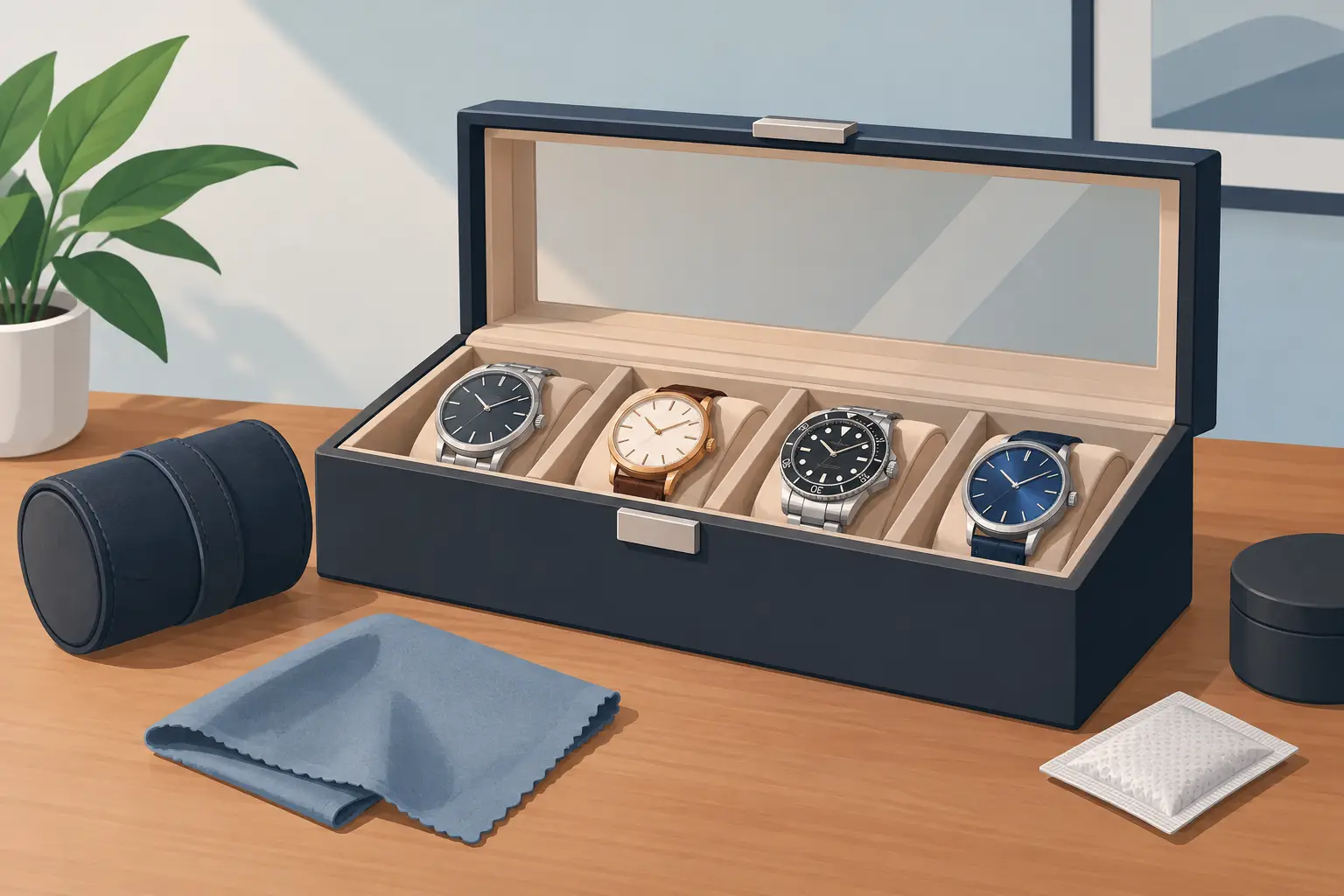
A mechanical watch can sit quietly in a drawer for weeks and still deserve the same consideration as the suit you save for major occasions. Knowing how to store mechanical watches protects more than their timekeeping. It preserves polished case surfaces, supple leather straps, magnetic resistance, and the long-term appeal that makes a well-chosen watch worth owning.
For a rugged Seiko automatic, a vintage hand-wound dress watch, or a serious Swiss piece, the right storage routine is less complicated than many collectors make it sound. The goal is to create a clean, stable environment and avoid the few conditions that do real harm.
Start With a Clean, Dry Watch
Before putting a mechanical watch away, wipe the case, crystal, bracelet, and clasp with a soft microfiber cloth. Fingerprints carry oils, moisture, and salts that can dull polished steel over time. This is especially worthwhile after a hot day, a long commute, or an evening out when the watch has been in contact with sweat or fragrance.
If the watch has a leather strap, let it air dry naturally before storage. Never put a damp leather strap into a closed watch box. Leather can hold moisture against the caseback, develop an odor, or stiffen as it dries. A quality bracelet is more forgiving, but it should still be dried thoroughly after exposure to rain, pool water, or a workout.
For watches rated as water resistant, a quick rinse with fresh water can make sense after saltwater exposure. Make sure the crown is fully secured first, then dry the watch carefully. Water resistance is not a license to store a wet watch.
Choose a Stable Storage Environment
The ideal home for a mechanical watch is cool, dry, dark, and reasonably consistent. A dedicated watch box, a lined drawer organizer, or a watch roll stored in a closet usually works well. What matters most is avoiding sharp swings in temperature and humidity.
Heat can dry out lubricants sooner than expected and may damage leather straps, adhesives, and vintage dial finishes. Humidity raises the risk of moisture entering a compromised case, particularly on older watches whose gaskets may no longer be reliable. Direct sunlight is equally unforgiving. It can fade a dial, discolor lume, and age a strap long before its time.
Avoid leaving watches on a bathroom counter, near a radiator, in a sunny windowsill, or in a garage. A safe is excellent for security, but only if it is not a damp, sealed metal box. If you use one, a small rechargeable silica gel desiccant can help manage moisture. Check it periodically and recharge or replace it according to its instructions.
Watch Boxes, Rolls, and Pouches
A watch box is the best all-around choice for a growing collection. It keeps pieces separated, limits dust, and makes selecting a watch for the day feel deliberate rather than chaotic. Look for soft, non-abrasive cushions and enough space that bracelets and buckles are not forced into awkward shapes.
Watch rolls are ideal for travel or smaller collections. They protect each watch from rubbing against the next and slide neatly into a dresser drawer or safe. For a single watch, a soft pouch is perfectly acceptable, provided the watch is clean and dry first.
The storage material deserves some attention. Inexpensive synthetic interiors can sometimes give off a strong chemical odor, which is not where you want to keep a fine leather strap for months. A well-made fabric, microfiber, suede-like lining, or quality wood box is the more refined choice.
Store Mechanical Watches Away From Magnets
Modern life is full of magnetic fields: speakers, tablets, laptop cases, phone accessories, chargers, smart-home devices, and magnetic clasps. A mechanical watch can become magnetized when its hairspring is affected, causing it to gain time dramatically or run inconsistently.
Most contemporary watches offer better magnetic resistance than older models, but that does not mean they are immune. Keep your watch box away from speaker systems and magnetic charging stations. Do not rest a watch directly on a laptop, amplifier, or electronic device just because it is convenient.
If a watch suddenly begins gaining several minutes per day after sitting near electronics, magnetization is a likely explanation. A watchmaker can test and demagnetize it quickly. Prevention is easier, and it costs nothing.
Should You Use a Watch Winder?
A watch winder keeps an automatic watch moving when it is not on your wrist. It can be useful for watches with calendars, moonphases, or complicated perpetual calendars that are tedious to reset. For a simple three-hand automatic or a date watch, it is rarely necessary.
There is a trade-off. A quality winder set to the manufacturer’s recommended direction and turns per day can keep a complicated watch ready to wear. A cheap, constantly running winder can create unnecessary wear, produce annoying noise, and keep the movement active when it would otherwise be resting.
Mechanical watches are designed to run, so a properly configured winder is not inherently harmful. Still, it is a convenience accessory, not a requirement. Many collectors prefer to let their automatics wind down, then reset them when they return to the rotation. This is often the sensible choice for a watch you wear only occasionally.
Hand-wound watches should never go on a winder. Store them with the crown protected from pressure, and wind them only when you plan to wear them.
The Best Position for Storing a Mechanical Watch
For most modern mechanical watches, storing the watch dial-up on a cushion or soft surface is the simplest and safest approach. It protects the crystal and reduces the chance of the bracelet or buckle scratching the case.
Some enthusiasts experiment with resting a watch crown-up, crown-down, or dial-down to offset minor timing variation. Position can affect rate because gravity influences a mechanical movement, but this is a fine-tuning exercise, not a universal storage rule. Unless you have tracked your particular watch and noticed a consistent issue, dial-up storage is the practical default.
Vintage watches are a special case. If the crystal is fragile, heavily domed acrylic, or already scratched, store the watch where nothing presses against it. If a vintage piece has an unknown service history or questionable water resistance, keep it especially far from humidity and temperature changes.
Prepare Watches for Long-Term Storage
If you will not wear a mechanical watch for several months, give it a little more attention. Clean it, make sure it is completely dry, and store it in a separated compartment or pouch. There is no need to keep it running throughout the entire period.
For watches with a date, it is wise to move the date away from the end of the month before storage if you know you will be resetting it later. When you bring it back into service, avoid changing the date during the movement’s danger zone, generally between about 9 p.m. and 3 a.m. Exact guidance varies by caliber, so your watch manual takes priority.
A mechanical watch does not need to be wound monthly simply because it is stored. Modern lubricants are formulated to remain stable for years, not days. What it does need is proper service at intervals recommended by the manufacturer or a trusted watchmaker, especially if accuracy declines, the power reserve shortens, or moisture appears under the crystal.
Protect the Strap and Bracelet
Storage affects the watch’s wearing hardware as much as the movement. Fasten metal bracelets loosely around their cushions rather than stretching them tight. If the cushion is too large, do not force the bracelet around it. That can put unnecessary strain on links, clasps, and spring bars.
Leather straps should be stored in their natural curve, not sharply folded. Keep them away from heat, sunlight, and scented products. A leather strap may eventually need replacement, but careful storage gives it a far more graceful life.
Rubber and fabric straps are low-maintenance, although they should still be cleaned and dried before being packed away. If a watch has sentimental or investment value, consider storing the original bracelet or strap separately when you regularly wear it on an alternate option. Keeping original components in excellent condition supports the watch’s complete, authentic character.
A Storage Routine Worth Keeping
The best watch storage system is one you will actually use. Keep a microfiber cloth near your box, give each watch its own space, and reserve the winder for pieces that genuinely benefit from it. That small ritual turns a collection from a pile of accessories into a considered wardrobe of craftsmanship.
A mechanical watch is built to mark your time, not to demand constant attention. Store it with the same care you bring to choosing it, and the next time you reach for it, the watch will be ready to carry its share of the occasion.