
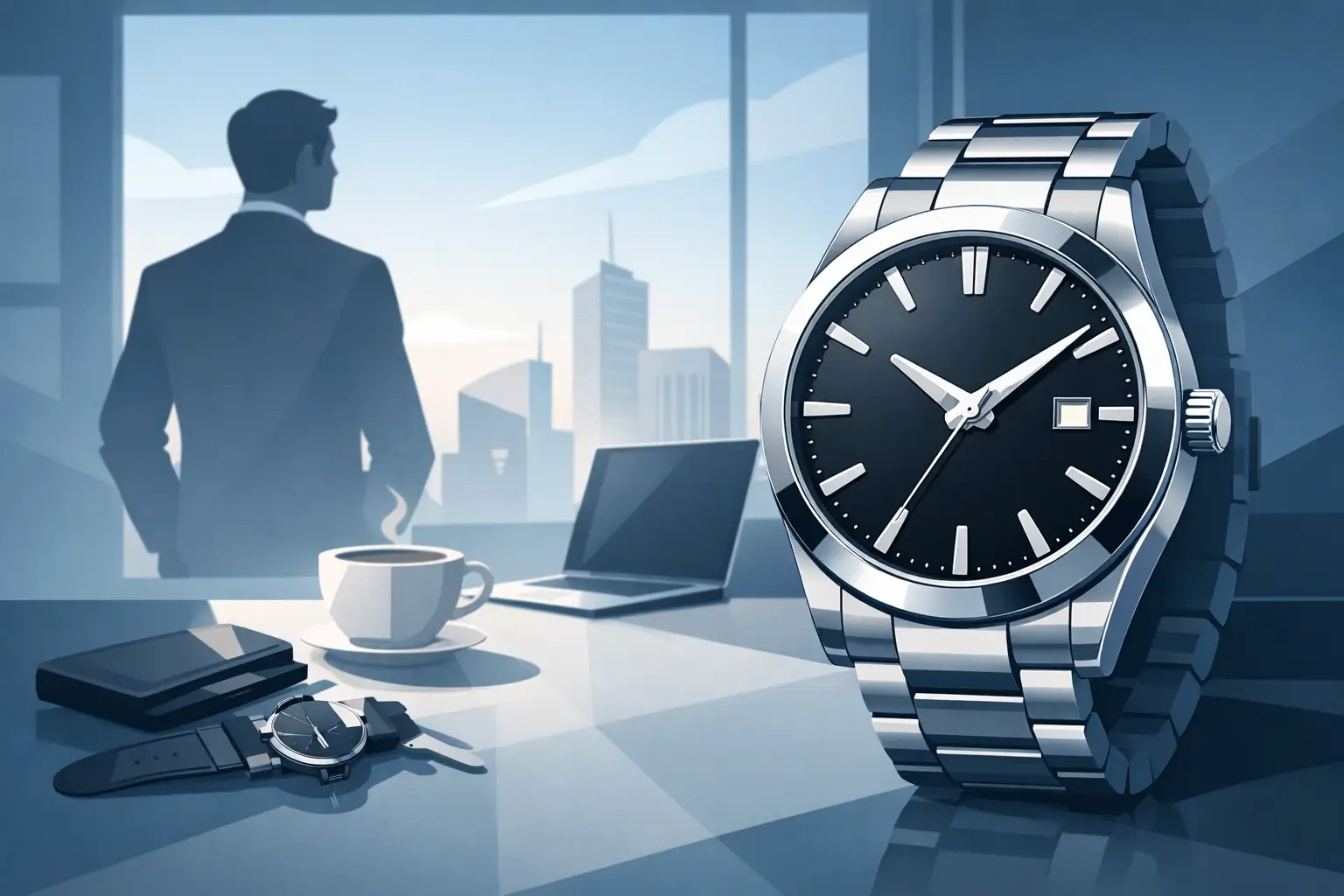
A serious everyday watch has to survive more than a close-up on a dresser. It needs to look right under a blazer, feel comfortable through a long workday, and still have enough character to earn a second glance at dinner. The Tissot Gentleman is built for exactly that role: a Swiss-made watch that leans polished without becoming precious.
It is not a tool-watch icon in the vein of a dive watch, nor is it a fragile dress piece reserved for formal occasions. Its appeal comes from a carefully judged middle ground. For men buying a first Swiss automatic or upgrading from fashion watches, that balance makes the Gentleman one of Tissot’s most sensible entries.
What Makes the Tissot Gentleman Stand Out
At 40mm, the Gentleman occupies familiar territory for a modern men’s watch. It has enough wrist presence for most buyers without crossing into oversized territory. The case is relatively slim and cleanly proportioned, with a mix of brushed and polished finishing that gives it more visual depth than a basic department-store watch.
The dial does much of the work. Applied hour markers, a restrained date window at 3 o’clock, and sharp dauphine-style hands create a look that feels purposeful rather than decorative. Blue, black, silver, and green dial options each shift the personality of the watch. Blue is the safest all-around choice, silver is the most classically dressy, black is direct and versatile, and green adds a more contemporary note without looking loud.
Tissot also gives the Gentleman 100 meters of water resistance on many references. That does not turn it into a dedicated dive watch, but it does remove the anxiety that comes with a delicate dress watch. Rain, hand washing, and a casual poolside afternoon are far less concerning than they would be with a traditional leather-strap piece.
Tissot Gentleman Powermatic 80 vs. Quartz
The biggest choice is not dial color. It is movement.
The Tissot Gentleman Powermatic 80 is the version that draws watch enthusiasts. Its automatic movement is powered by wrist motion and offers approximately 80 hours of power reserve. Leave it off from Friday evening to Monday morning and it should still be running. That is a practical advantage over many entry-level automatics with reserves closer to 38 or 42 hours.
Depending on the reference, the Powermatic 80 may also feature an advanced balance spring designed to offer greater resistance to magnetism. For an office worker regularly around phones, laptops, speakers, and magnetic bag clasps, that is a meaningful modern benefit. The movement is visible through an exhibition caseback on many models, which adds a small but satisfying sense of mechanical theater.
The trade-off is simple: an automatic watch is a machine. It can gain or lose time, needs periodic servicing, and costs more upfront. The Powermatic 80 is designed as a reliable everyday caliber, not as a hand-finished collector’s movement. Buyers expecting chronometer-level precision from every example should adjust expectations or consider a certified chronometer model instead.
The quartz Gentleman is the smarter pick for men who value precision and low maintenance above all else. It is typically thinner, less expensive, and ready whenever you reach for it. There is no romance in a battery-powered movement for some collectors, but there is plenty of logic. If this will be your one watch and you do not want to reset it after a week in the drawer, quartz has a strong case.
How the Gentleman Wears in Real Life
The Gentleman is best understood as a refined daily watch. It works with a navy suit, but it does not look out of place with an oxford shirt, dark denim, and leather boots. That flexibility is its strongest feature.
On the steel bracelet, it reads more confident and contemporary. The bracelet gives the watch a little extra weight and makes it an easy choice for travel, commuting, and warm weather. A leather strap softens the look immediately, making the Gentleman feel closer to a traditional business watch. If you want one watch that can cover professional and social settings, the bracelet is usually the better starting point. You can always add a strap later.
Wrist size matters, though. A 40mm case is a crowd-pleasing size, not a universal one. Men with wrists below roughly 6.5 inches may find the Gentleman broad, especially on its bracelet. Its compact lug-to-lug profile helps, but trying on a similar 40mm watch before buying remains wise. Buyers with medium to larger wrists will likely find its proportions comfortably balanced.
Legibility is another win. The hands and markers are easy to read in ordinary light, and the date complication is useful without disrupting the dial. The luminous material is adequate for checking the time in a dim room, though this is not a watch chosen for serious nighttime visibility. A field watch or diver will outperform it after dark.
Where It Sits Among Its Rivals
The Gentleman lives in a competitive segment filled with strong Swiss, Japanese, and microbrand alternatives. Its closest internal rival is the Tissot PRX Powermatic 80. Both share accessible Swiss automatic appeal, but their personalities could not be more different.
The PRX is sporty, integrated-bracelet driven, and deliberately retro. The Gentleman is quieter, more traditional, and easier to pair with formal clothing. A buyer who wears sneakers and casual tailoring most days may prefer the PRX. A buyer who needs a watch for client meetings, weddings, and office life will often get more mileage from the Gentleman.
Against models such as the Hamilton Khaki Field, Seiko Presage, or Certina DS lines, the decision comes down to style and priorities. Hamilton brings military character. Seiko Presage often brings more dial flair at the expense of a more formal aesthetic. Certina can appeal to buyers who want sportier durability. The Gentleman’s advantage is restraint. It does not force a particular identity on the wearer.
That restraint can also be its limitation. Men searching for a dramatic case shape, colorful texture, heritage reissue appeal, or a recognizable luxury statement may find it too reserved. The Tissot name carries genuine Swiss watchmaking credibility, but the Gentleman is designed to signal taste rather than status.
Is the Tissot Gentleman Good Value?
For the price, the automatic Gentleman offers a convincing package: Swiss manufacture, a proven long-power-reserve movement, sapphire crystal, solid water resistance, and finishing that looks appropriate in professional settings. It feels like a step up from entry-level watches without demanding the financial leap associated with brands such as Longines, Tudor, or Omega.
Value is not only about specifications. A watch can offer more complications, a brighter dial, or a lower price and still spend most of its life in a box because it does not fit the owner’s wardrobe. The Gentleman succeeds because it is easy to wear repeatedly. It has enough polish for important moments and enough practicality for ordinary ones.
For a first mechanical watch, choose the Powermatic 80 if the movement is part of the appeal and you enjoy the ritual of ownership. Choose quartz if your priority is a clean, capable Swiss watch that asks almost nothing of you. Either way, select the dial and strap combination you can picture wearing on an unremarkable Tuesday. That is where a genuinely good everyday watch proves its worth.