
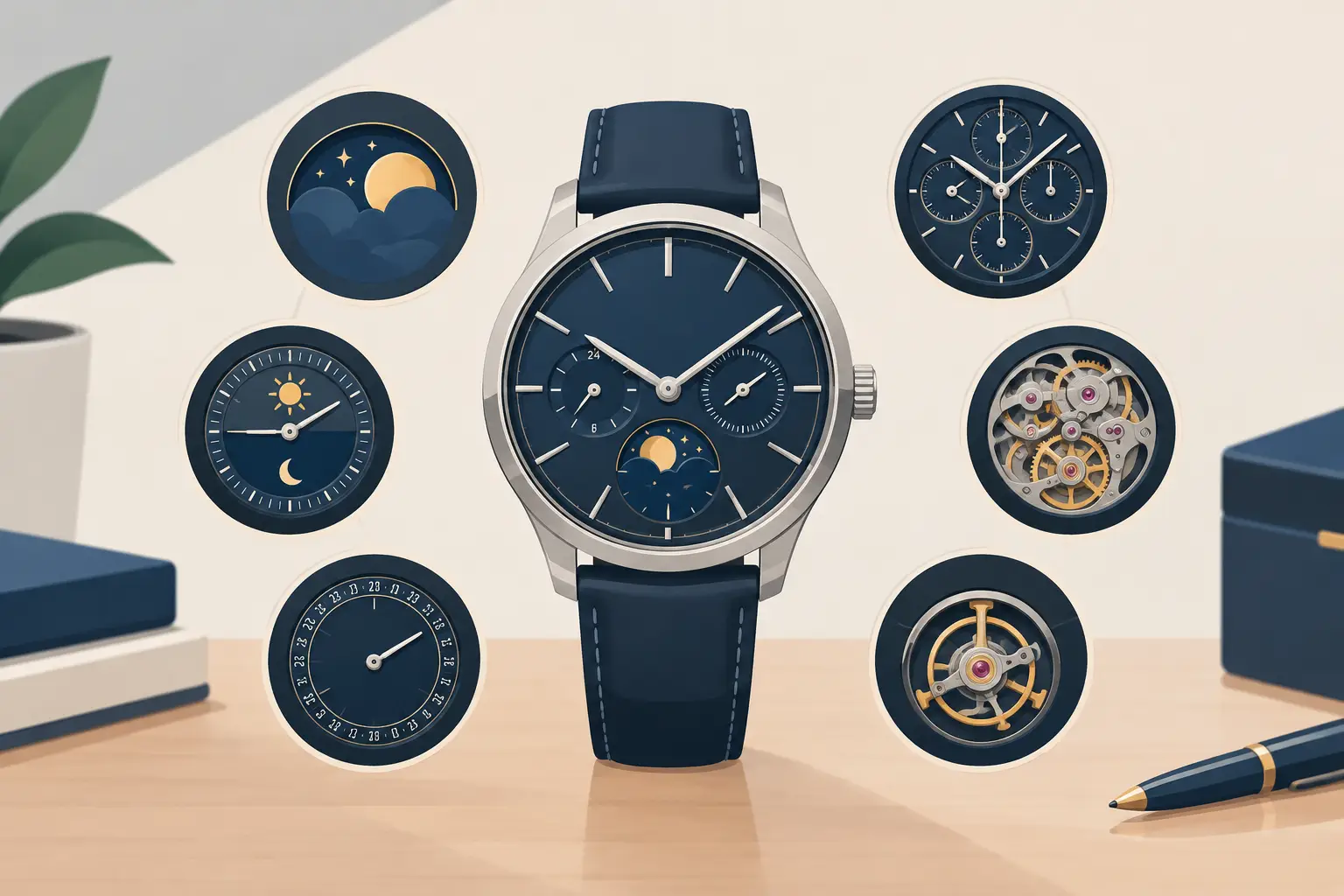
A watch can tell more than the time without becoming a cluttered instrument panel. The best complication is one you will actually use, whether that means checking a second time zone before a business trip or timing a steak on the grill. This guide to watch complications separates the genuinely useful features from the impressive-but-unnecessary ones, so you can choose a watch with confidence.
In watchmaking, a complication is any function beyond the basic display of hours, minutes, and seconds. That definition covers the humble date window as well as a perpetual calendar or a chiming minute repeater. Complications often add cost, visual interest, and mechanical prestige, but they can also make a watch thicker, harder to read, and more demanding to maintain. The right choice comes down to your routine, your style, and the level of involvement you want from your watch.
Start With the Complications You Will Use
For most men, a date display is the smartest first complication. A simple window at 3 o’clock or 6 o’clock adds everyday utility without changing a watch’s clean, balanced character. It works particularly well on office watches, divers, and versatile sports models. The trade-off is purely aesthetic: on a minimalist dress watch, a date window can interrupt an otherwise elegant dial.
Day-date watches take that usefulness a step further by showing the day of the week alongside the date. They are ideal if you wear one watch most days and appreciate a little more information at a glance. The added display gives a watch a more traditional, executive presence, although it can feel busy on a small dial.
Before paying more for any feature, consider how often you would reach for it. A complication should support your life, not simply give you another subdial to explain when someone asks about your watch.
The Essential Guide to Watch Complications
Chronograph: the sportiest choice
A chronograph is a stopwatch built into the watch. Usually operated with pushers on the side of the case, it can measure elapsed seconds, minutes, and sometimes hours. It is one of the most recognizable complications in men’s watches, partly because the subdials, pushers, and tachymeter scales give a case visual energy.
You do not need to race cars to enjoy a chronograph. It is useful for workouts, parking meters, meetings, cooking, and travel. More importantly for many buyers, it brings a confident motorsport or aviation-inspired look to casual clothing. A chronograph can be less suited to formal wear, though. Its busier dial and thicker case rarely have the quiet elegance of a slim three-hand dress watch.
Quartz chronographs are typically affordable, accurate, and easy to own. Mechanical chronographs offer far more craft appeal, with intricate levers, wheels, and clutches working beneath the dial. They also command a higher price and may cost more at service time.
GMT: made for travel and remote work
A GMT complication tracks a second time zone with an additional hand that circles the dial once every 24 hours. Pair it with a 24-hour bezel or scale, and you can read home time and local time without doing mental math. For frequent travelers, international clients, military personnel, or anyone with family overseas, it is among the most practical watch complications available.
Not all GMTs work the same way. A “caller GMT” usually lets you adjust the 24-hour hand independently, which is convenient for monitoring another location. A “flyer GMT” lets you jump the local hour hand forward or backward without stopping the watch, making it better for crossing time zones. Flyer GMTs are often more expensive, so the distinction matters most if you travel regularly.
A GMT also has style range. On a steel bracelet, it looks polished enough for a business trip. On leather or rubber, it becomes a capable weekend companion. The extra hand adds color and personality without overwhelming the dial.
Dive bezel: simple, durable timing
A rotating bezel is technically an external complication rather than a movement complication, but it deserves attention because it is so useful. On a dive watch, the bezel turns in one direction and tracks elapsed time. Align the bezel’s zero marker with the minute hand, and the hand tells you how many minutes have passed.
It is remarkably intuitive, needs no battery, and is easier to use than a chronograph when your hands are wet or gloved. Even if you never dive, it is useful for coffee breaks, laundry, workouts, and grilling. A dive bezel also brings a rugged, masculine profile that works naturally with denim, polos, and casual tailoring.
Power reserve: useful for mechanical owners
A power reserve indicator shows how much stored energy remains before a mechanical watch stops. This is especially helpful on manual-wind watches and automatics that may sit unworn for a few days. Rather than discovering a dead watch on Monday morning, you can see when it needs winding or wearing.
Its appeal depends on your habits. If you rotate several mechanical watches, a power reserve display can be genuinely useful. If you wear one automatic every day or prefer a quartz watch, it is less essential. Visually, these indicators can be handsome, but they sometimes disrupt a symmetrical dial.
Moonphase and calendar: classic character over daily necessity
A moonphase display tracks the lunar cycle through a small aperture, often with a detailed moon against a blue or black sky. It is not a practical need for most buyers. Its value is emotional: a moonphase gives a dress watch romance, mechanical charm, and an old-world sense of occasion.
Calendar complications range from simple annual calendars to perpetual calendars. An annual calendar accounts for months with 30 and 31 days but usually needs one adjustment each year in February. A perpetual calendar is designed to account for leap years as well. These are impressive achievements of traditional watchmaking, but they are expensive, complex, and often expensive to service.
For a first serious watch, a standard date or day-date is usually the better value. Consider annual and perpetual calendars when you are drawn to the craftsmanship itself and are comfortable treating the watch as a long-term luxury purchase.
Match the Dial to Your Personal Style
A complication should be legible before it is impressive. If you cannot read a watch quickly in ordinary light, its extra features have become decoration rather than function. Look at the dial from arm’s length, not only in product photos. Can you distinguish the hands from the subdials? Is the date window easy to see? Does the color contrast work for your eyes?
Your wardrobe should influence the choice as well. A clean date watch with a leather strap pairs naturally with business attire, weddings, and formal dinners. A GMT provides a refined travel-minded look that works across office and weekend settings. Chronographs and dive watches lean sportier, with more presence under a casual jacket or alongside jeans and boots.
Case size matters. Extra mechanisms can make watches thicker, and a thick chronograph may sit awkwardly under a fitted shirt cuff. Men with smaller wrists often do well with compact three-hand watches, restrained GMTs, or vintage-inspired chronographs rather than oversized tool-watch designs.
Mechanical vs. Quartz Complications
The same complication can feel very different depending on the movement. Quartz watches make features like alarms, digital dual time, calendars, and chronographs affordable and highly accurate. They are sensible choices for active routines, travel, and first-time buyers who want function without the cost of mechanical servicing.
Mechanical watches offer a different reward. Their complications are driven by springs, gears, cams, and carefully engineered components, which is why a mechanical chronograph or calendar carries so much prestige. You are paying not just for what the watch does, but for how it does it.
That prestige comes with responsibility. Mechanical watches can require periodic service, and complicated movements generally cost more to maintain than simple ones. If you want a low-fuss daily watch, simple quartz or a basic automatic movement is often the wiser purchase. If the ritual and craftsmanship are part of the appeal, a mechanical complication can make ownership far more satisfying.
Buy for Function, Then Enjoy the Fascination
A watch with more complications is not automatically a better watch. A well-proportioned date watch from a respected brand can deliver more everyday pleasure than a crowded calendar you rarely set correctly. Likewise, a rugged diver with a timing bezel may serve your life better than a delicate dress watch with a moonphase.
Choose the feature that earns its place on your wrist, then let the finishing, proportions, and craftsmanship make it memorable. The best complication is the one that gives a great watch a little more purpose every time you look down at it.