
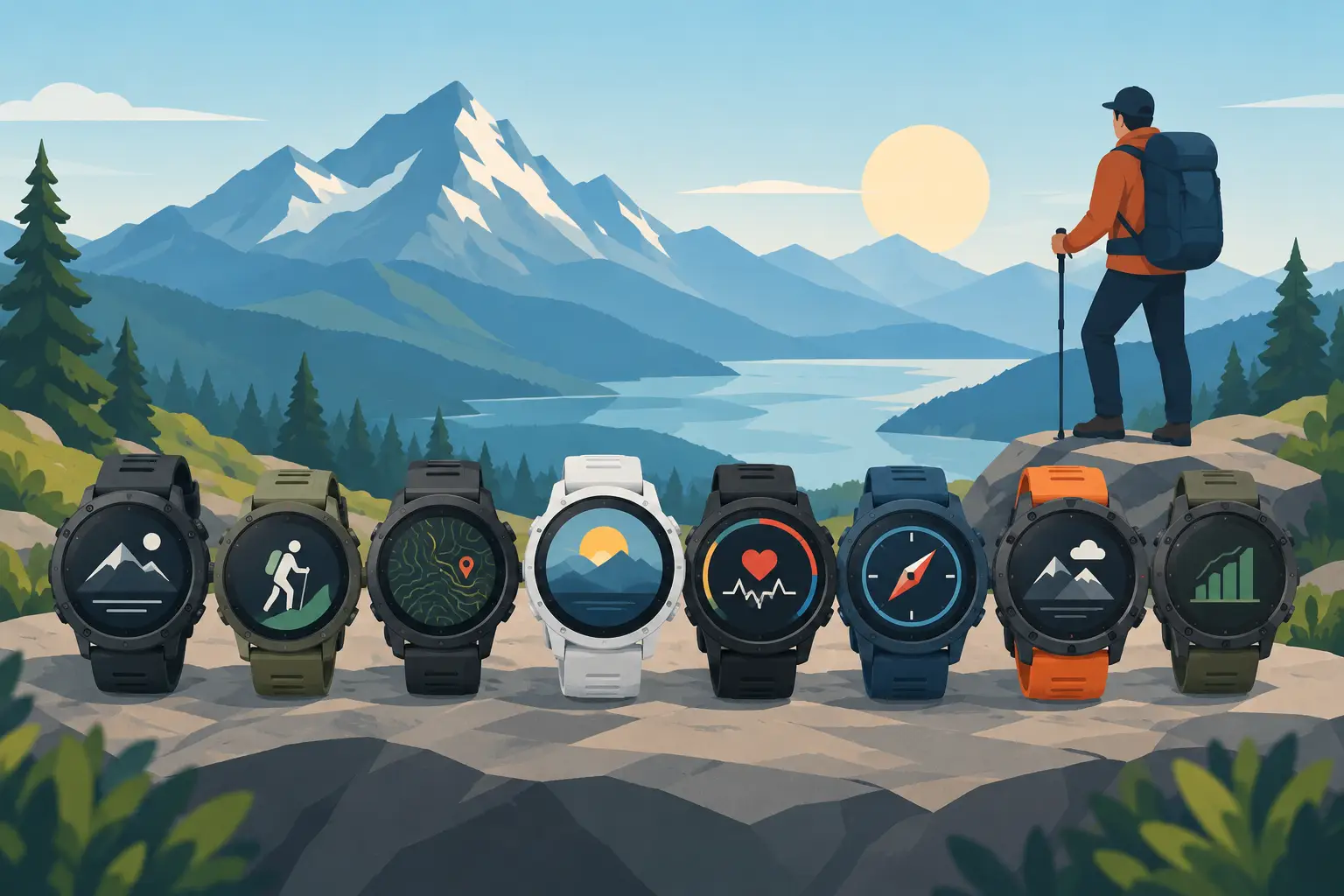
A hiking watch earns its place when the weather turns, the trail disappears under loose rock, and your phone is better left in your pack. The best digital watches for hiking do more than count steps. They give you trustworthy navigation, useful elevation data, serious battery life, and a case that can take a scrape against granite without looking fragile.
For most men, the right choice comes down to how far and how often they hike. A weekend day hiker can get excellent value from a durable Casio or G-Shock. Multi-day backpackers and mountain athletes will appreciate GPS mapping, solar charging, and detailed training metrics from Garmin, Suunto, or COROS. Here are the standout options, with the trade-offs that matter before you buy.
Best Digital Watches for Hiking at a Glance
The Garmin Instinct 3 Solar is the best all-around pick for hikers who value battery life and toughness over a full-color map display. Garmin’s fēnix 8 is the premium choice for ambitious hikers who want mapping, training tools, and a more polished everyday watch. The Suunto Vertical is a compelling navigation-first alternative, while the COROS VERTIX 2S is built for endurance-minded users who refuse to worry about charging.
At the affordable end, Casio’s Pro Trek PRW-35 brings genuine outdoor credibility without the cost or distraction of a smartwatch. The G-Shock Rangeman GW-9400 remains one of the most dependable tools a hiker can wear. Apple Watch Ultra 2 deserves consideration for iPhone owners who want trail capability in a watch that transitions easily to work and travel.
Garmin Instinct 3 Solar: Best Overall
The Garmin Instinct 3 Solar has the purposeful, tool-watch character many hikers actually want. Its monochrome display is easy to read in direct sun, its fiber-reinforced case is built for rough use, and solar assistance can stretch battery performance dramatically when you spend long days outdoors.
It covers the essentials well: GPS tracking, barometric altitude, compass guidance, weather information, heart-rate monitoring, and safety features. The newer screen options add visual appeal, but the solar monochrome version is the one to choose if maximum endurance is the priority.
The compromise is straightforward. This is not Garmin’s most elegant watch, and it does not offer the rich onboard mapping experience of the fēnix line. Still, for the hiker who wants a dependable companion rather than another miniature phone, it is hard to beat.
Garmin fēnix 8: Best Premium Hiking Watch
The fēnix 8 sits at the intersection of serious outdoor equipment and luxury-adjacent sports watch design. Its premium materials, bright display options, extensive activity profiles, and detailed mapping make it one of the most complete digital watches available for hiking.
Topographic maps and turn-by-turn navigation are especially valuable on unfamiliar terrain. Add advanced recovery insights, multi-band GPS on select versions, a flashlight, and strong water resistance, and the fēnix becomes a credible choice for hiking, trail running, skiing, and everyday training.
It is expensive, and many casual hikers will never use its full suite of capabilities. It is also larger and more technical-looking than a classic field watch. But for the man who sees weekends outdoors as part of his identity and wants one high-level watch to cover nearly everything, the fēnix 8 has real allure.
Suunto Vertical: Best for Navigation and Battery Life
Suunto has a loyal following among hikers who prefer clean design and mountain-focused functionality. The Suunto Vertical stands out for its offline maps, strong GPS performance, and excellent battery options, particularly in its solar configurations.
The interface is less crowded than Garmin’s, which can be a strength when you only need the next route cue, your elevation, and a clear sense of where you are. Its route-planning ecosystem and breadcrumb navigation are particularly useful for long hikes in areas with inconsistent cell service.
Suunto’s smartwatch features are more restrained, and its training analysis is not as deep as Garmin’s. That restraint gives the Vertical a focused character. It feels designed for moving through the mountains, not merely collecting data about it.
COROS VERTIX 2S: Best for Long Expeditions
If charging opportunities are scarce, the COROS VERTIX 2S deserves a serious look. It is known for exceptional GPS battery life and carries the big, confident proportions of a watch made for exposed ridgelines and multi-day efforts.
The VERTIX 2S offers global offline mapping, navigation, altitude data, a compass, and multi-GNSS positioning. COROS also delivers a clean app experience and performance metrics that will appeal to hikers who also train for ultras, climbs, or endurance events.
Its size may overwhelm smaller wrists, and the styling is more athletic than refined. Still, men who prioritize expedition-level endurance over office-friendly versatility will find few better options.
Best Affordable Digital Watches for Hiking
Not every hike requires satellite maps or a four-figure purchase. A simpler digital watch can be the smarter choice if you already navigate with a paper map, handheld GPS, or phone and mainly need dependable timekeeping and outdoor sensors.
Casio Pro Trek PRW-35: Best Value Outdoor Watch
The Casio Pro Trek PRW-35 carries the practical spirit that made the Pro Trek line a favorite among outdoorsmen. It offers Casio’s Triple Sensor layout for altitude, barometric pressure, temperature, and compass readings, plus solar charging and atomic timekeeping on compatible versions.
Its resin case keeps weight low, and its design feels more considered than many entry-level adventure watches. You do not get GPS tracking or maps, which is the key limitation. But for day hikes, camping weekends, and travelers who want a capable watch without daily charging, it represents excellent value.
G-Shock Rangeman GW-9400: Best for Pure Durability
The Rangeman is not subtle, and that is precisely the point. This is one of the most hard-wearing digital watches in the outdoor category, with shock resistance, 200-meter water resistance, solar power, and a proven sensor package.
It is a fine option for hikers who work outdoors, hunt, camp, or simply prefer gear with a near-indestructible reputation. The display is information-dense, and the large case has unmistakable G-Shock presence. It lacks GPS, so it should not replace a navigation plan on remote routes, but it is an excellent backup tool and a rugged daily wearer.
Apple Watch Ultra 2: Best for iPhone Owners
For the iPhone user who wants one watch for training, messages, travel, and the trail, Apple Watch Ultra 2 is the most polished choice. Its bright display, precise GPS, action button, cellular option, compass waypoints, and emergency features make it genuinely useful outdoors.
It also has a more premium visual finish than most dedicated sports watches. Titanium construction and the large, crisp screen give it an elevated feel whether it is paired with hiking layers or a casual weekend outfit.
Battery life remains its major weakness beside Garmin, Suunto, and COROS. It can handle day hikes comfortably, but multi-day hikers should plan around charging or choose a dedicated outdoor watch instead. It is best viewed as a highly capable lifestyle watch with strong hiking credentials, not an expedition instrument.
What Matters Most in a Hiking Digital Watch
GPS is valuable, but it is not the only specification worth paying for. For trail navigation, look for multi-band GPS if you frequently hike in dense forest, steep valleys, or urban-adjacent terrain where signals can bounce. Offline maps are more useful than breadcrumb trails when routes become complex, though they add cost and can shorten battery life.
An altimeter, barometer, and compass – often called ABC sensors – remain useful even in the era of GPS. A barometric altimeter can provide more responsive elevation readings, while pressure trends may offer an early clue that weather is changing. No wristwatch replaces a proper forecast or sound backcountry judgment, but these tools add useful context.
Comfort matters more than buyers expect. A 51mm titanium flagship can look impressive online, yet feel excessive after eight hours of arm swing. If your wrist is average or slim, consider a smaller case size. Nylon straps are often more comfortable and dry faster than silicone, while silicone handles sweat and rain with less fuss.
Finally, think honestly about charging. Solar models are helpful, but they are not magic. Their benefit depends on sunlight exposure, settings, and the watch’s power mode. For most hikers, a watch that comfortably lasts through the longest trip they realistically take is a better purchase than one loaded with features they will never touch.
A hiking watch should make you more confident on the trail, not more distracted by your wrist. Choose the model that suits your routes, your tolerance for charging, and the way you want your gear to look and feel when the trailhead is still dark.