
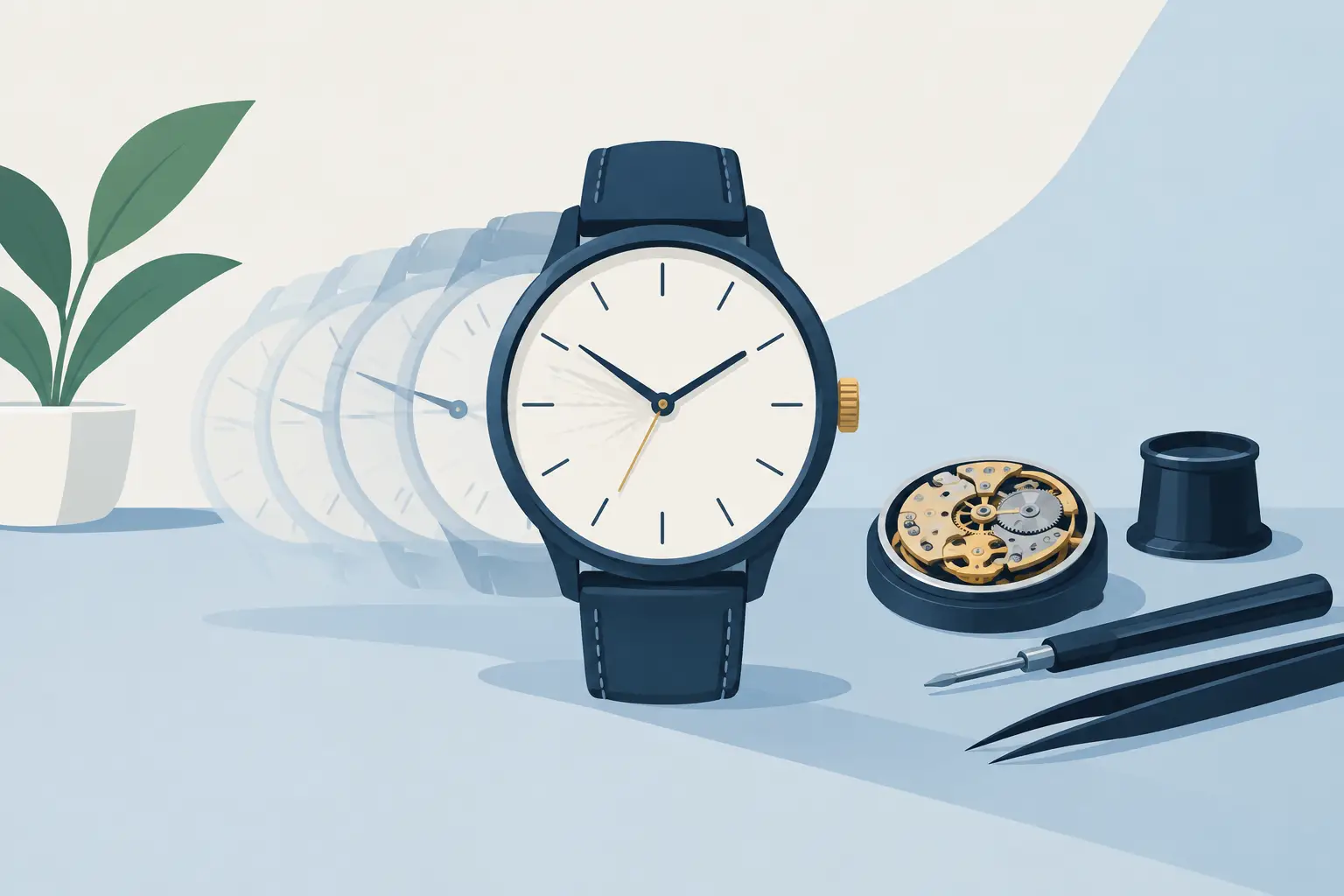
A watch that is five minutes late can ruin a meeting. A watch that gains a few seconds per day may simply be behaving exactly as its movement was designed to behave. Understanding why watches lose time helps separate a normal quirk of mechanical craftsmanship from a problem worth taking to a watchmaker.
The answer depends heavily on what is inside the case. Quartz watches, automatic watches, manual-wind pieces, and vintage models all keep time differently. A $40 digital Casio and a Swiss automatic dress watch may both be reliable daily companions, but their standards of accuracy, maintenance needs, and weak points are not remotely the same.
Why Watches Lose Time: Start With the Movement
A quartz watch uses a battery to send an electrical current through a quartz crystal. The crystal vibrates at a remarkably consistent frequency, allowing the watch to measure time with high precision. Most standard quartz watches are accurate to roughly 15 seconds per month, and many perform better.
A mechanical watch uses a mainspring, gears, escapement, and balance wheel. It is an impressive miniature machine, but it is also influenced by gravity, temperature, lubrication, shock, and the amount of power remaining in the mainspring. Even a well-regulated automatic watch can gain or lose several seconds per day.
That distinction matters when judging performance. If a quartz watch loses two minutes over a month, it deserves attention. If an automatic watch loses two minutes over a month, it may be running within its stated tolerance. Always compare your watch against the maker’s specifications before assuming something is wrong.
What Counts as Normal Accuracy?
For an everyday quartz watch, a deviation of a few seconds per month is generally nothing to worry about. High-accuracy quartz movements can narrow that margin dramatically, often losing or gaining only a few seconds per year.
Mechanical watches require a different mindset. Many entry-level automatics are rated around minus 20 to plus 40 seconds per day. Better Swiss and Japanese movements are commonly regulated more tightly, while chronometer-certified watches are held to higher standards. A premium watch is not necessarily perfectly accurate, but it should deliver consistency. A watch that is consistently eight seconds fast per day is easier to live with and regulate than one that varies wildly from day to day.
Common Reasons a Watch Starts Running Slow
The most likely cause depends on the movement, but a handful of issues account for most timekeeping complaints.
A Weak Battery in a Quartz Watch
When a quartz watch begins losing time, the battery is often the first suspect. Some movements continue running as voltage drops but struggle to maintain normal performance. Others use an end-of-life indicator, such as a second hand that jumps in two-second intervals rather than one.
Do not wait until the battery is completely dead if the watch has shown obvious warning signs. An exhausted battery can leak, potentially damaging the movement and turning a simple battery change into a costly repair. For a watch you wear regularly, a timely replacement is basic ownership, not an optional extra.
Magnetism
Magnetism is one of the most overlooked reasons mechanical watches run poorly. Phones, tablet covers, laptop speakers, wireless chargers, handbag clasps, and some gym equipment can expose a watch to magnetic fields. A magnetized hairspring can stick together, changing the balance wheel’s motion and causing the watch to gain time dramatically. In some cases, the watch may become erratic or stop.
Mechanical watches are more vulnerable than quartz models, although quartz movements are not entirely immune to strong magnetic exposure. The good news is that demagnetizing is usually quick and inexpensive. A watchmaker can test for magnetism and correct it without a full overhaul.
Dried or Contaminated Lubricants
Inside a mechanical watch, tiny components move under controlled friction. Specialized oils reduce wear and help the movement maintain stable amplitude. Over time, those lubricants can dry out, thicken, migrate, or collect debris. The result may be a watch that loses time, runs inconsistently, or has a reduced power reserve.
This is why servicing matters, particularly for a watch with sentimental or financial value. There is no universal service schedule. A modern automatic worn occasionally may run well for years, while a vintage watch or a daily-worn dive watch may need closer attention. Water resistance, age, usage, and the manufacturer’s guidance all affect the right interval.
Low Power Reserve or Inconsistent Winding
An automatic watch needs regular motion to keep its mainspring wound. If it spends most of the week on a desk or sits unworn for several days, it may run with low power before stopping. Some movements keep better time at full or near-full wind than they do near the end of their power reserve.
A watch winder can be useful for certain collections, especially complicated calendars that are tedious to reset. It is not essential for most automatic watches, however. Wearing the watch regularly or giving it a careful manual wind when appropriate is usually enough. Check the manufacturer’s instructions first, since not every automatic should be treated the same way.
Position, Temperature, and Daily Wear
Gravity affects a mechanical movement differently depending on its position. Your watch may run slightly fast when left dial-up overnight and slightly slow when crown-down. Watchmakers use positional regulation to minimize these differences, but they cannot erase physics altogether.
Temperature also plays a role, especially in older mechanical watches. Extreme heat or cold can alter lubricants and the behavior of components. Modern watches are engineered to handle ordinary life well, but leaving a fine automatic on a car dashboard in summer is not a test of durability worth performing.
Shock, Wear, or Moisture Damage
A hard impact can disturb a mechanical movement, bend a pivot, dislodge a hand, or damage the balance assembly. You do not need to drop a watch from a balcony for this to happen. A sharp hit against a doorframe or a poorly timed fall can be enough.
Moisture is more serious. If you see fog under the crystal, treat it as urgent. Even watches built for water resistance can lose protection when gaskets age, crowns are left open, or the case has suffered a knock. Moisture can corrode internal parts, degrade oils, and create accuracy problems long before visible damage appears.
How to Tell Whether Your Watch Needs Service
Track the watch against a reliable time source for seven days. Note the difference at the same time each day and record whether it is consistently fast, consistently slow, or unpredictable. A consistent rate suggests regulation may help. Random swings point more strongly toward magnetism, low amplitude, damage, or an issue that needs diagnosis.
A sudden change is more concerning than a long-standing small deviation. If your automatic has always run 10 seconds slow per day and now loses two minutes, do not try to compensate by constantly resetting it. Likewise, a quartz watch that starts losing several minutes may need more than a fresh battery.
Bring the watch to a qualified watchmaker if it has stopped unexpectedly, changed rate suddenly, been exposed to water, shows condensation, or loses far more time than its specification allows. For a valuable Rolex, Omega, TAG Heuer, or vintage family piece, professional evaluation protects more than accuracy. It protects the watch’s long-term condition and value.
Simple Habits That Protect Accuracy
Keep mechanical watches away from strong magnets, store them in a dry place, and avoid unnecessary impacts. Make sure the crown is properly secured before swimming or washing your hands. If you own several watches, rotate them thoughtfully rather than letting an automatic sit unwound for months at a time.
For quartz watches, replace batteries promptly and have water-resistance seals checked when the case is opened. For mechanical watches, judge service by performance and condition rather than following a rigid calendar alone. A well-made watch is built to be worn, but it rewards sensible care.
A little variation is part of the character of a mechanical watch. What matters is knowing your watch’s normal rhythm. Once you do, a small change in its timing becomes useful information – and an easy chance to keep a favorite piece looking sharp and performing as it should.