
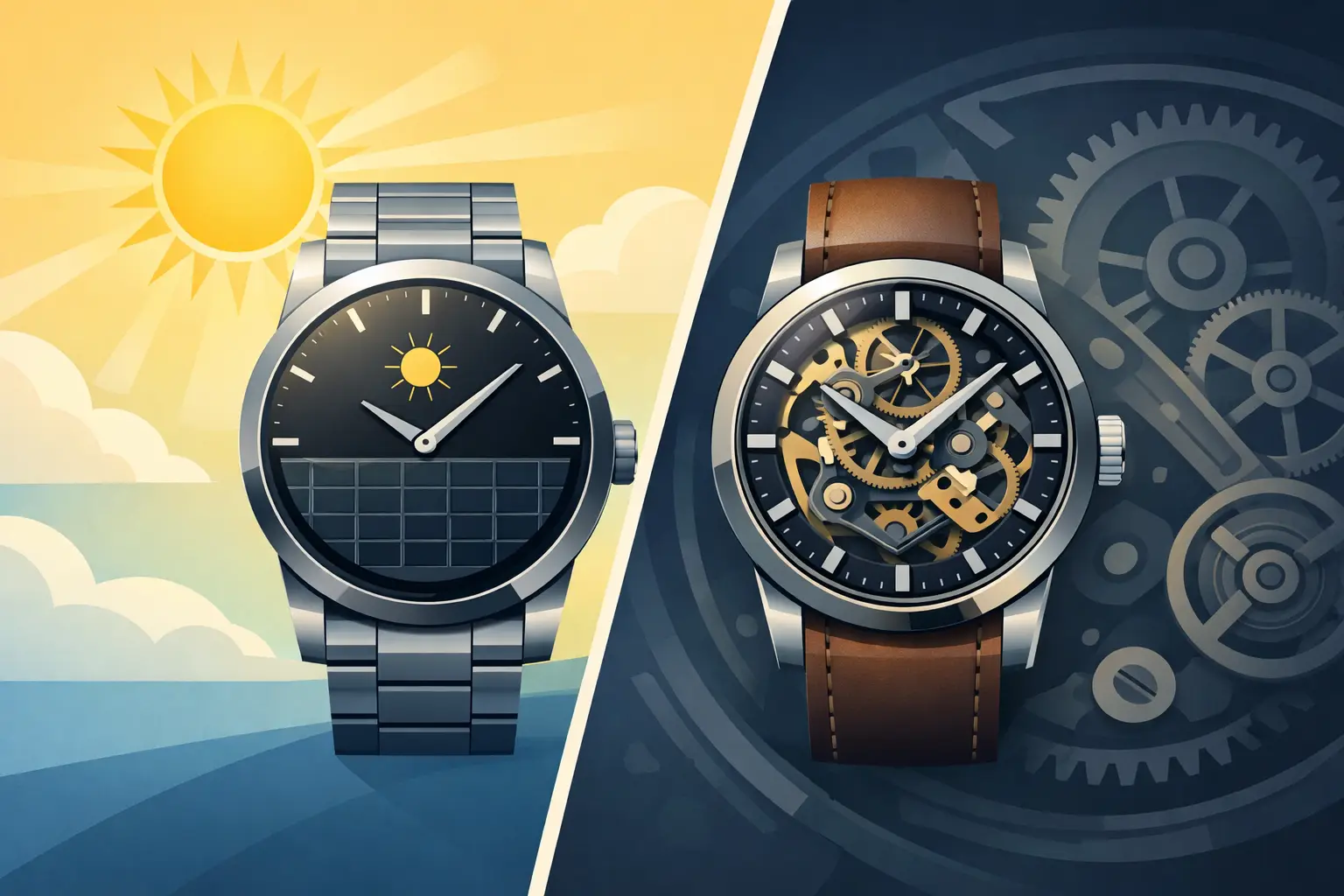
A watch can say a great deal before you say a word. The clean confidence of a solar field watch and the mechanical charm of an automatic diver may both look right with a tailored jacket or a weekend overshirt, but they ask different things of their owner. In the solar vs automatic watches debate, the better choice is not about prestige alone. It comes down to how you live, what you value, and whether you want your watch to be a dependable tool, a small mechanical ritual, or both.
For a first serious watch, this distinction matters more than many buyers expect. Movement affects accuracy, maintenance, thickness, price, and even the personality of the piece on your wrist.
Solar vs Automatic Watches: The Core Difference
A solar watch is powered by light. Its dial, or a discreet layer beneath it, captures natural and artificial light and converts it into energy stored in a rechargeable cell. Brands such as Citizen and Seiko have made solar technology especially familiar, but solar movements now appear in everything from hard-wearing sport watches to refined dress-casual designs.
An automatic watch is mechanical. It uses a weighted rotor that turns with the motion of your wrist, winding a mainspring that powers the watch. No battery is required, but the movement is a miniature machine made of gears, springs, levers, and jewels. That engineering is visible through an exhibition caseback on many models, and it is a major part of the appeal.
The practical difference is simple: solar watches turn light into reliable power, while automatic watches turn wrist motion into stored mechanical energy. The emotional difference is just as real. Solar feels efficient and modern. Automatic feels traditional, tactile, and connected to the history of watchmaking.
Why Solar Watches Make Sense for Most Daily Wear
Solar watches are among the easiest watches to own. Give one regular exposure to light and it can run for months in darkness after reaching a full charge. You do not need to wind it before a trip, reset it after leaving it in a drawer for a week, or plan around a short power reserve.
That convenience pairs well with strong accuracy. Most solar watches use quartz regulation, typically keeping time within seconds per month rather than seconds per day. For men who rely on a watch for meetings, flights, workouts, and daily schedules, that is a meaningful advantage. You put it on, and it simply works.
Solar also makes a strong case for the man who wants low ownership costs. While the rechargeable cell will not last forever, it generally lasts far longer than a standard disposable watch battery. There is no periodic mechanical service requirement comparable to an automatic movement. Over several years, that can make solar a smart value, especially below the mid-range price bracket.
Style is no longer a limitation, either. The category includes rugged digital-inspired designs, titanium travel watches, military field styles, and polished stainless-steel models that work comfortably with business casual clothing. A solar chronograph can offer an assertive, purposeful look without demanding much attention from its owner.
Solar is not completely maintenance-free, however. A watch kept in a dark drawer for extended periods may lose its charge. The answer is usually simple exposure to light, but it is worth remembering if you rotate through a large collection. Also, some enthusiasts find that the technology lacks the romance of a mechanical caliber. It is highly capable, but it does not offer the same sense of interaction.
The Allure of an Automatic Watch
An automatic watch has a presence that is difficult to reduce to specifications. The seconds hand often sweeps smoothly rather than ticking once per second. The case may have a satisfying heft. Through the caseback, you can see the rotor move and the movement at work. For many men, those details make an automatic feel less like an accessory and more like an object of craftsmanship.
This is where automatic watches earn their place in a collection. A well-chosen mechanical watch can carry heritage, design language, and a story that remains compelling long after the purchase. Whether it is a sporty Japanese diver, a Swiss-inspired dress watch, or a classic pilot model, an automatic movement adds depth to the ownership experience.
There is also no concern about a depleted battery or rechargeable cell. If the watch stops, a few turns of the crown and a period of wear will bring it back to life. For someone who wears the same watch most days, that routine is almost invisible.
The trade-off is precision. Many accessible automatic watches run within roughly 15 to 30 seconds per day, though performance varies by movement, regulation, position, age, and temperature. A well-regulated premium movement can do much better, but solar quartz remains the more accurate choice for ordinary daily timekeeping.
Automatic watches also need occasional service. Lubricants age, seals need inspection, and mechanical components eventually benefit from the attention of a qualified watchmaker. Service intervals vary by brand and usage, but this is an ownership cost to factor into the purchase. Buying an inexpensive automatic can be rewarding, yet a major repair years later may cost a significant portion of the watch’s original price.
Accuracy, Maintenance, and Convenience
If your priority is faultless practicality, solar has the edge. It is more accurate, requires less intervention, and handles an irregular wearing schedule better. It is particularly well suited to commuters, frequent travelers, active men, and anyone looking for one reliable watch that can cover most situations.
If your priority is craftsmanship and long-term connection, automatic has the edge. It asks more from you, but that interaction is the point. Setting the time after a few days away, feeling the crown engage, and noticing the rotor move are small experiences that make a mechanical watch feel personal.
Water resistance deserves a separate thought. The movement type does not determine whether a watch is suitable for swimming or diving. A solar watch and an automatic watch can both be highly water resistant, provided the case construction and rating support it. What matters is choosing the right watch for the activity and having its seals checked when appropriate.
Thickness can vary as well. Solar movements are often compact, allowing for slim, comfortable cases. Automatic movements generally require more vertical space, particularly when paired with a date display, dive-watch water resistance, or a rotating bezel. A thicker automatic can look commanding, but it may be less comfortable under a fitted shirt cuff.
Which Movement Fits Your Style?
A solar watch fits a man who wants his wardrobe to work as hard as he does. Think clean dial designs, titanium cases, practical complications, and durable finishes. It is the natural choice for a first watch, a travel watch, a daily beater, or a dependable gift for someone who does not want a hobby disguised as a timepiece.
An automatic watch fits a man who appreciates the details behind the dial. It can be the watch you wear to dinner, bring out for the weekend, or choose when an occasion calls for something with more character than a phone-synced tool. It also makes sense for a budding collector because it introduces the mechanics, finishing, and brand history that define so much of watch culture.
Budget influences the decision. At entry-level prices, solar often delivers more technology, accuracy, and feature value for the money. Automatic watches at the same price can still be excellent, especially from established Japanese brands, but the appeal is usually less about superior specifications and more about mechanical charm. As prices rise, automatic watches offer more refinement in movement finishing, case work, and heritage, while solar remains compelling for its utility.
A Smart Way to Choose
Picture the watch on an ordinary Tuesday, not only in a product photo. Will you wear it every day, leave it in a watch box, take it through airports, or reserve it for evenings and weekends? Your answer usually points to the right movement.
Choose solar if you want a precise, low-fuss watch that is ready whenever you are. Choose automatic if the engineering itself adds value to the experience and you are comfortable with periodic setting and future servicing. Neither is a compromise when it matches the role you want the watch to play.
The most satisfying watch is the one that earns wrist time. A solar model may become your trusted daily companion, while an automatic may be the piece that reminds you why watches still matter in a digital age.