
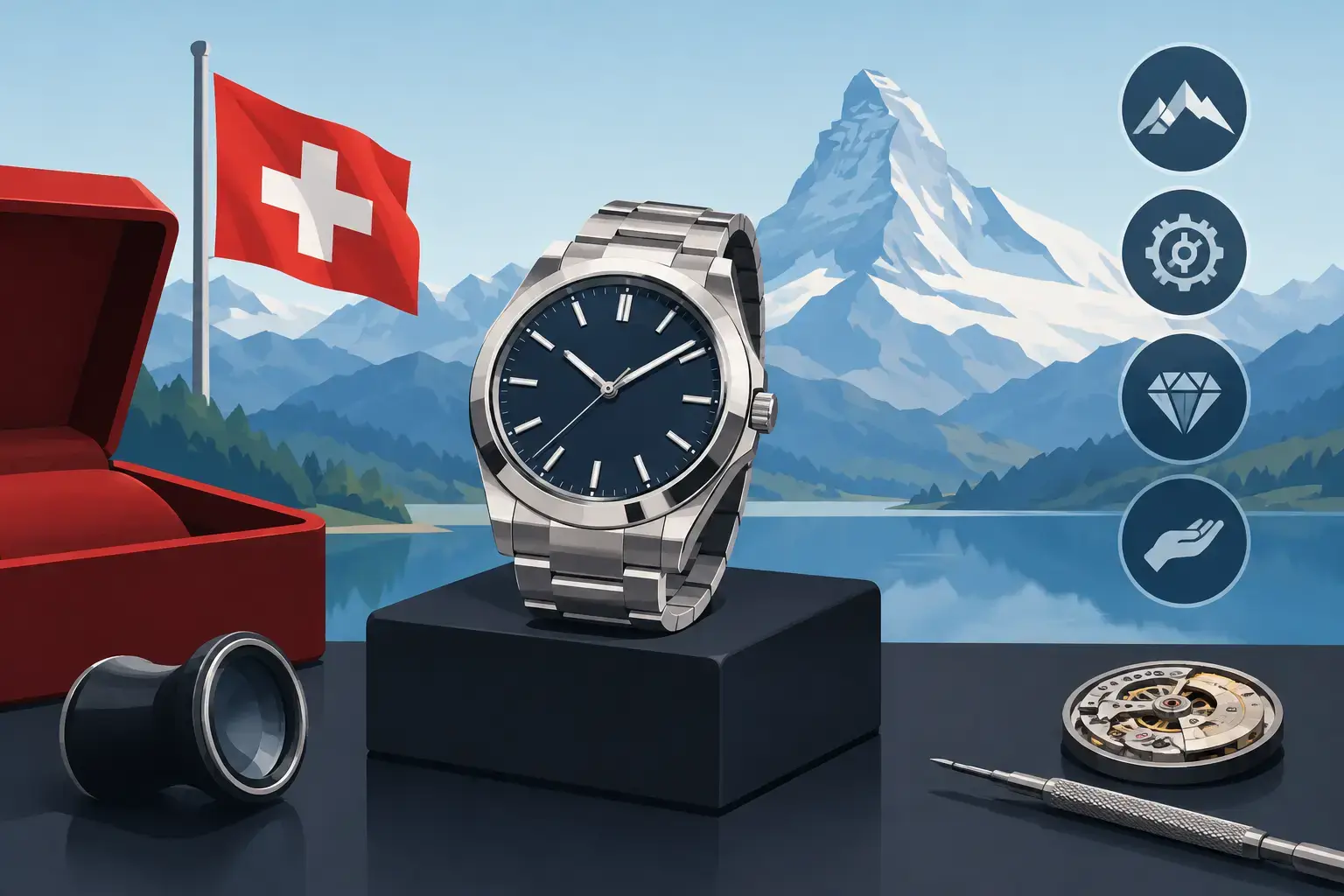
A Swiss watch can cost more than a perfectly capable smartwatch, quartz watch, or automatic made elsewhere – even when all three tell time just as well. So, why are Swiss watches expensive? The short answer is that buyers are paying for skilled labor, tightly controlled production, mechanical engineering, finishing, and a reputation that has been built over centuries.
That does not mean every Swiss watch is automatically worth its price. The country of origin is meaningful, but it is not a shortcut around smart buying. A well-chosen Swiss watch should offer something you can see, wear, and appreciate over years of ownership: strong design, dependable construction, serviceability, and a sense of occasion every time it goes on the wrist.
Why Are Swiss Watches Expensive Compared With Others?
The price gap starts with where and how the watch is made. Switzerland has high wages, high operating costs, and a watch industry built around specialized suppliers and trained craftspeople. Producing a mechanical movement, fitting its components, regulating its timekeeping, and inspecting the finished watch require more human expertise than mass-producing a basic quartz movement.
Swiss brands also tend to build their pricing around longevity rather than disposable ownership. A mechanical watch is designed to be serviced, not replaced when the battery dies or a component fails. That long-term proposition has a cost upfront, but it is part of the appeal for a man buying his first serious watch or marking a major career milestone.
The final number on the tag also reflects smaller production runs. Many Swiss brands do not chase the enormous volume of mainstream fashion-watch companies. Lower volume means development, tooling, quality control, and distribution costs are spread across fewer watches.
The Swiss-Made Standard Carries Real Requirements
“Swiss Made” is not merely a decorative line on the dial. It is a legally protected designation with defined requirements. For a watch to qualify, its movement must be Swiss, the movement must be cased up in Switzerland, final inspection must happen there, and at least 60% of the watch’s manufacturing value must be generated in Switzerland.
That standard is not a guarantee that every component was manufactured in Switzerland. Cases, bracelets, crystals, and certain parts may come from global suppliers. Still, the rules create a meaningful level of accountability and make it harder to use Swiss identity as empty marketing.
For the buyer, this distinction matters. “Swiss movement,” “Swiss parts,” and “Swiss Made” are not interchangeable claims. A watch with a Swiss quartz movement can be an excellent, practical choice, but it is different from a fully Swiss-made mechanical watch with extensive in-house work. Read the specification sheet rather than relying on a flag graphic or a brand name that sounds European.
Labor Is a Major Part of the Price
The romance of Swiss watchmaking is real, but so is the labor bill. Watchmakers train for years to assemble, diagnose, regulate, and repair fine movements. On more expensive pieces, specialists may polish cases, apply decorative finishes, set hands and indices, test water resistance, and inspect alignment under magnification.
A simple-looking three-hand watch can involve a surprising amount of detail. The hands must sit precisely, the dial markers must line up cleanly, the crown action must feel crisp, and the movement must perform within the brand’s stated tolerances. These details separate a refined watch from one that merely looks good in a product photo.
At the entry level, much of this work is standardized and assisted by modern machinery. As prices climb, hand-finishing and individual adjustment become more prominent. That is why the difference between a $700 Swiss automatic and a $7,000 Swiss automatic is not just the logo on the dial. It can include a higher-grade movement, more complex case work, tighter testing, and substantially more time at the bench.
Mechanical Movements Are Tiny Machines
A quartz watch uses a battery and electronic oscillator to keep highly accurate time at a relatively low cost. A mechanical watch relies on a mainspring, gears, escapement, balance wheel, and dozens or hundreds of precisely manufactured components working together in a space smaller than a cookie.
That complexity is a major reason automatic Swiss watches command a premium. The movement must be assembled with minimal friction, lubricated correctly, and regulated so it performs reliably across positions and temperatures. Chronographs, GMT functions, calendars, and moonphase displays add more parts and more opportunities for error.
A mechanical movement is not necessarily more accurate than quartz. In fact, affordable quartz watches often win that contest easily. The value of mechanical watchmaking lies elsewhere: engineering, tactile interaction, serviceability, and the quiet satisfaction of wearing a machine powered by your movement. It is a luxury purchase, but not an irrational one if that experience matters to you.
Materials and Finishing Change the Feel on the Wrist
Swiss watches frequently use durable materials such as 316L steel, sapphire crystal, ceramic bezels, solid precious metals, and carefully machined bracelets. None of these materials is exclusive to Switzerland, but reputable Swiss brands often execute them to a high standard.
Sapphire crystal, for example, is highly scratch resistant and common on better Swiss watches. A properly finished steel case will have clean transitions between brushed and polished surfaces. A quality bracelet will articulate smoothly, fit closely to the case, and use a clasp that feels secure rather than flimsy.
The dial may be where the money becomes most visible. Applied indices, crisp printing, layered textures, luminous material, and sharply finished hands give a watch presence in ordinary light, not just under showroom lamps. These are details that make a watch feel tailored to a suit, elevated with a knit polo, or confident under a jacket cuff.
Heritage, Prestige, and Brand Investment Matter Too
Part of a Swiss watch price is tangible. Part is emotional. Brands such as Rolex, Omega, Cartier, IWC, and TAG Heuer have spent decades building identities around exploration, motorsport, military history, sport, design, and achievement. Buyers are not only purchasing a movement and a case. They are buying into a story with social recognition.
That prestige is supported by major spending on research, design, boutiques, advertising, events, and after-sales service. It is fair to call this a brand premium. It is also fair to recognize that brand equity can make a watch more enjoyable to own, easier to service, and sometimes stronger in resale demand.
Resale is never guaranteed. Even famous Swiss watches can lose value, especially when bought new at full retail. If preserving money is the priority, focus on established models with stable demand, buy carefully, and avoid treating any watch as a sure investment. Most watches are best viewed as personal luxury goods first.
Expensive Does Not Always Mean Better for You
A Swiss watch is worth considering when you want mechanical character, refined finishing, recognizable heritage, and the prospect of long-term ownership. It may not be the right answer if your priority is absolute accuracy, rugged low-cost utility, or a watch you can replace without thinking twice.
A Seiko, Citizen, Casio, or Timex can be a smarter daily choice depending on your budget and lifestyle. Japanese brands in particular offer excellent automatic movements and finishing at competitive prices. Swiss watches do not have a monopoly on good design or reliable performance.
For a first Swiss watch, resist the urge to buy solely for the word “Swiss” on the dial. Look at the movement type, case size, water resistance, service options, bracelet quality, and whether the style works with your real wardrobe. A restrained 38mm to 40mm steel watch with sapphire crystal and a versatile dial will usually deliver more wear than an oversized statement piece that only suits special occasions.
The best Swiss watch is not necessarily the most expensive one in the display case. It is the one that fits your life, feels substantial every time you fasten it, and still looks like your style long after the initial thrill of the purchase has passed.