
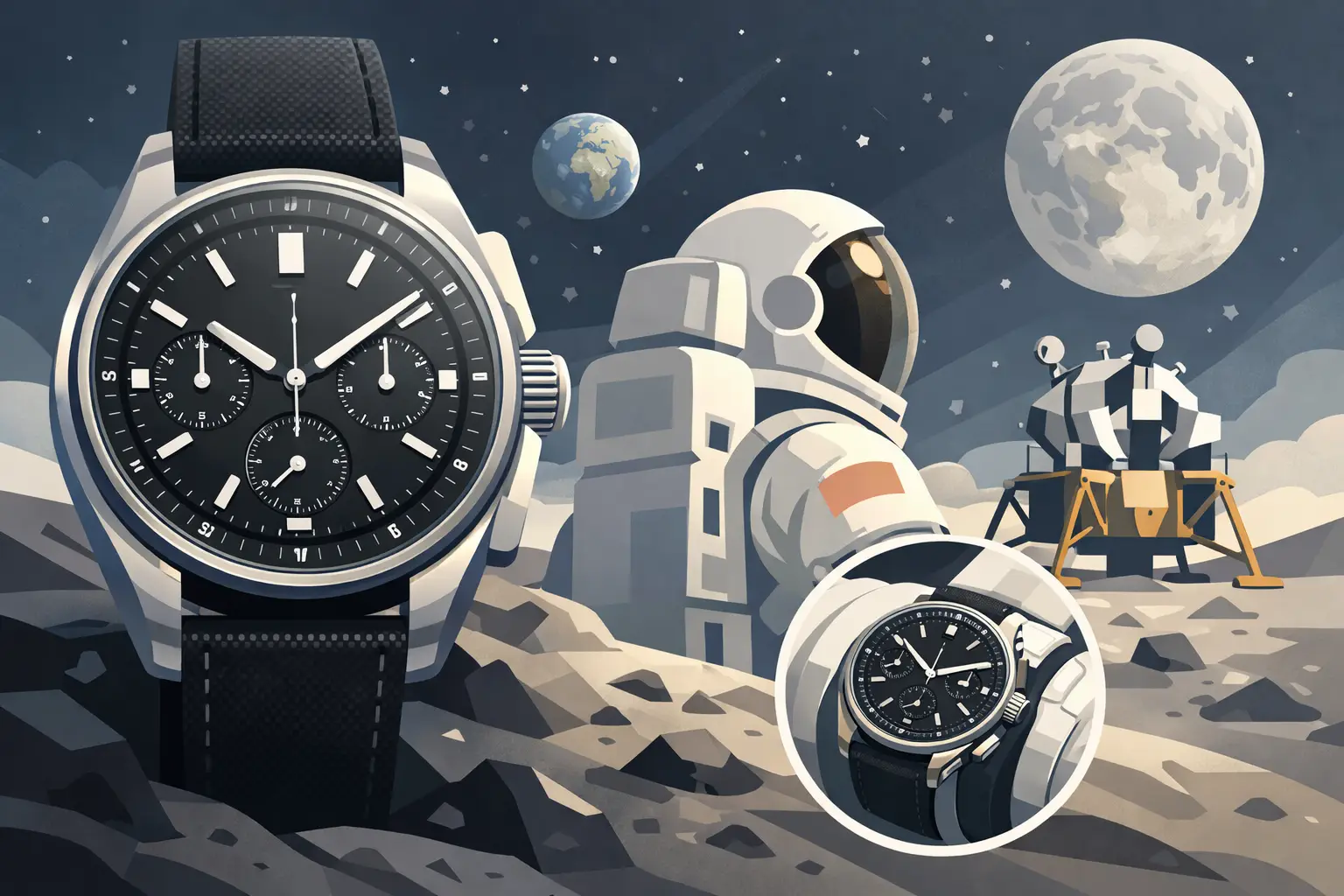
The Bulova Lunar Pilot is not merely a chronograph with a space-themed dial. It is a direct descendant of the watch worn on the moon by Apollo 15 commander Dave Scott, after his issued Omega failed during the mission. That story gives this Bulova Lunar Pilot review real substance: this is one of the few accessible watches that connects a modern buyer to genuine lunar history rather than borrowed astronaut imagery.
It also occupies a useful lane in the market. The Lunar Pilot offers serious heritage, distinctive styling, and remarkably precise quartz technology for less than many entry-level Swiss mechanical chronographs. Its main compromise is equally clear: it is a large watch with a highly specific look. For the right wrist and the right buyer, though, it has more character than its price suggests.
Bulova Lunar Pilot Review: The Case for It
The Lunar Pilot succeeds because Bulova did not try to turn it into a generic vintage reissue. The design stays close to the 1971 original, with an asymmetrical stainless-steel case, pump pushers, black tachymeter bezel, and a dial layout that feels purpose-built rather than decorative. At a glance, it carries the visual language of a mid-century instrument watch: all business, no polish for polish’s sake.
The black dial is crowded in the best possible way. Its three white subdials, bright markers, outer timing scale, and crisp white hands create strong contrast. Reading elapsed time is easy, while the applied details give the watch more depth than a flat, budget-focused quartz chronograph. The red chronograph seconds hand brings just enough color to prevent the dial from becoming too severe.
This is a watch for men who appreciate presence. It works especially well with denim, field jackets, knitwear, and casual tailoring, where its technical personality looks intentional. It can pair with a button-down at the office, but it is not the understated all-purpose chronograph you would choose for a conservative formal environment. A Lunar Pilot makes a statement about taste: you know the story, and you chose something less predictable than the usual luxury-signaling options.
The lunar connection is more than marketing
Plenty of watches reference space exploration. Few have a legitimate claim to the moon. During Apollo 15, Dave Scott used his personal Bulova chronograph to time an important lunar surface activity. The original later became a highly valuable piece of watch history, and Bulova’s modern Lunar Pilot carries that legacy in a format ordinary enthusiasts can actually buy and wear.
That provenance matters because it gives the model lasting appeal. You are not buying a novelty commemorative piece that will feel dated after a season. You are buying an affordable chronograph linked to one of the defining achievements of the twentieth century. For a first serious watch or a thoughtful gift for a history-minded collector, that emotional value is difficult to match.
The High-Performance Quartz Movement
The standout technical feature is Bulova’s proprietary high-performance quartz movement. It vibrates at 262 kHz, substantially faster than conventional quartz movements, which typically operate at 32 kHz. In practical terms, that frequency supports excellent accuracy and allows the chronograph seconds hand to sweep more smoothly than the one-second jumps most people associate with quartz watches.
This movement changes the ownership experience. There is no need to wind the watch, no concern about setting it aside for a week, and no expensive mechanical service schedule hovering in the background. Press the upper pusher and the chronograph starts instantly. The central seconds hand moves with a refined glide, while the subdials handle elapsed minutes and hours with satisfying clarity.
Mechanical-watch purists may still prefer the tactile charm of a hand-wound or automatic chronograph. That is fair. A mechanical movement offers a different kind of romance, especially when you can see the gears and levers at work through a display caseback. But at this price level, a mechanical chronograph generally asks for compromises in finishing, thickness, reliability, or long-term maintenance. Bulova’s quartz approach is the sensible choice for a buyer who wants heritage and function without treating his watch like a fragile hobby.
Size and Wearability: The Key Consideration
Here is the issue to settle before buying: the traditional Lunar Pilot is large. Its case measures roughly 45 mm across, with a long lug-to-lug profile that gives it substantial wrist coverage. The asymmetrical case shape helps the pushers sit comfortably, but it does not make the watch small.
On a wrist around 7 inches or larger, the original-size Lunar Pilot can look balanced, especially with casual clothes. Its slimness relative to many modern chronographs also helps it wear better than the diameter suggests. Still, men with smaller wrists, or anyone who prefers a discreet watch, may find it visually dominant.
Bulova has answered that concern with smaller Lunar Pilot variants around 43.5 mm. For many buyers, this is the more versatile choice. It retains the essential design and movement while sitting more naturally under a cuff and looking less like a deliberate oversized statement. If you are shopping online and uncertain about fit, measure a watch you already enjoy rather than relying on case diameter alone. Lug-to-lug length and your personal style matter just as much.
The bracelet-equipped versions give the Lunar Pilot a more substantial, everyday feel, while a leather strap softens its military-instrument character. A strap change can transform it. On black leather, it becomes more vintage and polished; on a gray or olive fabric strap, it leans harder into its lunar-tool-watch roots.
Dial Details, Crystal, and Everyday Use
Bulova equips the Lunar Pilot with a sapphire crystal, a meaningful advantage at its price point. Sapphire is highly resistant to scratches, which matters on a watch designed to be worn rather than locked away for special occasions. The polished case surfaces and signed crown also give it a level of fit and finish that feels appropriately premium.
The chronograph is practical for everyday timing, whether you are tracking a parking meter, a workout interval, or a presentation. The tachymeter is more of a heritage detail than a feature most owners will use regularly, but it belongs on the watch and reinforces its professional-tool appearance.
Water resistance is adequate for daily life but should not be mistaken for dive-watch capability. Rain, handwashing, and the occasional splash are one thing. Swimming, snorkeling, or a weekend by the pool call for a watch with more confidence around water. This is a chronograph first, not a sports watch built for the deep end.
Is the Lunar Pilot Good Value?
For men comparing watches in the mid-hundreds, the Lunar Pilot offers a rare combination: authentic history, a proprietary movement, sapphire crystal, strong finishing, and a recognizable design that does not imitate a Rolex, Omega, or TAG Heuer. That makes it an excellent value, particularly for buyers who care more about personality and everyday dependability than mechanical prestige.
Its closest alternatives depend on what you want most. A Seiko Speedtimer may appeal if you prefer a more compact, contemporary Japanese chronograph. A mechanical hand-wound chronograph from a heritage-focused brand may be the better emotional purchase if seeing a movement through the caseback is central to your enjoyment. And if the goal is a sleek office watch, a simpler three-hand Swiss model could serve your wardrobe better.
But those watches do not offer this specific package. The Lunar Pilot is for the buyer who wants a conversation-starting chronograph with real credibility, not a watch chosen because it is the safest answer.
Who Should Buy the Bulova Lunar Pilot?
Buy the Lunar Pilot if you want a historically meaningful chronograph that can handle regular wear with minimal fuss. It is particularly compelling for space enthusiasts, first-time collectors, and experienced watch owners who want a dependable grab-and-go piece with more soul than a standard quartz watch.
Pass if your wrist is small and the 43.5 mm version still feels too prominent, if you strongly prefer automatic movements, or if you need serious water resistance. The Lunar Pilot is not trying to satisfy every watch buyer. Its appeal comes from being specific.
The best reason to choose it is not simply that it went to the moon. It is that the watch still feels purposeful back on Earth: precise, distinctive, and confident enough to become the piece you reach for when an ordinary day deserves a little more character.