
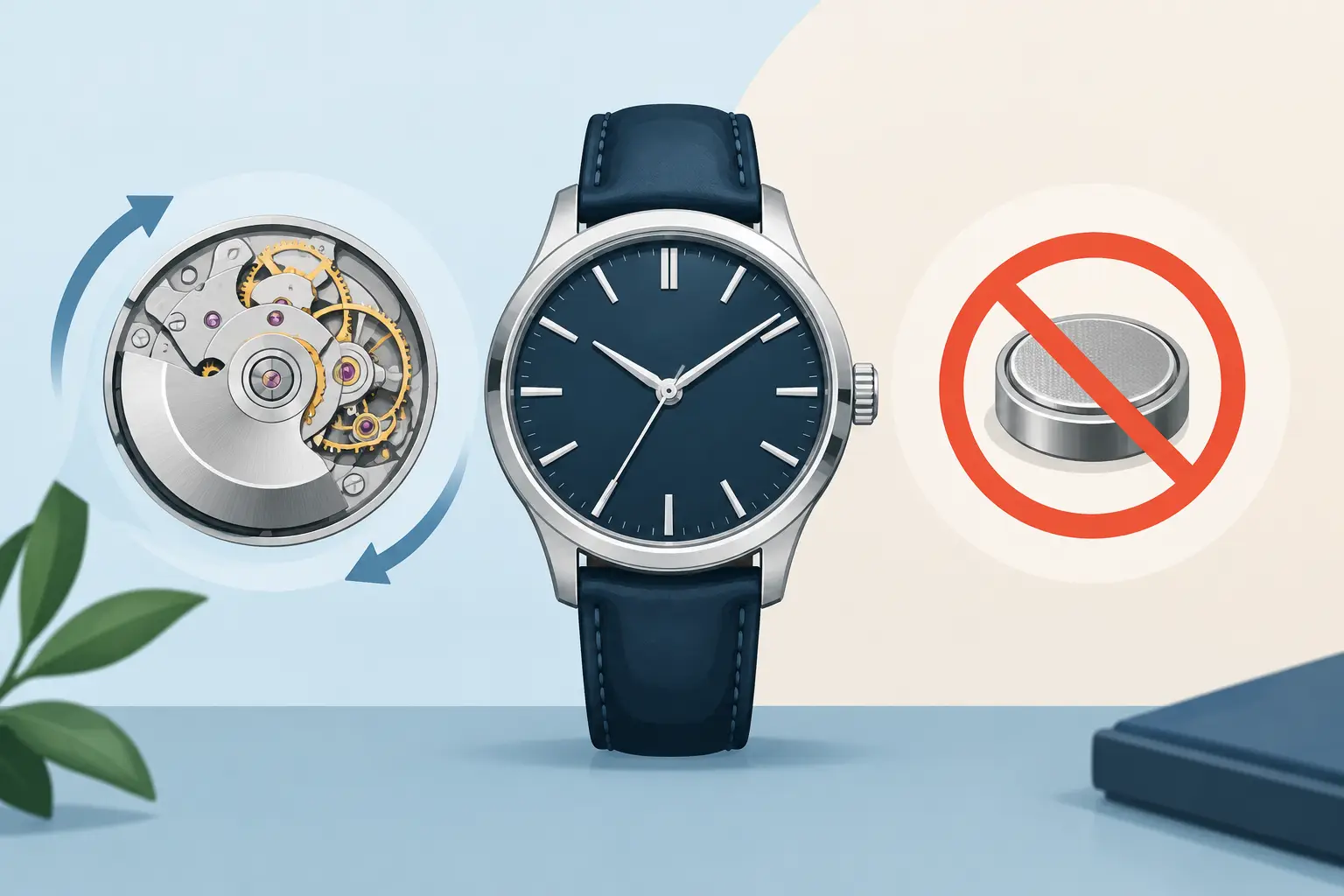
A watch that powers itself from the motion of your wrist has a certain appeal. It feels more considered than a disposable accessory – a small piece of engineering with gears, springs, and a heartbeat you can see through the caseback. But do automatic watches need batteries? In the traditional sense, no. A true automatic watch runs entirely on mechanical energy, not a battery.
That simple answer matters when you are choosing your first serious watch. It affects how the watch wears, how it is maintained, what it costs over time, and whether it suits your daily routine. Automatic ownership is rewarding, but it comes with a few realities that a basic quartz watch does not.
Do Automatic Watches Need Batteries to Run?
No. An automatic watch uses a mechanical movement powered by a mainspring. As you move your arm throughout the day, a weighted rotor inside the case swings back and forth. That motion winds the mainspring, storing energy that is gradually released to drive the gears and hands.
There is no battery, circuit board, or electronic pulse regulating the time. Instead, the watch relies on an escapement and balance wheel – the traditional mechanism that gives a mechanical watch its distinctive, smooth-looking seconds-hand sweep.
This is why automatic watches are also called self-winding watches. They wind themselves while worn, although most can also be wound manually through the crown. That is useful after the watch has been sitting in a drawer or watch box for a few days.
An automatic movement is not automatically better for every man. Quartz remains the practical choice for grab-and-go accuracy and minimal upkeep. But for someone who values craftsmanship, heritage, and the ritual of wearing a watch, an automatic offers an experience a battery-powered movement cannot quite replicate.
How Long Will an Automatic Watch Run Off Your Wrist?
An automatic watch keeps running only while it has stored energy in its mainspring. Most entry-level and mid-range automatic movements offer a power reserve of roughly 38 to 42 hours. Take off the watch on Friday night, and it may have stopped by Sunday morning.
Many modern watches now offer power reserves of 70 hours or more. That is especially convenient if you rotate between an everyday field watch, a dress watch for the office, and a sportier weekend piece. With a longer reserve, you can skip a day or two without having to reset the time and date.
If the watch stops, nothing is wrong. Turn the crown 20 to 40 times, set the time, and wear it normally. The rotor will take over once it is on your wrist. Avoid shaking the watch aggressively to start it. A few gentle movements are fine, but hand-winding is more controlled and puts less unnecessary stress on the mechanism.
Wearing It Every Day vs. Using a Watch Winder
Daily wear is the easiest way to keep an automatic watch running. For many owners, that routine is part of the attraction. Put it on in the morning, and the watch is ready for the day.
A watch winder can keep an automatic running while it is not being worn, but it is a convenience rather than a necessity. It makes the most sense for watches with complicated calendars, annual calendars, or moonphase displays that take time to reset. For a straightforward three-hand automatic, letting it stop is perfectly normal.
Be selective with inexpensive winders. A poorly configured unit can run too fast, turn in the wrong direction, or create needless wear over time. Most watches do not need constant motion to remain healthy.
Why Some Watches Cause Battery Confusion
The word automatic is sometimes used loosely in watch shopping, especially in marketplace listings. Before buying, check the movement type rather than relying on a headline or product photo.
A quartz watch runs on a battery and uses a crystal oscillator for excellent accuracy. Its seconds hand usually ticks once per second. Automatic watches are mechanical and self-winding. Manual-wind watches are mechanical too, but require regular winding by hand.
Then there are hybrid categories. Solar watches use light to charge a power cell or rechargeable battery. Kinetic watches convert wrist movement into electrical energy that charges a storage cell. Some smartwatches have analog hands with electronic functions underneath. None of these are traditional automatic watches, even if they use motion or light to reduce battery changes.
The distinction is more than technical. A Seiko automatic, a Swiss-made dress watch, or a heritage-inspired diver is bought partly for the movement inside it. The mechanical caliber gives the watch personality, and sometimes a visible caseback turns that engineering into part of its style.
Can an Automatic Watch Have a Battery Anywhere Inside?
A conventional automatic watch does not need a battery to operate its timekeeping movement. However, a few specialty models combine mechanical and electronic features. An alarm, digital display, sensor, or connected function may have a separate power source even if the main hands are driven mechanically.
That is uncommon in the classic automatic watches most men compare from brands such as Seiko, Hamilton, Tissot, Orient, Longines, and Rolex. If a model is described simply as an automatic, assume its central timekeeping function is mechanical unless the specifications say otherwise.
A useful shopping habit is to look for the words “automatic mechanical movement” or “self-winding mechanical movement.” If the listing instead says quartz, solar, kinetic, Bluetooth, or rechargeable, it belongs to a different category.
The Trade-Off: Mechanical Charm vs. Quartz Convenience
Skipping battery replacement does not mean an automatic watch is maintenance-free. Mechanical movements are made of tiny interacting components and lubricants that age over time. Most quality automatic watches eventually need professional service, commonly every five to 10 years depending on the brand, use, and movement.
Service can cost more than several battery changes on a quartz watch. Automatic watches are also less accurate. A well-regulated mechanical watch may gain or lose a few seconds per day, while a good quartz watch may be off by only seconds per month.
For many buyers, those are not drawbacks so much as the price of entry into mechanical watch ownership. The watch becomes an object worth keeping rather than replacing. A properly maintained automatic can last for decades and, in some cases, become a piece you hand down.
Still, lifestyle should lead the decision. If you need exact time for travel, shift work, training, or a packed schedule, quartz is hard to beat. If you enjoy the tactile process of setting a watch, appreciate traditional craftsmanship, and want a stronger sense of connection to what you wear, automatic is the more compelling choice.
How to Keep an Automatic Watch Performing Well
Treat an automatic watch like a durable precision instrument, not fragile jewelry. Wear it regularly or wind it before use. Keep it away from strong magnets, which can affect timekeeping, and follow the water-resistance rating rather than assuming every metal watch is ready for swimming.
If your watch has a date complication, avoid changing the date around 9 p.m. to 3 a.m. On many movements, the date gears are already engaging during those hours. Set the time away from that window first, then adjust the date.
Finally, do not judge an automatic by quartz standards. A modest variation in daily accuracy is normal. What matters is whether the watch stays reasonably consistent. If it suddenly starts gaining or losing minutes, stops despite being worn, or develops condensation under the crystal, it is time for a watchmaker to inspect it.
Is a Battery-Free Watch Right for You?
An automatic watch is ideal for the man who sees a watch as more than a time display. It brings craftsmanship to an everyday object, whether you choose a versatile steel sports watch, a lean dress piece under a cuff, or a rugged diver built for weekends away.
You will not need to schedule routine battery replacements. You will need to accept occasional resetting, periodic service, and slightly less clinical accuracy. That exchange is exactly what gives an automatic watch its enduring allure: it does not merely tell time – it keeps time through motion, mechanics, and the life you put into it.