
A Seiko watch is more than just an instrument for telling time; it’s a piece of craftsmanship, a companion on your daily journey, and often, a keeper of personal stories. When it stops ticking, it can feel like losing a trusted friend. The good news is that most issues can be resolved with expert care. This guide will help you learn your official and independent repair options, understand potential costs, and decide the best way to get your cherished Seiko watch ticking again.
When Does Your Seiko Watch Need Professional Repair?
First, it’s essential to identify the problem with your timepiece. While some issues have surprisingly simple fixes, others require the skilled hands of a professional watchmaker. Recognizing the signs of a serious problem can save you significant time and money, ensuring your watch gets the attention it deserves without unnecessary hassle.
Common Seiko Problems You Might Encounter
If you notice any of these classic symptoms, it’s likely time to seek out a repair service. Addressing them promptly can prevent further damage and more costly repairs down the line.
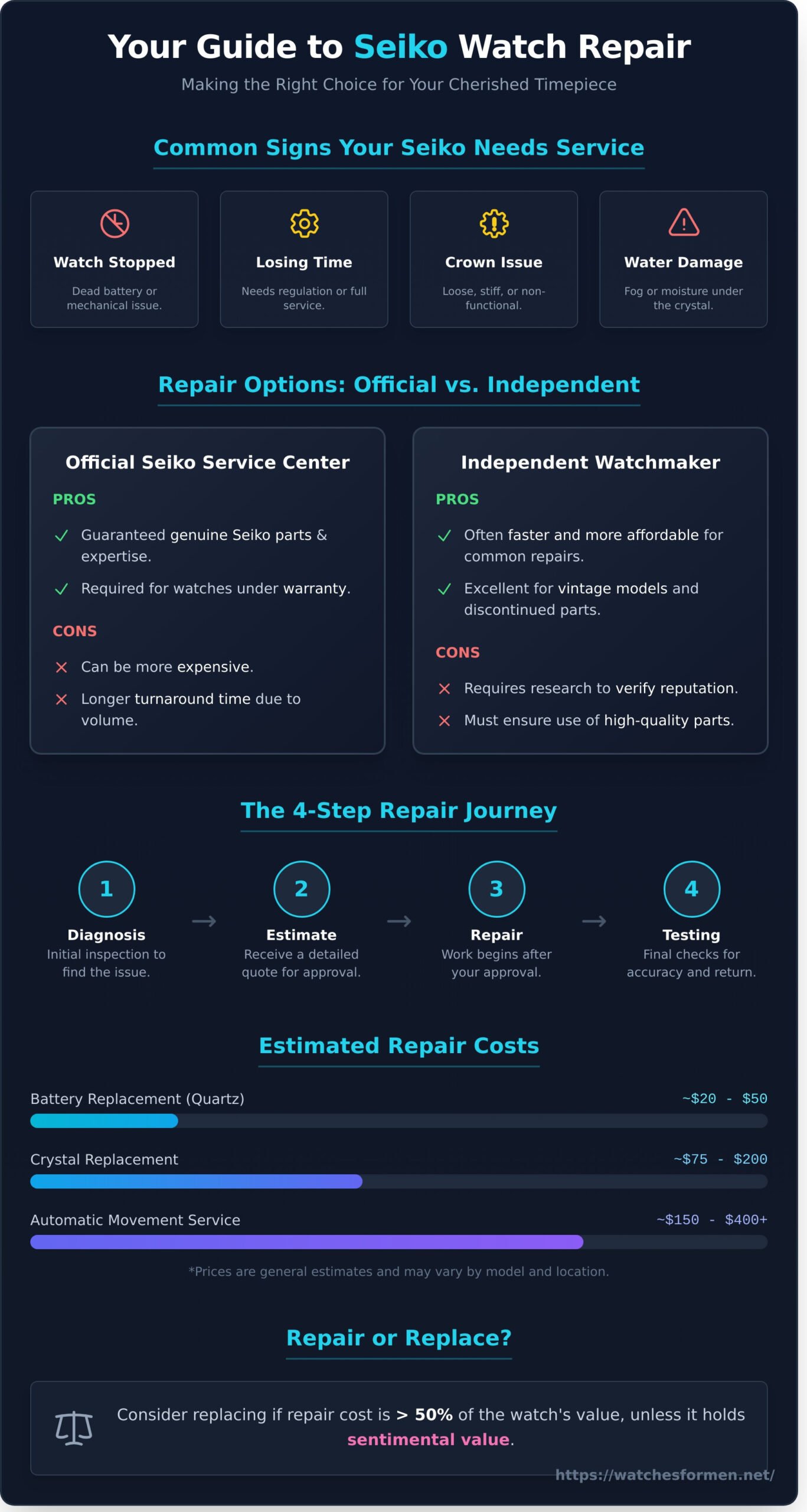
- Watch stopped running: This could be a dead battery in a quartz model or a more complex mechanical issue in an automatic watch.
- Losing or gaining significant time: A well-maintained Seiko should be accurate. If it’s suddenly off by several minutes a day, it needs regulation or servicing.
- The crown is loose, stiff, or won’t set the time: The crown is essential for setting your watch. Any issues with its function point to an internal problem.
- Water damage or condensation under the crystal: Moisture is the enemy of a watch movement. Fogging under the glass is a clear sign that the seals have failed and immediate action is needed.
See also The Best Affordable Dress Watches: Timeless Elegance on a Budget
Simple DIY Checks vs. When to See a Professional
While the allure of a quick fix is tempting, it’s crucial to know your limits. A wrong move can cause irreparable damage, especially to the delicate movement of an automatic watch.
- DIY: Replacing a battery in a simple, non-dive quartz model is often straightforward if you have the right tools and follow instructions carefully.
- Professional: You should always consult a professional for anything involving opening an automatic watch, as its intricate mechanics are easily damaged.
- Professional: A scratched or cracked crystal replacement requires special tools for a proper, water-resistant seal.
- If in doubt, always seek an expert’s opinion. A brief consultation can prevent a minor issue from becoming a major one.
Your Repair Options: Official Seiko Service vs. Independent Watchmaker
Once you’ve determined your Seiko needs professional help, you have two main paths to get it fixed. Each route has distinct advantages depending on your watch’s age, its monetary or sentimental value, and whether it is still under warranty. Making an informed choice is key to a successful repair.
Option 1: The Official Seiko Service Center
Sending your watch directly to Seiko ensures it receives factory-level care. This is the preferred option for newer or high-value timepieces where authenticity and original parts are paramount.
- Pros: You are guaranteed to receive genuine Seiko parts installed by technicians trained specifically on their movements.
- Pros: This is the ideal, and often required, choice for watches that are still covered by the manufacturer’s warranty.
- Cons: The service can sometimes be more expensive and have a longer turnaround time due to shipping and high volume.
- How the official process generally works: You’ll typically fill out a form online, ship your watch to the service center, and await an estimate for approval before any work begins.
Option 2: A Trusted Independent Watchmaker
A local, reputable watchmaker can offer a more personal and often quicker service. This is an excellent path, especially for vintage pieces or standard maintenance outside of the warranty period.
- Pros: An independent watchmaker is often faster and can be more affordable for common repairs and servicing.
- Pros: This is often the best choice for vintage or older models, as experienced watchmakers may have better access to discontinued parts or the skills to fabricate them.
- Cons: You must do your research to verify their reputation and ensure they use high-quality, genuine parts.
- Tips for finding a qualified local professional: Look for certifications (like AWCI), check online reviews, and ask other watch enthusiasts for recommendations.
See also The Definitive Guide to Men’s Wrist Watch Styles
Understanding the Repair Process and Potential Costs
Knowing what to expect from the repair process can demystify the experience and help you manage your expectations. Costs can vary widely based on the specific Seiko model, the complexity of its movement, and the extent of the damage. In some cases, you might find that investing in a new watch is the more logical choice.
What to Expect: The Typical Repair Journey
Whether you choose an official center or a local expert, the process follows a standard, professional sequence designed to protect both you and the watchmaker.
- Step 1: Initial evaluation and diagnosis. The watchmaker will inspect your timepiece to determine the exact cause of the problem.
- Step 2: Receiving a detailed cost estimate. You will be provided with a quote outlining the necessary work and the total cost for parts and labor.
- Step 3: Approving the work and the repair phase. No work will begin until you give your approval. Once you do, the watchmaker will service your watch.
- Step 4: Final testing and receiving your watch. After the repair, the watch is tested for accuracy and water resistance before being returned to you.
Estimated Costs for Common Seiko Repairs
While every repair is unique, these price ranges can give you a general idea of what to expect for some of the most common services. Always get a specific quote for your watch.
- Basic battery replacement for a quartz watch: ~$20 – $50
- Full service for an automatic movement (e.g., Seiko 5, SKX): ~$150 – $400+
- Crystal replacement for common models: ~$75 – $200
- Note: These are general estimates for reference only. Prices vary based on your location, the watchmaker, and the specific model.
Repair vs. Replace: When to Consider a New Seiko
There comes a point where the cost of repair may approach or exceed the value of the watch itself. A good rule of thumb is to question a repair that costs more than 50-60% of the watch’s replacement value, unless it holds significant sentimental value. If a repair seems too costly, it might be the perfect opportunity to explore a new timepiece. Modern classics like the endlessly versatile Seiko 5 Sports SRPD55K1 or the iconic Seiko Prospex “Turtle” SRPE93 offer incredible craftsmanship and value. Of course, the story behind your current watch is priceless, so repairing it often preserves more than just a timepiece. Ultimately, the choice is a balance between practicality and passion. If you decide it’s time for something new, you can explore our guides to the latest Seiko models.


See also A Gentleman’s Guide to the Wrist Watch for Men
Frequently Asked Questions
Here are answers to some of the most common questions about Seiko watch maintenance and repair.
How often does a Seiko automatic watch need servicing?
It is generally recommended to have a Seiko automatic watch serviced every 5 to 7 years. Regular servicing involves cleaning, lubricating, and adjusting the movement to ensure it runs accurately and to prevent premature wear on its components.
Is it worth repairing an old Seiko 5 watch?
Often, yes. While the monetary value of many older Seiko 5 models is modest, their durability and sentimental value can make them well worth repairing. A standard service can bring a beloved family heirloom back to life for many more years of enjoyment. You can learn more in our detailed Seiko 5 Sports Watch Review.
Will Seiko repair a vintage watch?
Seiko will service older watches as long as they still have the necessary parts in stock. For very old or rare vintage models, they may no longer have the components, which is when a skilled independent watchmaker becomes the best option.
How long does a typical Seiko watch repair take?
The timeline can vary greatly. A simple battery change might be done while you wait. A full movement service at an official center could take anywhere from 4 to 8 weeks, depending on their backlog and whether parts need to be ordered.
Can I get a replacement for my Seiko watch band?
Yes, absolutely. Official Seiko bands and bracelets can be ordered through authorized dealers or the service center. There is also a vast aftermarket of high-quality straps available online, allowing you to customize the look of your watch.
Whether you’re reviving a family heirloom or maintaining a modern tool watch, taking proper care of your Seiko ensures it will continue to serve you well for years to come. If the time has come to find a new companion for your wrist, let our expert guides help you make the perfect choice. Discover your next timepiece in our Seiko Watch Buying Guides and explore the world of affordable elegance and timeless craftsmanship.