
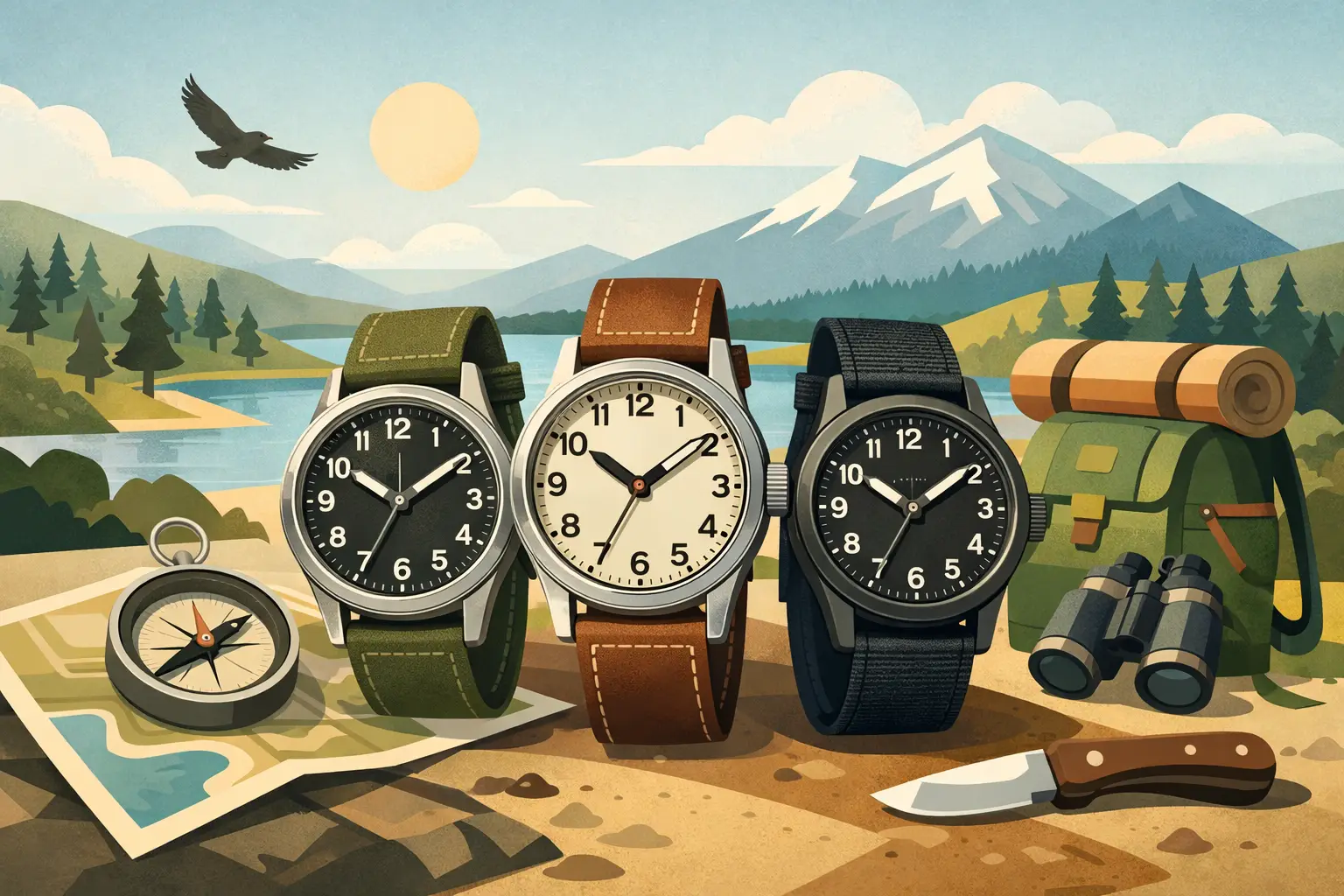
A good field watch does not need a boardroom introduction. It earns its place the moment you glance down in poor light, catch it on a jacket cuff, or wear it through a long Saturday without giving it a second thought. That is the enduring appeal of field watches: they are straightforward, capable, and stylish enough to look intentional rather than purely utilitarian.
For men building a versatile watch collection, the field watch is often the smartest first serious purchase. It offers more character than a basic fashion watch, fewer formal rules than a dress watch, and far more everyday range than a bulky dive or tactical model. The best examples bring military-inspired purpose into a modern wardrobe without looking like costume gear.
What Defines a Field Watch?
The field watch began as a practical military instrument. Soldiers needed a watch that was legible at a glance, durable under harsh conditions, and compact enough to wear comfortably for extended periods. The category has evolved, but those priorities remain visible in its design language.
Most field watches feature a clean, high-contrast dial, prominent Arabic numerals, luminous hands and markers, and a straightforward three-hand layout. A date window is common, though purists often prefer the balanced symmetry of a no-date dial. Cases are usually stainless steel, with brushed surfaces that hide small scratches better than high-polish finishes.
The key word is restraint. A field watch rarely depends on a complex bezel, multiple subdials, or flashy finishing to make its point. Its appeal comes from proportion, legibility, and an honest sense of purpose. That simplicity also makes it remarkably easy to wear with denim, chinos, knitwear, work shirts, and casual tailoring.
Why Field Watches Work So Well as Daily Watches
There are more dramatic watches available, but few are as adaptable. A 38mm or 40mm field watch sits naturally on most wrists and slips beneath a shirt cuff without the bulk of a large sports watch. On a canvas strap, it feels relaxed and outdoorsy. On brown leather, it becomes warmer and more refined. Switch to a steel bracelet, and the same watch can hold its own in a business-casual office.
That versatility matters if you want one watch to handle most of your week. A field watch does not announce itself before you do. Instead, it supports a well-considered look with quiet confidence.
It is also a category with exceptional value. Entry-level names such as Timex, Casio, Seiko, Citizen, and Bertucci offer credible designs at accessible prices. Step up to Hamilton, and you enter one of the most recognizable names in the genre, with Swiss-made mechanical options and direct military heritage. At higher price points, brands such as Longines, Tudor, and IWC reinterpret the field-watch formula with finer materials, stronger movements, and more elevated finishing.
Choosing the Right Field Watch Size
A field watch should look purposeful, not oversized. Because its dial is designed for fast reading, it can appear visually larger than its case measurement suggests. This is why a 38mm model is often the sweet spot for the category, even for men accustomed to larger watches.
For smaller wrists, 36mm to 38mm usually delivers the most classic fit. Men with average wrists can comfortably wear 38mm to 40mm, while 41mm and above works best if the case remains relatively thin and the lug-to-lug measurement is controlled. The distance from one lug tip to the other is often more important than diameter. A 40mm watch with long, straight lugs may wear larger than a 42mm watch with compact, curved lugs.
Case thickness deserves equal attention. A slim field watch around 10mm to 12mm feels more versatile and traditionally proportioned. Thicker cases are not automatically a drawback, especially on automatic models with greater water resistance, but they can shift the look from classic military-inspired style toward modern tool-watch territory.
Quartz, Automatic, or Hand-Wound?
Movement choice is where your habits should lead the decision.
Quartz field watches are the practical choice for men who want accuracy, low maintenance, and grab-and-go convenience. They are often thinner and less expensive than mechanical alternatives. A quartz Timex Expedition or Citizen military-style watch can be an excellent everyday companion, particularly if you rotate through several watches and do not want to reset the time each week.
Automatic field watches offer a more emotional ownership experience. Their mechanical movements are powered by wrist motion, and the sweeping seconds hand brings a little life to an otherwise understated design. They typically cost more and require periodic servicing, but many buyers appreciate the craftsmanship and connection to traditional watchmaking. The Hamilton Khaki Field Automatic is popular for exactly this reason: it feels authentic without becoming inaccessible.
Hand-wound models are the most romantic option. Winding your watch each morning can become a small ritual, and hand-wound movements allow for slimmer cases. The trade-off is obvious: if you forget to wind it, it stops. For enthusiasts, that is part of the charm. For someone buying a single everyday watch, quartz or automatic is usually the safer route.
Dial Legibility and Nighttime Readability
A field watch lives or dies by its dial. Look for strong contrast between the numerals, hands, and dial background. Black dials with white markings are classic, but white, cream, green, blue, and matte gray versions can be equally useful if the hands remain easy to distinguish.
Avoid overly busy designs. A 24-hour inner track is historically appropriate and can look great, but it should not make the primary hour markers difficult to read. Similarly, faux-aged lume can add vintage character, yet heavy cream coloring may limit a watch’s versatility if your style leans clean and modern.
Lume quality matters more than many first-time buyers realize. If you expect to wear the watch on evening walks, camping trips, travel days, or early commutes, choose a model with generously applied luminous material. Affordable watches may glow brightly at first but fade quickly. Better lume generally holds visibility longer, though no mechanical watch should replace a dedicated light source outdoors.
The Strap Changes the Entire Watch
A field watch is one of the easiest watches to personalize because it responds so well to different straps. The original military-style canvas or nylon strap remains a natural fit. It is light, comfortable, inexpensive to replace, and well suited to hot weather or active use. Olive green, khaki, black, and navy all reinforce the category’s heritage without feeling forced.
Leather makes a field watch more polished. A medium-brown, distressed leather strap pairs especially well with cream or black dials and works beautifully with boots, denim, and fall layers. Smooth dark brown leather is a stronger choice if you plan to wear the watch with an oxford shirt or sport coat.
Steel bracelets add weight and durability, but they can change the personality of the watch. On some models, a bracelet makes the design feel more premium and city-ready. On others, it can soften the rugged simplicity that made the watch attractive in the first place. If you are unsure, prioritize a watch with standard lug widths and quick-release straps. Flexibility is one of the category’s great advantages.
Durability: Know What You Actually Need
The military roots of field watches can make buyers assume every model is built for extreme conditions. That is not always true. Many contemporary field watches borrow the aesthetic while offering modest water resistance, mineral crystals, and decorative rather than hard-use specifications.
For a true everyday watch, 100 meters of water resistance is an excellent target. It covers rain, hand washing, swimming, and the occasional unplanned splash without worry. A 50-meter rating is sufficient for ordinary daily exposure, but it is not the best choice if you want to swim regularly.
Sapphire crystal is the premium option for scratch resistance, particularly if you are hard on your watches or wear one every day. Mineral crystal is common at lower prices and can be perfectly acceptable, though it marks more easily. Acrylic crystal scratches most readily, but it suits vintage-inspired models and can often be polished back into shape.
Do not confuse durability with excessive size. A watch does not need a 45mm case and a tactical-looking bezel to survive ordinary life. A well-made 38mm steel field watch with sapphire crystal, reliable water resistance, and a dependable movement is usually the more elegant long-term choice.
A Smart Budget for Your First Field Watch
Under $100, focus on quartz reliability, clear design, and comfort. Timex and Casio remain hard to beat, particularly for buyers who want a dependable casual watch without overthinking the purchase. At this level, accept that finishing, lume, and crystal quality may be basic.
From roughly $100 to $400, you will find stronger build quality, solar-powered options, better materials, and entry-level automatics from Seiko, Citizen, and Orient. This is a compelling range for a buyer who wants a watch that feels like a genuine upgrade.
Between $500 and $1,000, the field-watch category becomes especially strong. Hamilton is the natural benchmark, offering heritage, Swiss movements, and designs that have remained relevant for decades. Above that point, you are paying more for brand prestige, finishing, movement refinement, and design distinction rather than a dramatic leap in basic usefulness.
The best field watch is not necessarily the one with the deepest military backstory or the longest specification sheet. It is the one that looks right on your wrist, fits your routine, and still feels worth wearing when the occasion calls for nothing more complicated than a dependable watch with real character.