
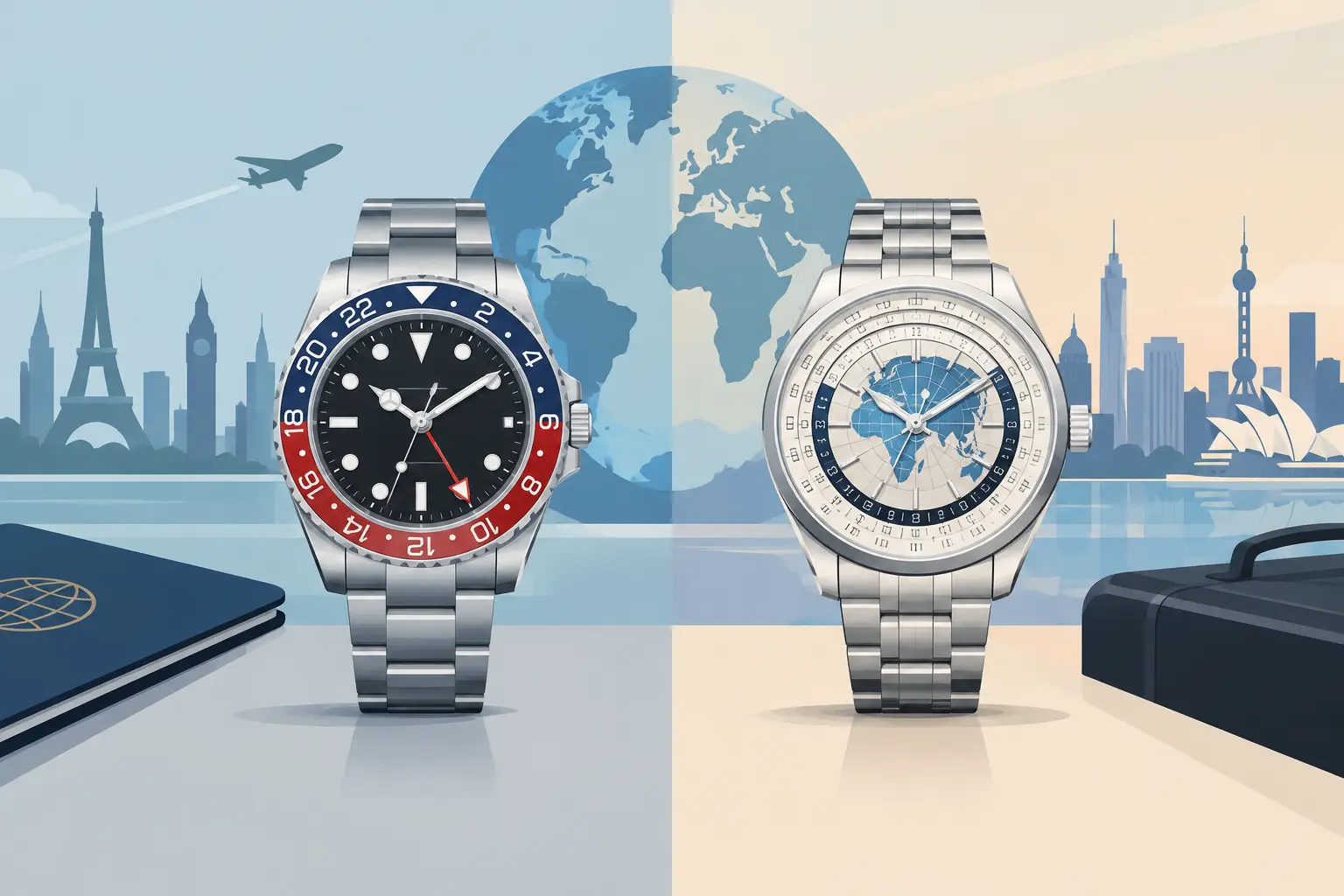
A red-eye flight lands in London, your phone is searching for service, and a client back in Chicago is about to start their day. That is where the GMT vs world time question stops being watch-collector trivia and becomes a matter of practical design. Both complications connect a wristwatch to life across borders, but they do it in distinctly different ways – and one may suit your routine, taste, and budget far better than the other.
For men choosing a first serious travel watch, the appeal is obvious. A second time zone adds purpose to a classic steel sports watch, a refined dress piece, or even a tough everyday tool watch. The difference lies in how much information you want at a glance and how much visual presence you want on the wrist.
GMT vs World Time: The Core Difference
A GMT watch is built to track a home time and a second time zone, usually through an extra hand that circles the dial once every 24 hours. That hand points to a 24-hour scale, either printed on the dial, placed on a rotating bezel, or both. If the regular hands show local time in New York, the GMT hand might show home time in Los Angeles, London, or wherever matters to you.
A world time watch displays the time in 24 major global reference cities at once, or at least makes them quickly readable. Its defining feature is the city ring around the edge of the dial, typically paired with a 24-hour ring. Set the correct city at 12 o’clock, and the watch shows the corresponding hour across the world. It is a more information-rich complication, designed for someone whose day genuinely touches several regions.
Think of a GMT as a focused conversation between two places. A world timer is the wider room.
What a GMT Watch Does Best
GMT watches earn their popularity because they are intuitive, versatile, and usually cleaner-looking than world timers. You do not need to study a ring of city abbreviations to read one. A quick look tells you local time, then the distinct GMT hand tells you the second zone.
For most buyers, that is enough. A consultant traveling between the US and Europe, a pilot, a military professional, or someone with family overseas often needs only local time and home time. A GMT gives that information without crowding the dial or turning a straightforward watch into a miniature dashboard.
There are two main types to understand. A caller GMT lets you independently adjust the 24-hour hand. This is useful when you stay in one place but regularly need to monitor another time zone, such as a manager coordinating with a London office. A traveler GMT lets you jump the local hour hand forward or backward independently. That is the more convenient format for frequent flyers because it lets you change local time after landing without stopping the watch.
This distinction matters more than the label on the dial. A watch can look like a classic travel companion yet be less convenient for actual travel if it uses a caller-style movement. Neither is inherently better. It depends on whether you travel yourself or mostly keep track of somebody else’s time.
A GMT also has enduring style credentials. The extra hand and 24-hour bezel bring a technical edge without making the watch feel overly specialized. A black-and-blue bezel can feel sharp with business-casual clothing; a vintage-inspired red-and-blue design adds heritage character to denim, knitwear, and weekend jackets. In a more restrained execution, a GMT can still slide beneath a cuff and work with a suit.
When World Time Makes More Sense
World time watches make their case through range and romance. A city ring that runs from New York and London to Dubai, Tokyo, and Sydney carries the visual language of international travel. Even when you are at your desk, it suggests a life organized around more than one horizon.
Practically, a world timer is ideal for people managing several international relationships. A founder with teams in California, Germany, and Singapore can scan the dial and see whether a call is reasonable. The same is true for finance professionals, global sales teams, remote workers, and collectors who enjoy following markets, sports, or family across continents.
The trade-off is legibility. More information requires more dial furniture. On a well-designed world timer, the city ring, 24-hour disc, and central hands feel balanced and elegant. On a smaller or less carefully executed watch, they can feel busy. If you value instant readability above all else, a GMT generally wins.
World time watches also tend to lean dressier, although there are sporty exceptions. Their symmetrical layouts, polished cases, and city names often pair beautifully with tailoring. They make a confident statement at a dinner, in a boardroom, or during a business trip where a standard three-hand watch might feel too quiet. For a man building a collection, a world timer can bring sophistication that a second dive-style GMT may not.
The Daylight Saving Time Catch
Neither complication is a perfect substitute for a phone. GMT is a time standard, while many places now use daylight saving time and some do not. A GMT hand set to London will remain accurate because the United Kingdom operates on a standard offset that shifts seasonally, but your relationship to another city may change when one location changes clocks before the other.
World timers have the same limitation, only on a broader scale. Their city rings reflect standard time-zone relationships, not every local daylight-saving rule. The watch remains a remarkably useful reference, but it cannot automatically account for political decisions, regional exceptions, or changing clock dates.
For that reason, choose these watches for orientation and elegance, not as an infallible global scheduling system. When timing a critical call, confirm the calendar. When stepping off a plane, your watch will still give you the satisfying, immediate sense of where you are and where home stands.
Choosing Between GMT and World Time
Start with the question your watch needs to answer most often. If it is “What time is it at home?” buy a GMT. If it is “What time is it in Tokyo, Paris, and Los Angeles right now?” a world timer has a real advantage.
Your personal style should carry equal weight. A GMT is usually the more adaptable one-watch choice. It can be rugged, understated, colorful, vintage-inspired, or luxurious, and it fits naturally into casual and professional wardrobes. It is also available at nearly every budget level, from affordable quartz and automatic options to prestigious Swiss models.
A world timer is more of a deliberate purchase. The complication rewards a buyer who enjoys the dial as much as the function. It often feels more elevated, more formal, and more collector-driven. That does not mean it needs to be expensive, but design quality matters. Look for crisp city printing, strong contrast between day and night hours, and a case size that leaves the dial readable rather than cramped.
Movement choice is worth considering too. A quartz world timer can be exceptionally accurate and convenient, particularly if you want a practical travel watch without a luxury-level price. A mechanical GMT or world timer delivers a different appeal: the pleasure of gears, finishing, and a complication working beneath the dial. For an enthusiast, that craftsmanship is part of the reason to own the watch in the first place.
A Better Way to Think About Travel Watches
The best travel watch is not necessarily the one that displays the most information. It is the one that makes your own life easier while looking right on your wrist. For many men, a GMT is the clear answer: useful, handsome, and uncomplicated. For others, the world time format better reflects a career, family, or curiosity that reaches across the map.
Choose the watch whose second glance means something to you. Whether it points home with one extra hand or maps the day from city to city, it should make time feel more personal, not more complicated.