
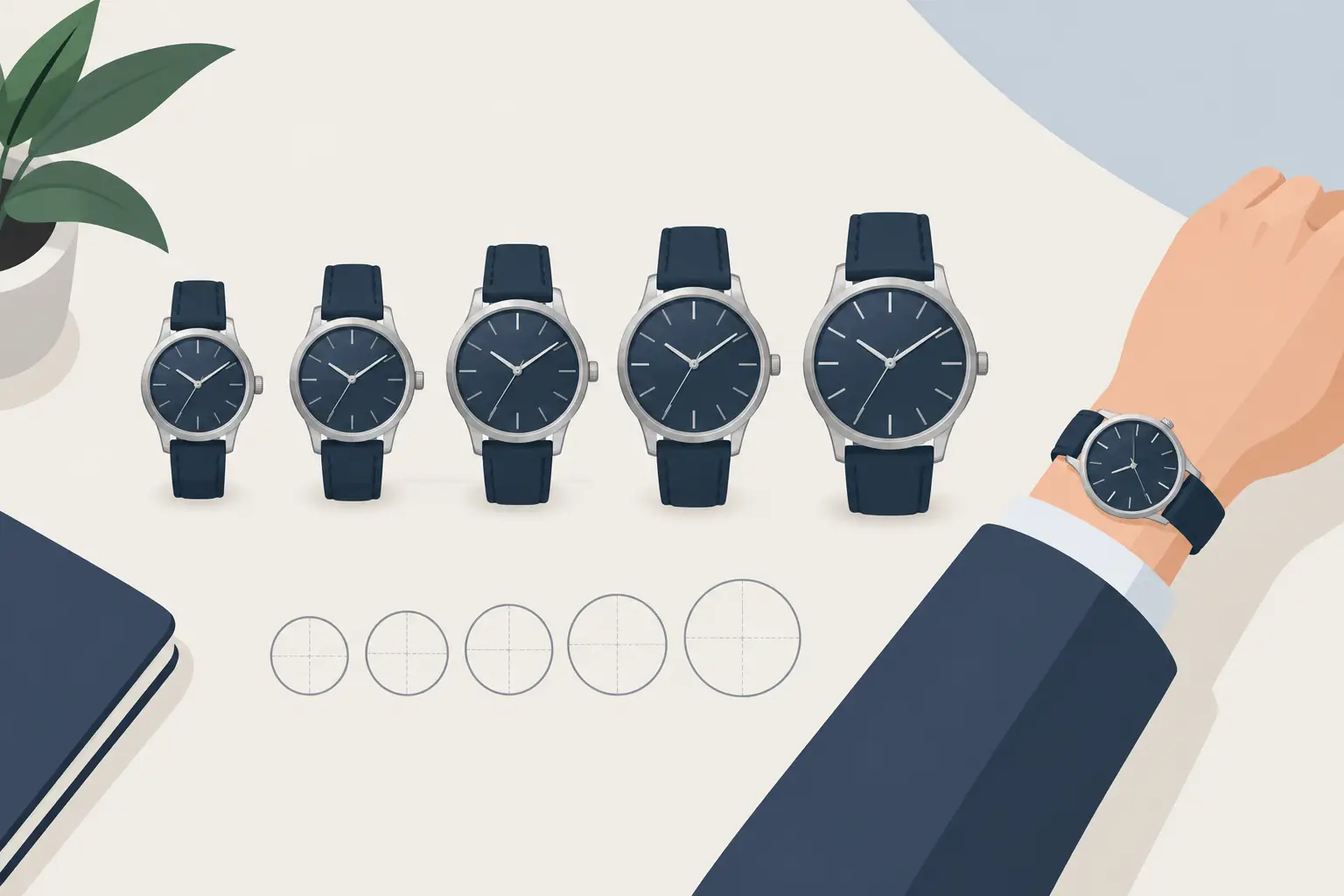
A 40mm watch can look quietly tailored on one man and oversized on another. That is why a useful watch case sizes guide starts with more than a single diameter number. The right watch should sit comfortably, suit the occasion, and feel proportional to your wrist and personal style.
For most men, case size is the fastest way to narrow a crowded field of watches. It shapes first impressions before anyone notices the movement, dial texture, or brand name. A refined 36mm dress watch and a 44mm dive watch can both be excellent choices, but they make very different statements.
Watch Case Sizes Guide: Start With the Measurements
Case diameter, measured in millimeters across the face excluding the crown, is the number most listings lead with. It is useful, but it does not tell the whole story. A 40mm chronograph often wears larger than a 40mm three-hand field watch because subdials, a wider bezel, and pushers give it more visual weight.
Lug-to-lug measurement is often the better predictor of fit. This is the distance from the tip of the upper lugs to the tip of the lower lugs. Ideally, the lugs should not extend beyond the edges of your wrist. A watch with a compact 46mm lug-to-lug can wear neatly even if its case diameter sounds substantial.
Case thickness matters just as much, especially for office wear. A 12mm automatic watch may be comfortable but struggle beneath a fitted dress shirt cuff. A slim 7mm to 10mm case has an understated elegance that works naturally with tailoring. Larger sports watches can be thicker by design, particularly dive watches with higher water resistance or chronographs with more complex movements.
Finally, look at the lug width and bracelet design. A broad 22mm bracelet adds presence, while a tapered 18mm or 20mm strap can make the same case appear more restrained. Integrated-bracelet watches tend to wear larger because the bracelet flows directly from the case instead of narrowing at conventional lugs.
Common Watch Sizes for Men
There is no universal ideal, but these ranges provide a reliable starting point when shopping online or comparing watches in person.
- 34mm to 36mm: Classic and compact. This range suits smaller wrists, vintage-inspired designs, and formal watches. It also appeals to men who prefer the poised proportions of older Rolex Oyster models, Cartier-style dress pieces, or traditional field watches.
- 37mm to 39mm: The versatile middle ground. These watches work for many wrist sizes and transition easily from jeans and an Oxford shirt to a blazer. A 38mm everyday watch is one of the safest first serious-watch purchases.
- 40mm to 42mm: Modern, confident, and broadly popular. This is a natural range for dive watches, GMTs, and contemporary sport watches. On an average or larger wrist, it offers strong presence without automatically looking excessive.
- 43mm to 45mm: Purpose-built and bold. You will often see these sizes in pilot watches, rugged chronographs, and professional dive models. They can look excellent on larger wrists, though thickness and lug length deserve close attention.
- 46mm and above: Statement territory. These watches are designed for maximum legibility or visual impact, not subtlety. Unless you have a very large wrist or specifically want an oversized sports-watch look, they can be difficult to wear daily.
These categories are guidelines, not rules. A slim 42mm watch with short lugs may fit better than a square 38mm model, while a dark dial and narrow bezel can make a watch appear larger than its stated diameter.
Match the Case to Your Wrist
The quickest method is to measure your wrist circumference with a flexible tape measure or a strip of paper. Measure where you normally wear the watch, just above the wrist bone. If you land around 5.5 to 6.5 inches, compact cases between 34mm and 38mm will usually look balanced. At 6.5 to 7.5 inches, 38mm to 42mm gives you the broadest choice. Wrists above 7.5 inches can often carry 42mm to 45mm comfortably.
Still, wrist shape changes the equation. A flat, broad wrist can accommodate a larger diameter well. A rounder or narrower wrist may make long lugs more noticeable, even at the same circumference. This is where lug-to-lug becomes essential.
A useful visual check is to photograph the watch from arm’s length rather than judging it only from inches away in a mirror. Watches often look larger to the wearer because they are viewed at close range. A photo shows how the piece reads in a natural social setting.
Do not buy a smaller watch just because it is called “classic,” or a bigger watch because current sports models favor scale. A watch is part of your presentation. It should look intentional, not like a trend wearing you.
Let the Watch Style Set the Scale
A dress watch earns its appeal through restraint. Cases between 36mm and 40mm, a slim profile, and a leather strap create the clean lines that work with business attire and formal events. A 38mm watch can look more luxurious than a larger model when the finishing, dial, and proportions are right.
Field watches are flexible by nature. Traditionally compact and highly legible, they often look best from 36mm to 40mm. This range preserves their practical heritage while still feeling substantial enough for casual weekend wear.
Dive watches are commonly 40mm to 42mm, though the category includes everything from vintage-style 36mm divers to imposing 44mm professional models. Their rotating bezels, thick cases, and steel bracelets create visual mass, so a 41mm diver may wear closer to a 43mm plain-dial watch.
Chronographs need room for subdials and pushers, making 40mm to 43mm common. If you want one for daily wear, prioritize a case under roughly 13mm thick and check whether the pushers dig into your wrist when you bend it.
Pilot watches traditionally favor generous dials and clear numerals, often ranging from 40mm to 44mm. Their size is part of their character, but a 39mm or 40mm pilot watch can be the more polished option if you plan to wear it with smart-casual clothing.
Why Dial Design Can Change the Fit
Two watches with identical measurements can have dramatically different wrist presence. A wide dial opening, thin bezel, light-colored dial, and large Arabic numerals make a case appear bigger. A dark dial, thick dive bezel, or busy chronograph layout can visually contain the watch, though its thickness may still make it feel substantial.
Square and rectangular watches require special caution with size charts. Their measurements are not directly comparable to round cases. A 30mm by 40mm rectangular dress watch may have the same elegant presence as a 36mm round watch, while a square 40mm case can look significantly larger than a 40mm circular model.
The bracelet or strap also influences how a watch sits. A supple leather strap can help a slightly large case curve around the wrist. A stiff steel bracelet can make it feel broader until it breaks in and is correctly sized. If you are between sizes, choosing a model on a strap may give you more flexibility.
Avoid These Common Sizing Mistakes
The most common mistake is treating diameter as the only specification that matters. Before committing, compare diameter, lug-to-lug, thickness, and lug width together. Brands do not always publish every measurement, but the more complete the dimensions, the easier it is to predict real-world fit.
Another mistake is sizing only for the mirror. A bold 44mm watch may look impressive when you are standing still, then feel top-heavy at a keyboard, under a jacket cuff, or during a long drive. Consider when and where you will actually wear it.
It is also worth separating confidence from sheer size. A well-proportioned 38mm Seiko, Hamilton, or Tudor-style sport watch can feel every bit as purposeful as a much larger piece. Presence comes from design, finishing, and how naturally the watch belongs on your wrist.
If you are buying a gift, a 38mm to 40mm round watch is usually the most forgiving choice for an adult man. It is versatile, modern without being extreme, and easy to dress up or down.
The best case size is the one you stop thinking about after you fasten the clasp. When it feels balanced, clears your cuff when needed, and reflects the way you want to present yourself, it has earned a place in your rotation.