
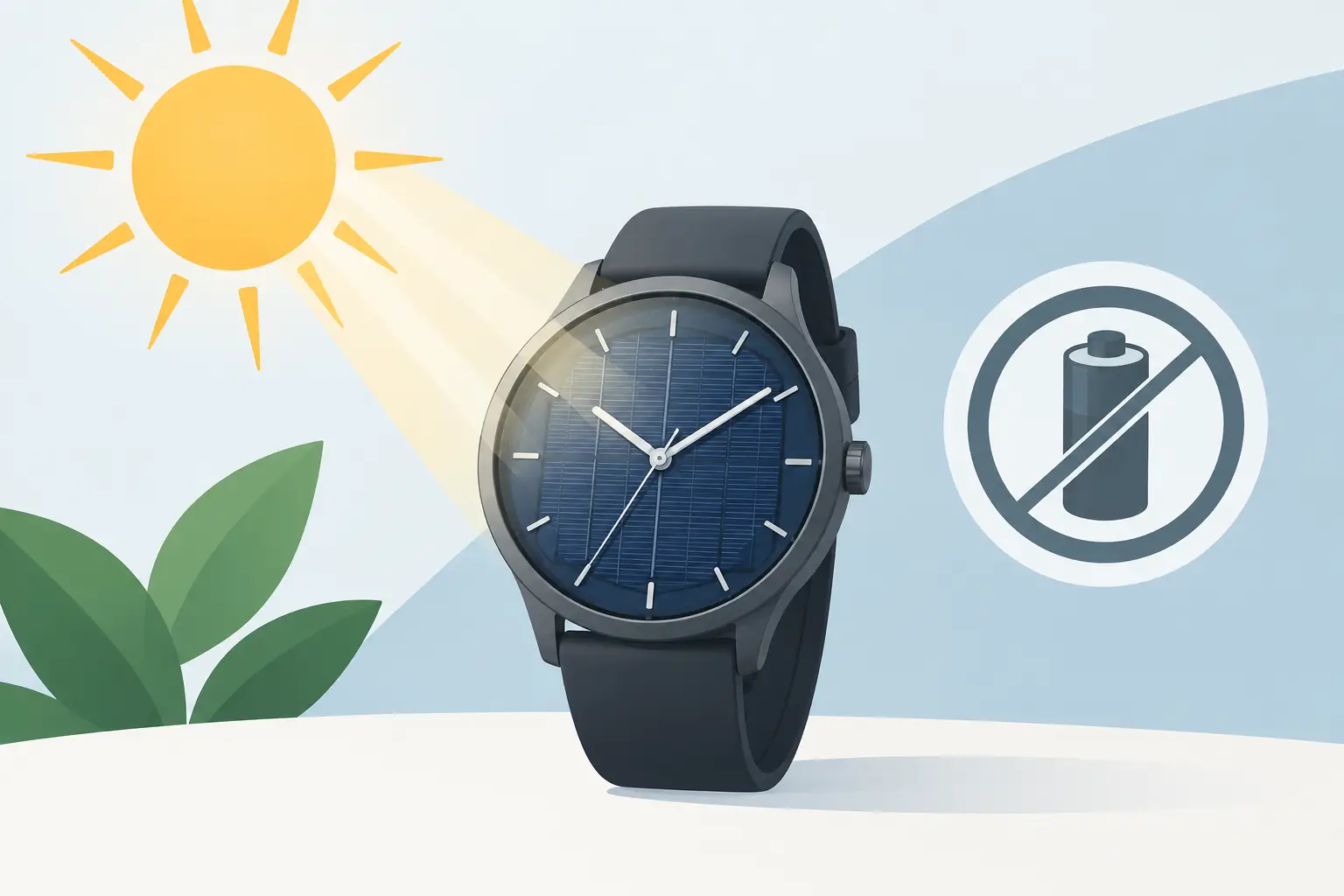
A solar watch can sit on your wrist for years, quietly keeping time without a trip to the jeweler. That convenience leads to a fair question: do solar watches need batteries? The short answer is yes, but not in the disposable, every-few-years sense most buyers associate with quartz watches.
Solar watches use light to charge an internal energy-storage component, usually a rechargeable cell. It is designed to last far longer than a conventional watch battery, often a decade or more with sensible use. For a man who wants the accuracy of quartz with less maintenance and no daily winding ritual, that makes solar one of the most practical movements available.
Do Solar Watches Need Batteries or Replacement Cells?
A solar watch needs a way to store the energy it collects, so it does contain a battery-like component. Depending on the brand and movement, this may be called a rechargeable cell, secondary battery, accumulator, or capacitor. Its job is to hold electrical power collected through the dial and release it steadily to run the movement.
The distinction matters. A standard quartz watch uses a disposable battery that gradually drains and is normally replaced every one to three years. A solar watch recharges its cell repeatedly whenever it receives light. You do not remove it, charge it with a cable, or routinely replace it on a fixed schedule.
That does not mean a solar watch is maintenance-free forever. Rechargeable cells have a finite life. After many years of charging and discharging, the cell may no longer hold enough reserve power, and a watchmaker can replace it with the correct part. Still, the ownership experience is very different from buying a fresh coin-cell battery every couple of years.
How a Solar Watch Actually Charges
The dial is more than a design detail. Beneath it sits a photovoltaic panel that converts light into electricity. The panel can gather energy from direct sunlight, daylight, and many indoor light sources. The electricity is then stored in the rechargeable cell and used to power the quartz movement.
Sunlight charges a watch much faster than office lighting. A few hours outside can deliver meaningful power, while dim indoor exposure may only maintain a well-charged watch rather than replenish a depleted one. This is why a solar model can be an excellent everyday watch but may need occasional attention if it spends months in a dark drawer.
The best solar designs make this technology almost invisible. The watch still offers the clean dial, polished case, and dependable precision a modern wearer expects. In sportier pieces, solar power is especially useful because energy-hungry functions such as alarms, chronographs, world time, GPS synchronization, and illumination can otherwise shorten battery life dramatically.
What Happens When It Runs Out of Charge?
When a solar watch runs low, it may continue running with reduced functionality, move its seconds hand in larger jumps, or stop entirely. Many models use a low-charge indicator, commonly a seconds hand that advances every two seconds instead of every second. That is not necessarily a mechanical failure. It is the watch asking for light.
Place it in bright, indirect sunlight or near a sunny window and allow time for the reserve to build. Avoid leaving it on a dashboard or in intense heat, especially in summer. Strong light is helpful; excessive heat can damage seals, lubricants, gaskets, and the rechargeable cell.
A fully depleted watch may require more than a quick afternoon outdoors. Consult the model’s instructions for recommended charging times, since dial color, panel efficiency, movement type, and available light all affect the process. A solar chronograph with multiple functions may take longer to recover than a simple three-hand model.
How Long Does a Solar Watch Battery Last?
Many solar watch cells can perform well for 10 years or longer. Some last considerably longer, particularly when the watch receives regular light and avoids extreme temperatures. But there is no universal expiration date. Usage habits and the specific movement matter more than a number printed on a spec sheet.
A watch worn several days a week usually has an easy life. It gets exposure to daylight during commutes, lunches, errands, and weekends outside, so the charge level remains healthy. A watch stored in a closed box for long periods is more likely to drain deeply, which can put greater strain on an aging cell.
There is also a difference between an affordable solar field watch and a feature-packed satellite-timekeeping model. Both may offer outstanding convenience, but the latter has more electrical demands. Buyers should view solar power as a low-maintenance advantage, not a promise that service will never be required.
Signs Your Solar Watch May Need Service
Before assuming the rechargeable cell has failed, give the watch a proper charge in bright light. If the issue remains after the recommended charging period, professional service may be the answer. Common warning signs include:
- The watch stops again soon after being fully charged.
- The low-charge indicator continues even with regular light exposure.
- Digital functions fade, reset, or fail to operate normally.
- The watch no longer holds accurate time after charging.
These symptoms can point to a worn storage cell, but they can also reflect movement damage, moisture intrusion, or a problem with the charging system. Solar watches are not ideal candidates for improvised battery changes. The cell must match the movement, and opening the case without proper equipment can compromise water resistance.
Solar vs. Conventional Quartz vs. Automatic
Solar watches appeal to men who want a watch that is ready when they are. Compared with conventional quartz, solar removes the regular battery-change cycle and reduces the chance of finding a favorite watch dead just before a meeting, flight, or wedding. It is particularly compelling for travel watches, durable outdoor models, and daily beaters.
Compared with an automatic watch, solar delivers superior set-it-and-forget-it convenience. An automatic movement is powered by wrist motion and carries its own romance: tiny gears, a sweeping seconds hand, and mechanical craftsmanship visible through an exhibition caseback. But if it is left unworn beyond its power reserve, it stops and must be reset. A solar quartz watch is typically more accurate and more forgiving.
The trade-off is emotional rather than practical. A finely made automatic can feel like an heirloom object, while solar technology is about precision, durability, and understated efficiency. There is room for both in a well-chosen collection. A solar watch handles weekdays, travel, and rougher use; an automatic can take center stage when the occasion calls for more traditional watchmaking character.
Who Should Buy a Solar Watch?
Solar is a strong choice for the buyer who values reliability over ritual. It works beautifully as a first serious watch, a gift for someone who does not want upkeep, or a dependable companion for an active lifestyle. Brands such as Citizen, Seiko, Casio, and Timex offer solar options across dress, field, dive-inspired, and digital categories, so choosing solar does not mean sacrificing personal style.
Pay attention to the rest of the watch, not just the power source. Case size should suit your wrist, water resistance should match your routine, and the dial should fit the settings where you actually wear it. A slim solar dress watch makes sense under a cuff; a rugged solar digital model earns its place on hikes, job sites, and long weekends away.
The smartest way to own a solar watch is simple: wear it. Let it see normal daylight, avoid prolonged darkness and extreme heat, and treat any sudden loss of power as a reason to charge it before assuming the worst. You get quartz accuracy with far less interruption, leaving you free to enjoy the thing that matters most: a watch that looks right and is ready when you need it.