
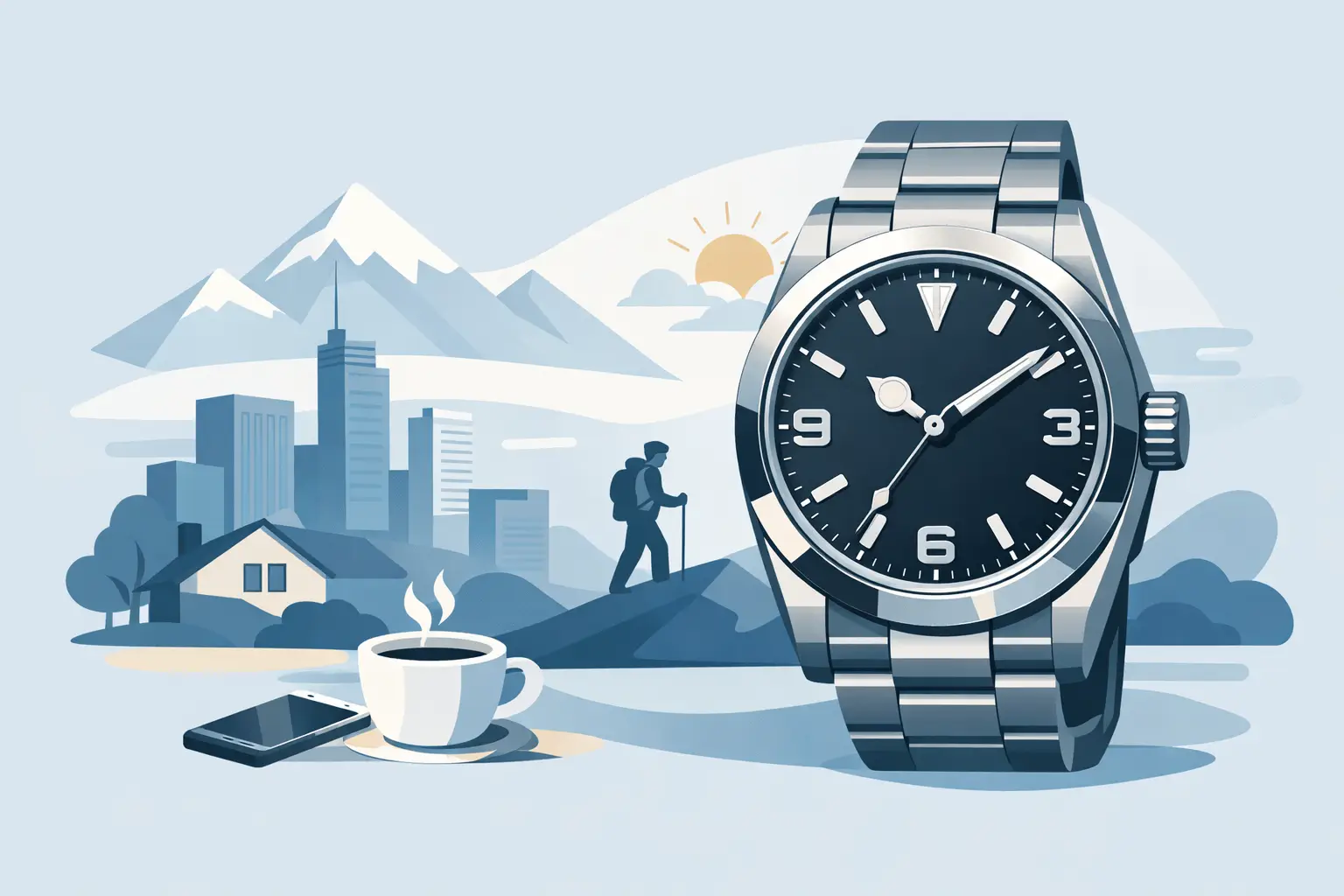
A Rolex Explorer does not need a rotating bezel, a polished center link bracelet, or a crowded dial to make an impression. Its appeal comes from restraint: a black dial, luminous 3-6-9 numerals, a steel case, and a reputation built around going farther than most owners ever will. For men who want one serious watch that works with jeans, tailoring, travel, and nearly every weekday in between, that restraint is exactly the point.
The Explorer is one of the clearest examples of Rolex getting the balance right between prestige and purpose. It carries the weight of the crown on the dial, but it is less performative than many of the brand’s better-known sports models. That makes it a strong choice for the buyer who values recognizable luxury without wanting his wristwear to dominate the room.
What Makes the Rolex Explorer Different
The Explorer’s story begins with Rolex’s association with Himalayan expeditions in the early 1950s. After the successful ascent of Mount Everest in 1953, Rolex introduced the Explorer as a watch shaped by the demands of exploration: legibility, water resistance, durability, and dependable timekeeping in difficult conditions.
That heritage matters, but the modern Explorer should not be mistaken for a bulky expedition instrument. It is a remarkably clean everyday luxury watch. The defining dial layout uses the Arabic numerals at 3, 6, and 9, balanced with simple baton markers and the familiar Mercedes-style hour hand. There is no date window to interrupt the symmetry and no complication included just for effect.
For many buyers, that simplicity is the Explorer’s strongest advantage. It has enough personality to feel iconic, yet it rarely clashes with what you are wearing. A Submariner makes a more overtly sporty statement. A Datejust can feel more formal. The Explorer sits confidently between them.
Rolex Explorer Sizes: 36mm or 40mm?
The current Rolex Explorer is available in 36mm and 40mm stainless-steel versions, both with black dials and Oyster bracelets. Choosing between them is less about which is objectively better and more about how you want the watch to wear.
The 36mm Explorer is closest in spirit to the classic model. It feels compact, balanced, and quietly elegant, particularly on wrists around 6.25 to 7 inches. Its proportions make it easy to slip beneath a shirt cuff, while the brushed Oyster bracelet keeps it casual enough for weekends. For a buyer who appreciates vintage-inspired sizing but still wants modern Rolex engineering, this is the purist’s choice.
The 40mm version adds more wrist presence without becoming oversized. It suits men with larger wrists or anyone accustomed to contemporary sports watches in the 40mm range. The extra dial real estate also gives the Explorer a slightly more assertive, modern feel. It remains understated by Rolex standards, but it is not as discreet as the 36mm.
Try not to choose purely by the number on the spec sheet. The Explorer has a smooth bezel and a dark dial, visual details that can make either size wear differently from another watch of the same diameter. Case shape, lug-to-lug length, and bracelet fit matter just as much. If possible, spend time with both sizes before making a decision.
The Case for 36mm
A 36mm Explorer has exceptional versatility. It looks right with a navy suit, an Oxford shirt, a field jacket, or a T-shirt. It also carries the model’s mid-century roots more naturally. Men stepping up from dress watches, vintage pieces, or slimmer everyday watches will likely find this size immediately comfortable.
The Case for 40mm
The 40mm Rolex Explorer offers a stronger visual anchor, especially with casual clothing and broader wrists. If your collection is made up of modern divers, chronographs, and GMT watches, it may feel like the more natural fit. The trade-off is subtle but real: it loses a little of the 36mm model’s old-school discretion.
The Details That Justify Its Reputation
Modern Explorer references use Rolex’s automatic caliber 3230, a no-date movement with approximately 70 hours of power reserve. It is certified as a Superlative Chronometer by Rolex, with stringent standards for precision after the movement is cased. In practical terms, this is a movement designed for ownership rather than ceremony. Wear it regularly, set it when needed, and it is built to handle the routine.
The Oystersteel case and bracelet are equally central to the experience. The Explorer is water resistant to 100 meters, which is more than enough for rain, swimming, travel, and ordinary active use. Its fully brushed bracelet is a particularly smart design decision. Brushed steel hides the fine hairline marks of daily wear better than polished surfaces, so the watch can age with a little more grace.
Legibility remains excellent in changing light. Rolex’s Chromalight lume gives the hands and hour markers a long-lasting blue glow, while the high-contrast black-and-white dial stays readable at a glance. These are not flashy specifications, but they are the kind that make a difference after months of ownership.
Is the Rolex Explorer a Smart First Rolex?
For the right buyer, yes. The Explorer is arguably one of the best first Rolex watches because it avoids a common mistake: buying a famous model that does not actually suit your lifestyle. It is durable enough to wear often, refined enough for professional settings, and distinct enough to feel special years after the purchase.
It is also a more focused proposition than a watch with multiple complications. There is no date to adjust after a month with fewer than 31 days, no rotating bezel to learn, and no polished surfaces demanding constant attention. That simplicity can be liberating for a first-time luxury buyer.
Still, it depends on what draws you to Rolex. If you need a date display for work, the Explorer may feel too sparse. If you want the visual impact of a dive watch, the smooth bezel can seem almost plain. And if a GMT function would genuinely improve your travel routine, an Explorer II or GMT-Master II may be more useful, though they deliver a very different look on the wrist.
The Explorer rewards buyers who understand that understated is not the same as ordinary. Its design has remained remarkably stable because it does not rely on trends to feel current.
New, Pre-Owned, or Vintage Explorer?
Buying new through an authorized retailer gives you the cleanest ownership experience: current specifications, factory warranty coverage, and the confidence of knowing the watch’s history from day one. The challenge is availability. Stainless-steel Rolex sports watches can require patience, and there is no guarantee that a particular model will be immediately available.
The pre-owned market opens the door to current references as well as discontinued favorites. The 39mm Explorer reference 214270 is especially popular with buyers who want a middle-ground size. Earlier 36mm references such as the 14270 and 114270 appeal to collectors who enjoy the slimmer profile and distinctive character of older production eras.
Vintage models can be deeply compelling, but they demand more knowledge. Dial originality, handset condition, bracelet stretch, service history, replacement parts, and case polishing can dramatically affect both value and collectibility. A lightly worn modern Explorer is often the safer move for a first serious purchase. A vintage Explorer makes more sense when you are buying the specific history and details of a particular reference, not just the name on the dial.
Whichever route you take, condition deserves as much attention as reference number. A sharp case, correctly functioning movement, clear provenance, and a reputable seller are more valuable than a small discount that creates uncertainty later.
How the Explorer Fits a Real Watch Collection
The Rolex Explorer can be the only watch a man owns, but it also plays well in a broader collection. Pair it with a dress watch for formal events and a capable dive watch for water-focused weekends, and you have three distinct roles without excessive overlap. It can also soften a collection full of larger, more complicated pieces by offering a return to pure time-only design.
Its greatest strength is that it never asks you to plan an outfit around it. The watch adds polish to casual clothes and keeps tailored looks from becoming too precious. That is rare territory for a luxury watch, especially one with such a recognizable name.
If the best watch is the one you reach for without hesitation, the Rolex Explorer earns its status every time you fasten the bracelet and head out the door.