
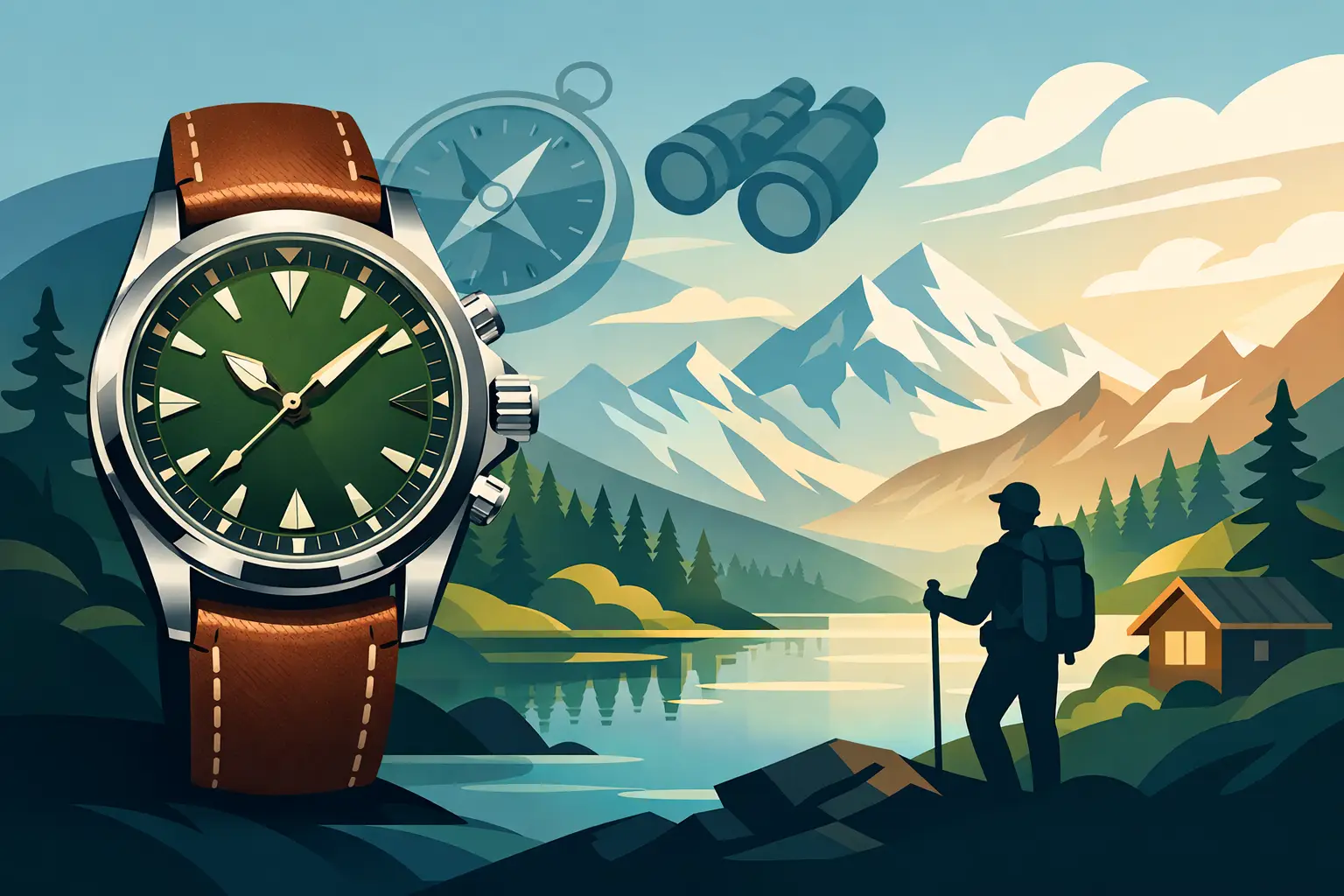
A watch can be technically capable and still feel anonymous. The Seiko Alpinist avoids that problem entirely. Its cathedral hands, internal compass scale, compact case, and unapologetically old-school dial give it a personality few watches near its price range can match. It is built for the man who wants more than a generic sports watch on his wrist, yet does not need a luxury logo to make a confident style statement.
The modern Alpinist is not a pure field watch in the military sense, and it is not a traditional dress watch either. That in-between identity is precisely its appeal. It carries enough heritage to interest collectors, enough water resistance for an active weekend, and enough polish to look right with an Oxford shirt on Monday morning.
Why the Seiko Alpinist Has Such a Following
The Alpinist name dates back to 1959, when Seiko introduced the original Laurel Alpinist for Japanese mountain climbers and outdoor-minded consumers. That history matters because it explains the watch’s design language. The Alpinist has always been about practical capability, but it has never looked purely utilitarian.
For years, the cult favorite was the SARB017, a now-discontinued reference recognized by its sunburst green dial, gold-tone numerals, and warm brown leather strap. Its popularity turned it into a modern collector classic. Seiko’s current Prospex Alpinist models retain much of that visual magic while offering updated movements, stronger water resistance, sapphire crystals, and more widely available service support.
The key detail is the internal rotating compass bezel, controlled by the secondary crown at 4 o’clock. It immediately separates the Alpinist from the crowded field-watch category. Most owners will not use it to navigate a hike, but that is beside the point. It is a functional reminder that this watch was designed with a sense of purpose.
There is also a rare balance in the proportions. Many modern sports watches feel large, flat, and overly polished. The standard Alpinist case, around 39.5mm wide, has enough presence for a modern wrist without swallowing it. Its short, curved lugs help it wear more compactly than the numbers suggest. For men who have found 42mm dive watches tiring after a full day, that comfort is a major advantage.
The Style Is More Versatile Than It First Appears
At first glance, the combination of Arabic numerals, gilt accents, and compass markings can seem busy. In person, however, the design comes together remarkably well. An Alpinist delivers texture and depth without relying on a loud colorway or an oversized case. It is the sort of watch that earns a second look rather than demanding the first one.
The classic green-dial SPB121 is the most recognizable modern choice. Its rich green shifts from nearly black to bright olive depending on the light, while the cream-colored indices and gold hands introduce a vintage warmth. On leather, it has a refined, slightly academic character that works especially well with denim, suede, knitwear, and tailored casual clothing.
The black-dial SPB117 offers a more restrained alternative. It keeps the defining Alpinist details but feels cleaner and easier to pair with business-casual wardrobes. If your watch box already includes colorful dials or if you want one piece that can move between the office, dinner, and travel, black is the safer decision.
For smaller wrists, the SPB155, often called the Baby Alpinist, deserves serious attention. Its approximately 38mm case drops the inner compass bezel for a simpler, more traditional field-watch profile. It loses one of the signature Alpinist quirks, but gains a cleaner dial and excellent everyday proportions. That trade-off makes it arguably the better choice for a buyer who loves the Alpinist spirit but prefers understated design.
What You Get for the Money
The modern Seiko Alpinist sits in a compelling middle ground. It is more distinctive and better finished than most entry-level automatics, while remaining far more approachable than Swiss luxury field watches. Depending on the reference, you can expect a stainless steel case, sapphire crystal, 200-meter water resistance, a display caseback, and an in-house automatic movement.
Most standard modern models use Seiko’s 6R35 movement, which offers roughly 70 hours of power reserve. That is a genuine lifestyle benefit. Take the watch off on Friday evening and it should still be running when you put it back on Monday morning. The movement is also easy to live with, backed by Seiko’s long-standing reputation for making durable mechanical watches at accessible prices.
Still, buyers should set realistic expectations. The 6R35 is not adjusted to chronometer-level accuracy, and its published daily tolerance is wider than what some shoppers expect at this price point. Many examples perform better than the specification, but variation exists. If absolute precision is your top priority, a quartz watch, a radio-controlled model, or a more expensive Swiss chronometer may serve you better.
Bracelet quality is another area where opinions vary. Seiko’s factory bracelets are perfectly functional, but they do not always feel as refined as the case and dial. Fortunately, the Alpinist is exceptionally strap-friendly. A dark brown leather strap emphasizes its vintage side, while olive canvas, black sailcloth, or a brushed steel bracelet can make it feel more rugged and contemporary. Few watches change character so easily with a simple strap swap.
Which Seiko Alpinist Is Right for You?
Choose the SPB121 if you want the full Alpinist experience. The green dial, gold details, compass bezel, and leather strap create the iconic look that made this line famous. It is the best choice for a buyer who sees a watch as part of his personal style and wants something with immediate character.
Choose the SPB117 if versatility is the priority. Its black dial is easier to dress up, the steel bracelet provides a more practical starting point, and it still delivers the distinctive dual-crown layout. It is a strong first serious automatic for a man who wants one watch that does not feel out of place in most settings.
Choose the SPB155 if fit and simplicity matter more than the compass feature. The smaller case and cleaner dial make it one of Seiko’s most wearable sport watches. It is especially appealing for wrists under about 7 inches, though plenty of larger-wristed buyers appreciate its vintage-minded restraint.
Seiko also offers GMT-flavored Alpinist designs, such as the SPB377, for frequent travelers. These models add a second time zone and a more substantial case, making them practical for work trips and international travel. They are less compact than the standard Alpinist, so they are best for buyers who value the complication enough to accept the added size.
Is It a True Outdoor Watch?
The Alpinist can handle rain, swimming, trail dust, and the occasional rough weekend without drama. Its 200-meter water resistance is far more capable than its elegant appearance suggests. The internal compass scale can provide basic direction-finding when paired with the sun, although it is no substitute for a dedicated compass, map skills, or GPS when safety is on the line.
Its real strength is everyday adventure rather than extreme expedition use. Think road trips, hiking, city exploration, fishing weekends, and travel days when you want one watch that looks good everywhere. If you need a watch strictly for hard-use outdoor work, a solar G-Shock or a purpose-built digital tool watch is the more sensible choice. The Alpinist brings a different value: it makes practical capability feel stylish.
The Case for Buying One
The Seiko Alpinist is not the cheapest automatic watch, the thinnest field watch, or the most accurate mechanical watch in its category. What it offers is harder to quantify: a recognizable identity. It looks like it has a story before you ever put it on, yet it remains practical enough to become part of your own routine.
For a first mechanical watch, it is a confident step beyond the obvious choices. For an established collector, it is a reminder that heritage, utility, and personality do not need a four-figure luxury price tag to feel special. Pick the version that suits your wrist and wardrobe, wear it often, and let the small details do the talking.