
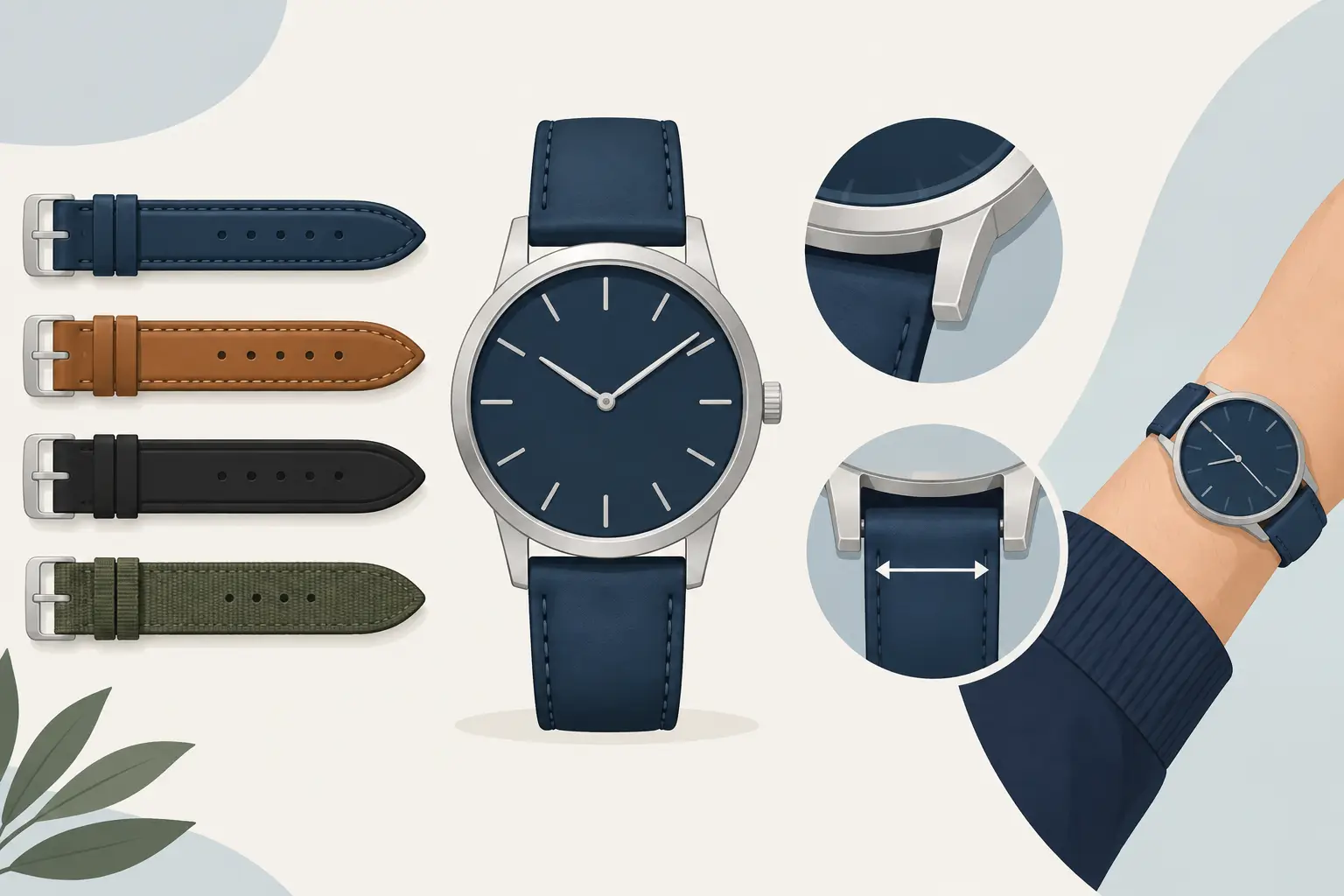
A good strap can make a familiar watch feel entirely new. Get the width wrong, however, and even a well-designed Seiko, Omega, or everyday field watch can look awkward at the wrist. This guide to watch lug width explains the small measurement that determines whether a strap sits with purpose or looks like an afterthought.
For a detail measured in millimeters, lug width has an outsized effect on comfort, proportions, and the personality of a watch. It also determines which replacement straps and bracelets will actually fit your case. Once you understand it, changing a strap becomes less of a gamble and more of a simple style decision.
What Watch Lug Width Actually Means
Lug width is the inside distance between the two lugs on one side of a watch case, measured in millimeters. The lugs are the projecting arms that hold the spring bar and secure the strap or bracelet. If that gap measures 20 mm, your watch requires a 20 mm strap at the case end.
Do not confuse lug width with lug-to-lug length. Lug-to-lug is the vertical measurement from the tip of the top lug to the tip of the bottom lug. It is a major factor in how large a watch wears, particularly on a smaller wrist. Lug width, by contrast, is about strap compatibility and visual balance.
Most men’s watches use familiar sizes such as 18 mm, 20 mm, or 22 mm. Larger dive watches may use 24 mm, while slim dress watches can be 16 mm or 17 mm. Some brands use less common widths – 19 mm, 21 mm, and 23 mm are frequent enough to matter – which can narrow your ready-made strap options.
How to Measure Watch Lug Width Correctly
The most accurate method is a digital caliper. Remove the strap, then place the caliper jaws between the inside faces of the lugs. Measure at the point where the spring bar sits, not at the outer tips of the lugs. A reading of 19.8 mm generally means you need a 20 mm strap.
A millimeter ruler works well if you do not own calipers. Hold it squarely across the space between the lugs and read the inner distance as carefully as possible. Avoid measuring an old strap alone, especially if it is leather. Leather compresses and can stretch near the spring bar, making it a poor source for an exact measurement.
You can also check the original specifications. The caseback, product manual, or model listing may state the lug width, although published dimensions occasionally refer to bracelet width at the clasp rather than at the case. When the information is unclear, measuring the watch itself settles the question.
Why the Exact Millimeter Matters
A strap that is 1 mm too narrow may attach, but it leaves visible gaps on either side. On a rugged tool watch, that gap can make the whole setup look undersized. A strap that is too wide is worse: it can pinch the lugs, resist installation, scratch the case, or place unnecessary pressure on the spring bar.
A properly sized strap should sit flush between the lugs without force. There may be a small natural tolerance depending on the material, but the fit should look deliberate from every angle.
A Guide to Watch Lug Width and Strap Proportions
Finding the correct width is the technical part. Choosing a strap that suits the case is where personal style enters the picture. A 20 mm strap can look refined, athletic, vintage, or commanding depending on its material, thickness, taper, and color.
Dress watches generally benefit from a slimmer profile. A polished 38 mm watch on a thin leather strap that tapers from 20 mm to 16 mm feels elegant and composed. The taper gives visual space to the case and makes a formal watch look more tailored under a cuff.
Sport watches can carry more visual weight. A 42 mm diver with 22 mm lugs often looks best on a substantial rubber strap, sailcloth strap, or steel bracelet. A heavily tapered, ultra-thin leather strap may technically fit, but it can leave the watch looking top-heavy.
Field watches offer the broadest range. A 20 mm canvas, nylon, leather, or rubber strap can each work well, but they tell different stories. Olive canvas emphasizes utility, brown leather brings in heritage character, and black rubber gives a practical modern edge.
There is no universal formula tying case diameter to lug width, but proportions offer useful guidance. A 36 mm to 39 mm watch commonly wears 18 mm or 20 mm lugs. A 40 mm to 42 mm case often uses 20 mm or 22 mm. Still, case shape matters more than the number alone. A slim 41 mm dress watch may look right with 20 mm lugs, while a broad-shouldered 39 mm dive watch can demand 22 mm.
Strap Taper Changes the Look at the Wrist
Taper is the reduction in width from the lug end to the buckle end. For example, a strap marked 20/16 mm is 20 mm wide at the case and narrows to 16 mm at the buckle. The first number must match your lug width. The second affects the final appearance and often the buckle size.
A pronounced taper gives a watch a more classic, dress-oriented profile. It is particularly effective on vintage-inspired chronographs, small seconds watches, and thin everyday pieces. A modest taper, such as 22/20 mm, preserves a stronger, more contemporary stance.
No taper is common on rubber dive straps, NATO-style nylon straps, and heavier leather designs. This straight-cut shape reinforces the capable look of a sports watch and distributes visual weight more evenly across the wrist. It can also feel more secure on a larger watch, although the effect is mainly aesthetic.
Standard, Odd, and Integrated Lug Widths
A 20 mm lug width gives you the greatest freedom. It is one of the most common sizes in modern watches, so leather, rubber, nylon, and quick-release options are easy to find in nearly every price range. The same is largely true of 18 mm and 22 mm.
Odd widths are not a reason to avoid a watch, but they deserve attention before you buy. A 21 mm width, found on certain luxury sports watches and chronographs, may limit inexpensive strap choices. Quality options are available, yet selection is naturally thinner than it is for 20 mm. Avoid forcing a 22 mm strap into a 21 mm space or settling for a loose 20 mm fit just for convenience.
Integrated-bracelet watches are a different situation altogether. Their bracelets or straps connect to a shaped case opening rather than conventional lugs. Even if the attachment measures something close to 20 mm, a standard strap may not fit. Some models accept brand-specific adapters or fitted straps, but many are best treated as bracelet-first watches.
Don’t Forget Spring Bars and Case Clearance
A correct strap width does not guarantee an easy fit. Thick leather, padded rubber, and some quick-release mechanisms can struggle with tight clearance between the spring bar and the case. This is especially common on watches with drilled lugs, curved cases, or tightly fitted end links.
Curved-end straps deserve particular care. They are designed to follow the contour of a specific case shape, reducing the gap between the strap and case. A generic curved-end strap may fit the width but still rub the case or leave an uneven gap. Straight-end straps are more versatile and usually the safer choice when you are experimenting.
The spring bar itself also matters. If you are fitting a heavy dive strap or bracelet, use bars that match the original diameter and shoulder style. A thin or poorly seated bar can compromise security, no matter how good the strap looks.
Common Lug Width Mistakes to Avoid
The first mistake is assuming all 20 mm straps are interchangeable in every practical sense. They share the same width, but thickness, end shape, hardware, and spring-bar clearance can produce very different results. A slim dress strap and a thick waterproof rubber strap may both fit the lugs, yet only one may suit the watch and your intended use.
The second is buying for the buckle rather than the lugs. Strap listings often show two measurements, such as 22/18 mm. The 22 mm number is the one that must match your watch. The 18 mm number only tells you the buckle width.
The third is overlooking the bracelet. If you plan to switch between a bracelet and a strap, check whether the case has standard spring bars and accessible lug space. A watch can look excellent on leather yet be frustrating to change if the bracelet uses proprietary end links or an unusual release system.
Finally, do not treat strap width as a purely technical specification. It is part of the watch’s design language. A watch with broad lugs wants a strap with enough presence to support them; a slender, polished case often benefits from restraint.
The right lug width gets the strap through the door. The right material, taper, and proportion make the watch feel like it belongs on your wrist – whether you are wearing it to the office, on a weekend trip, or for the first night out with a watch you intend to keep for years.